
Leader InterviewsMarTech Platforms & Strategy
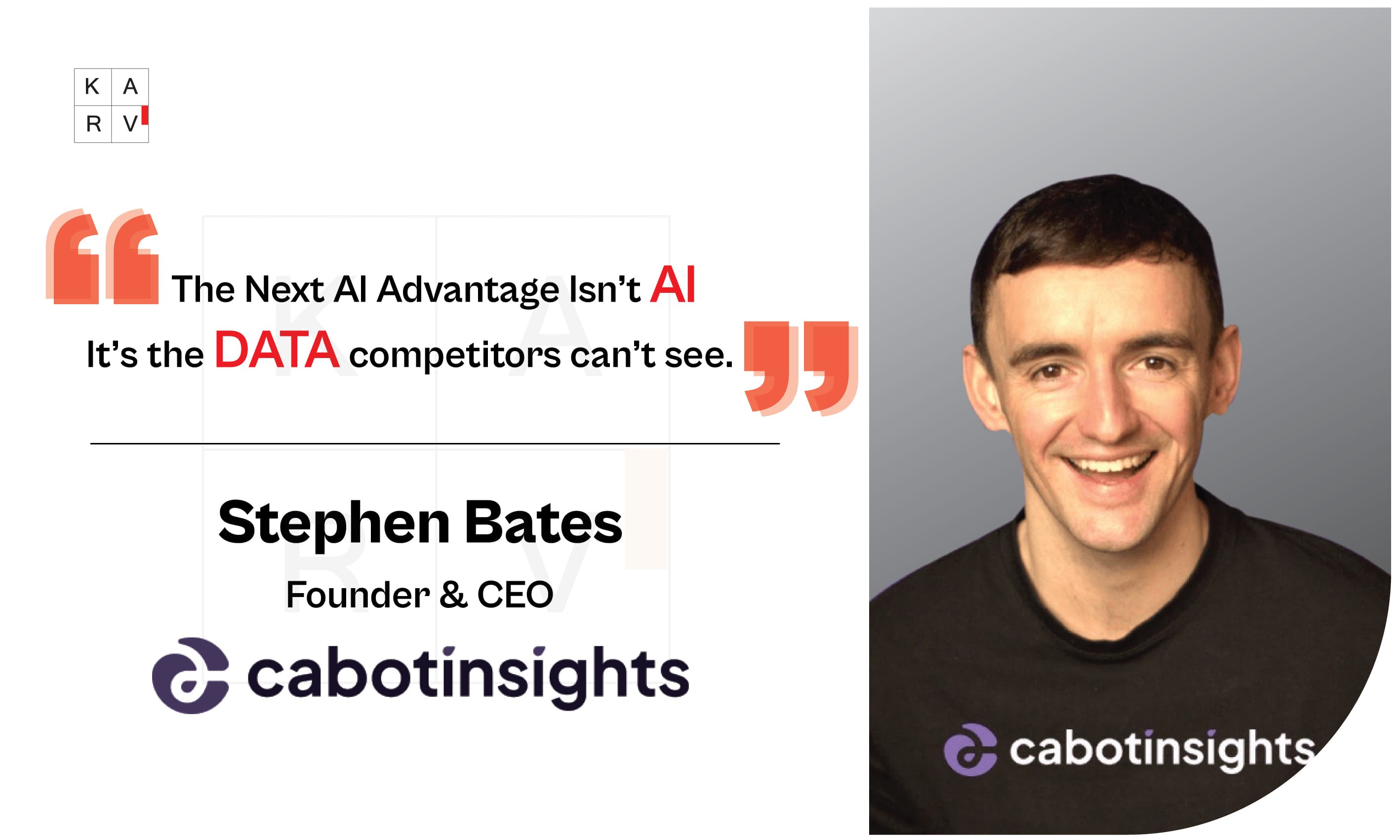
Stephen Bates on AI, Data Intelligence and Building the Next Generation of Go-to-Market Strategy
Article content
1. Building a Career Around Strategic Insight
Throughout your career, and now through Cabot Insights, you've helped organisations turn market intelligence into strategic advantage. Looking back, what experiences have most shaped your approach to helping businesses make better decisions?
A:
I moved to San Francisco just over ten years ago to get into tech sales. I remember walking through the city looking up at the high-rises and asking someone what that building was. They said Salesforce. I said, what is Salesforce. That is where I started.
The decade after that taught me the same lesson from three different directions.
The first was Salesforce itself, nearly five years working there when I returned from San Francisco. Based in Dublin and then moved to the enterprise corportate team in London. It is the best sales school I could have asked for and I would send anyone there. It is also where I watched and learned how big enterprise companies think with regards to data and insights. The biggest deal I closed was around $2.5 million, seven internal stakeholders, a nine-month cycle, and it was won by tying what we sold to a cost-to-serve target the board had already committed to publicly. That was the strategic part.
The second was being made redundant. I left Salesforce in early 2022, joined a hyper-growth startup, and six months later they cut ten percent of the company and I was in it. At the time it was not fun. Looking back it is the single best thing that happened to me, because it forced a bet I probably would have made voluntarily.
The third is where the actual insight came from. Someone brought me into an accelerator programme at Dogpatch Labs in Dublin, working alongside early-stage founders. When you build a skill set over ten years you stop noticing you have it. It was only in explaining to those founders the things I took completely for granted, how you qualify, how you go after a book a business, how you sequence a deal, how you read an organisation, that I realised there was a business in it. And I kept seeing the same gaps repeat across completely different companies.
If I had to name the moment that shaped how I work now, though, it is smaller than any of that. I met someone for coffee whose company had put four people from their data team on the job of checking whether 500 accounts were B2B tech with over a thousand employees. It took them four weeks. And this is a company in the go-to-market space. That was when I stopped thinking of my job as helping people sell better, and started thinking of it as rebuilding the layer
2. Why Better Data Doesn't Always Mean Better Decisions
Through Cabot Insights, you work with organisations navigating increasingly complex markets. Today's leaders have access to more data than ever before, yet better decisions remain elusive. What separates businesses that turn intelligence into competitive advantage from those that simply accumulate more information?
A:
Three reasons come to mind.
Firstly, most companies mistake more data for better data. They are not the same thing. Almost every company I speak to tells me their HubSpot or Salesforce is a mess. Duplicated records, stale fields, contacts enriched three years ago by a tool that never verified anything in the first place. So, before anyone invests in workflows and automation, the question is what state the revenue data layer is actually in. For an Irish health tech client, T-Pro, we cleaned and enriched 290,000 records in HubSpot. That was three to four weeks of unglamorous work and everything downstream depended on it.
I had the opposite version of that conversation with a CMO at a large UK company. I pushed hard at the start on cleaning the CRM first. They wanted to go straight into outbound and fix the workflows. We are now back at the data piece, months later, because it was skipped. That sequence is the most common mistake I see and it is almost never a technology problem.
The second reason is routing. Plenty of companies build good intelligence and then never put it in front of anyone. We built an account scoring model and pre-call qualification documents for a client, exactly the thing I would have wanted as a rep, and the reps were not using it. I have been a rep, so I know how that happens. You are busy. Someone tells you about a new tool every quarter. So we added a weekly thirty-minute call with the AEs that was not in the scope of work, purely to ask what they used, what was useful, and what was wrong with the data. That is what got it adopted. Intelligence has to land where the person already works and someone has to keep reinforcing it. A signal nobody saw does not count for anything.
The third is patience, and this is the one that genuinely separates companies. It is not a data gap or a tooling gap. It is whether an organisation can say out loud: we accept the current way is not working, we accept this will take time, and we are going to run experiments and get some of them wrong on the way to getting it right. That is hard when you are behind on the number this quarter. It needs buy-in at executive level, and where the CEO or the founders are properly bought in, things move quickly. Where they are not, it does not work, no matter how good the data is.
3. AI & the Future of Market Intelligence
AI is transforming how businesses gather, analyse, and act on market intelligence. Where do you see AI creating the greatest value, and where will human judgement continue to make the biggest difference?
A:
I want to start with the caveat, because there is no shortage of people telling you this is easy.
AI is not a magic pill. You do not implement it and watch the problems go away. There was a period where prospects were telling me they had to do something with AI because the board said so, and that rushed approach creates problems that show up eighteen months later.
You will also have seen the studies saying ninety-five percent of AI initiatives generate no return. I do not argue with the number, but I would not act on it either. A dataset that broad covers every industry, every company size, every level of maturity, selling completely different things. It tells you almost nothing about your situation. If I were a founder I would take my own industry as a subset, look at what my direct competitors are actually doing, and make it specific to my world.
Where AI creates real value is in the work that never scaled with people in the first place.
Watching a whole addressable market rather than the twenty accounts a rep can hold in their head. Verifying and re-verifying contact data continuously instead of once a year. Scoring accounts against a framework built with your own team, not a generic fit grade. Doing the research that used to eat the first ninety minutes of a rep's day. And, importantly, showing its working. When a rep or an executive asks where a conclusion came from, you can point at the job posting, the filing, the review. Asking a person to do that research and then justify the answer is days of work.
An agent is not magic either. It is data plus tools plus instructions, executing steps. Think of it as a junior teammate running in the background with no ego and no fatigue. Useful, and only as good as what you feed it.
The bigger shift is where this is going. Reps are going to stop touching the tools at all. The work happens in the background and the agents update the systems. I watched a revenue leader at Anthropic describe exactly that: their sellers do not log into tools, they open their terminal or Slack and tell the agent what to do. So the design question changes. You stop building the interface for the rep and start building the infrastructure for the agent.
Human judgement moves to both ends of that. At the front, it decides what your ICP actually is, what your offer is, and which signals genuinely predict a deal rather than just correlate with activity. My position has never been to remove people because of AI. It is the opposite. Keep your people, and give them back the hours so they spend their time on the conversation and the relationship. That part matters more now, not less of it. AI takes you to a certain stage and then it is on the salesperson, and that is done through trust.
4. Understanding Customers Before Markets Change
Organisations today must understand changing customer behaviour, competitive dynamics, and emerging trends faster than ever before. From your experience advising businesses through Cabot Insights, how can leaders stay ahead of market shifts rather than simply reacting to them?
A:
Everybody talks about buying signals as though they were invented two years ago. They were not. When I started in San Francisco we monitored exactly the same things: people changing roles, open job postings, funding rounds, new hires. It took longer and it was harder to act on quickly, but the signals themselves have not changed. What changed is the infrastructure around them. The scale and the speed, not the substance.
That matters because it tells you where the advantage is not. It is not in having a signal. A company posts an SDR role, your tool picks it up, you send an email, and so do the other eight hundred vendors watching the same job board. The prospect gets the same message fifteen times that week. The moment a signal becomes widely visible it becomes widely used, and the moment it becomes widely used it stops working.
So, a few things I would tell any leader trying to get ahead of a market rather than react to it.
Separate activity from intent. A comment on a post, an email open, one page view: those tell you somebody was online. Pricing page visited repeatedly, three people from the same account on your site in a week, a new CRO hired alongside two open SDR roles: those tell you somebody is ready. I get emails that open with "saw your comment on X" and go straight into a pitch. A comment is not a buying signal. It is evidence that someone was online.
Stack them rather than chase them. We work in four layers. An ICP filter, which is a gate and not a signal. Then a trigger event. Then confirming signals. Then the contact-level detail that dictates the hook. When we analysed one client's sixty-four existing customers, ninety-seven percent had three or more signals firing at the same time at the point they bought. One signal on its own is noise.
Stop segmenting on two or three criteria. The old approach was our ICP is everyone over 200 employees and $50 million in revenue. What about the company at 190 that hired six reps last month, promoted a new VP of sales, and quietly changed the language on their website? You have just excluded your best account with a headcount filter. Those days are over.
And build signals your competitors cannot see. The public sources are already commoditised, which is precisely why they stop working. There is one market we researched where almost the entire buying trail sits in public records that nobody in that software category bothers to read. That is an advantage for as long as it lasts. The durable version is your own product usage, your own customer patterns, your own research.
5. Strategy in an Age of Constant Change
With markets shifting rapidly and planning cycles becoming shorter, how should organisations rethink strategic planning to remain agile without losing long-term direction?
A:
Separate the things that move slowly from the things that move quickly, and stop planning them on the same cycle.
Some things barely move at all. Your addressable market is largely fixed. You cannot make it bigger except by entering a new industry, building a new product, or going after a different buyer. One of our clients sells into NHS trusts in the UK and hospitals in Ireland. That is roughly 146 trusts. No strategy session changes that number. I met a customer in Dubai who told me every company in the world was a potential buyer. When you hear that, the job is to make the target narrower, not to celebrate the size of it.
What moves quickly is everything inside that market. Which segment, which offer, which message, which channel, which moment. That should be run as experiments, not as an annual plan.
We worked with an early-stage company in Ireland that had raised about a million and had two or three customers. Over the engagement we ran forty-four campaigns across eight buyer profiles with six different offers. The measure of success was not how many meetings we booked them. It was how many experiments we let them run. They compressed something that might have taken twelve months of learning into about a month, and came out of it able to say, with evidence, who their buyer actually was. Do that repeatedly and you find what sticks. Then you put resources behind the thing that worked.
The discipline that makes this work is narrowness. Crawl before you can run. Pick one area, whether that is email infrastructure, ICP scoring, lead flow, or one manual process eating rep time. Spend three months in it. Prove it works. Then expand on top of it. The failure I see most often is a company under pressure trying to fix everything at once and finishing the quarter with six half-built things and nothing they can point at.
So, the long-term direction lives in the buyer definition and the system underneath. The short cycles live in the experiments. Leaders get into trouble either by treating the experiments as the strategy, or by treating the strategy as something you only revisit in December.
6. The Next Competitive Advantage
As access to technology and data becomes increasingly equal, what do you believe will truly differentiate successful organisations over the next five years?
A:
The product is not the advantage anymore, because anyone can build a product now. Distribution is. Getting people to know about you and use you is what makes a company successful, and you do that by winning attention and by experimenting until you find the approach that works in your specific market.
Underneath that, three things will separate people over the next five years.
Proprietary data. Everyone can buy the same tools and watch the same public sources, which is exactly why those sources stop producing an edge. The companies that build something durable are the ones with signals their competitors cannot access. Their own product usage. Their own customer patterns. Their own research. A shared job board is not a moat.
Ownership of the upkeep. This is the one I think is most underrated. You can buy every tool in the stack tomorrow and plenty of teams have. It is rarely the tooling that stalls a project. It is that nobody owns keeping it current. Markets age, people change roles, signals fire daily and rot if nobody catches them, and sending infrastructure degrades quietly without maintenance. An ops person builds version one, gets pulled onto next quarter's priority, and eighteen months later the reps are back in six browser tabs doing it by hand. What separates companies is not who has the system. It is who still has a working system in month nineteen.
Speed of rebuilding, which favours smaller companies more than people expect. We rolled our own agent tooling out across Cabot very quickly because we had no operational or technical debt to unpick. No legacy platforms, nobody to retrain. An early-stage company is genuinely at an advantage against a much larger competitor here. If you can pause a couple of priorities and rebuild the foundations properly now, you can outrun businesses with ten times your resources.
There is a fourth that is less about capability and more about character: whether you are willing to mark your own work down. We built a verification pass into our own research process that re-checks every claim against its source. On one recent piece of work it downgraded half the accounts we had scored as promising, because the evidence did not hold up on a second look. That is uncomfortable and that is the whole point. In a world where anyone can generate a confident-sounding answer in seconds, the scarce thing is knowing which of your answers are actually true.
7. Leadership in the Intelligence Economy
As AI reshapes marketing, customer intelligence, and business strategy, what qualities will define the next generation of business leaders?
A:
Curiosity, first, and I mean the practical kind. When I first looked at Claude Code I thought, what on earth is this. I have never written code in my life. I spent two weeks watching videos, reading, following people who were building things, and by the end of it I knew a hundred times more than when I started. That is not talent, it is just hours. But it changes every conversation you have afterwards, because you can challenge what someone is telling you and ask the question you would not have known existed. As a founder or an executive, you already know your business. The job is to keep learning enough to apply the new thing against what you already know.
A tolerance for being wrong in public. Experiment-led work only functions if the organisation is genuinely allowed to run things that fail. Leaders set that. If every test has to justify itself inside the quarter, you will get no tests, and you will get a lot of people quietly protecting the status quo.
A willingness to say the awkward thing, and to expect it from others. There is a lot of noise in this space. Posts claiming an entire SDR team was replaced in a fortnight, or five thousand leads generated last week. Ask for receipts. Ask for the screenshot, or an introduction to the client. And apply the same standard to who you buy from. If the agency or the adviser you are working with never pushes back, never says "I understand the urgency but that is not the right way to do it, let me show you", you are not buying advice. You should come off a call thinking, I had not considered that, and they are right.
Then two unglamorous ones. Reinforcement: change does not stick because you announced it at a kick-off, it sticks because somebody raises it every week and asks what was used and what was useless. And restraint about what not to automate. The face-to-face part, the rapport, the relationship, the room, that is where a seller earns their living. Everything we build is meant to buy people more time for that, not less of it.
I would add one more that sounds trivial. Always take the call. When someone asks for a coffee, take it. I can attribute a genuinely surprising amount of revenue to conversations I had no reason to expect anything from.
8. A Final Thought
If you could leave today's business leaders with one piece of advice on making smarter decisions in an increasingly AI-driven world, what would it be?
A:
Fix the foundations before you buy anything.
Agents do not fix broken systems. They scale whatever you feed them. If your data is a mess, automation delivers the mess faster and in more places. So the boring work, cleaning the CRM, agreeing what your buyer actually looks like, verifying contact data, getting your sending infrastructure right, is not the thing you do after the exciting project. It decides whether the exciting project works at all.
Then be patient with it, which is the harder half. Nobody wants to hear patience in a quarter where the number is behind. But the companies that get this right are the ones that agreed up front they were on a journey, gave themselves room to be wrong, and kept going anyway. Crawl before you can run.
And I would say this to anyone feeling behind: I get overwhelmed by how fast this is moving too. Everyone does. The answer is not to move faster in every direction at once. Take a step back, name the three or four things that eat your team's week, and work out where this technology makes an immediate difference to those. That is enough. You do not have to have a view on everything.
If I could leave one idea, it is that none of this is really about AI. It is about whether your organisation can tell itself the truth about what is working, act on it quickly, and give your people back the hours so they can do the part machines cannot do. Get that right and the technology is the easy bit. Get it wrong and no tool will save you.
About Stephen Bates
Stephen Bates is the founder of Cabot Insights, a go-to-market engineering firm based in Dubai. Cabot rebuilds the systems that sit underneath sales and marketing teams: scored addressable markets, verified data, live buying signals and the sending infrastructure that carries them, built for clients and then maintained and reported on monthly. Before founding Cabot, he spent nearly five years at Salesforce in Dublin and London, following earlier roles in San Francisco and at DocuSign. He is originally from Dublin and competes in marathons, triathlons and Hyrox.
About Cabot Insights
Cabot Insights is a go-to-market engineering firm based in Dubai. We build the data and signal infrastructure that sales and marketing teams run on: cleaned and enriched CRM records, scored account lists, live buying-signal tracking, and the email sending infrastructure that reaches prospects reliably. Unlike a one-off agency project, every build is maintained and reported on monthly after delivery, so it stays accurate as markets and contacts’ change. Clients range from early-stage startups running dozens of rapid outbound experiments to enterprise and healthcare organisations managing complex, regulated buyer bases.
Explore Another Exclusive Leader Interview
If this conversation on agentic AI, marketing transformation, growth and the future of AI-powered execution resonated with you, you may also want to explore our exclusive Leader Interview with Otso Karvinen, Co-Founder & Growth Strategist at Parvi.
Otso shares his perspective on how agentic AI is moving marketing beyond AI tools toward AI-powered execution, reshaping agency models, expanding growth capacity, changing the role of human strategy, and creating the foundations for AI-native marketing teams.
Read the full interview: Otso Karvinen, Co-Founder & Growth Strategist at Parvi