
Leader InterviewsMarTech Platforms & Strategy
Ernesto Ortega on Demand Generation, Marketing Operations and the Future of Growth
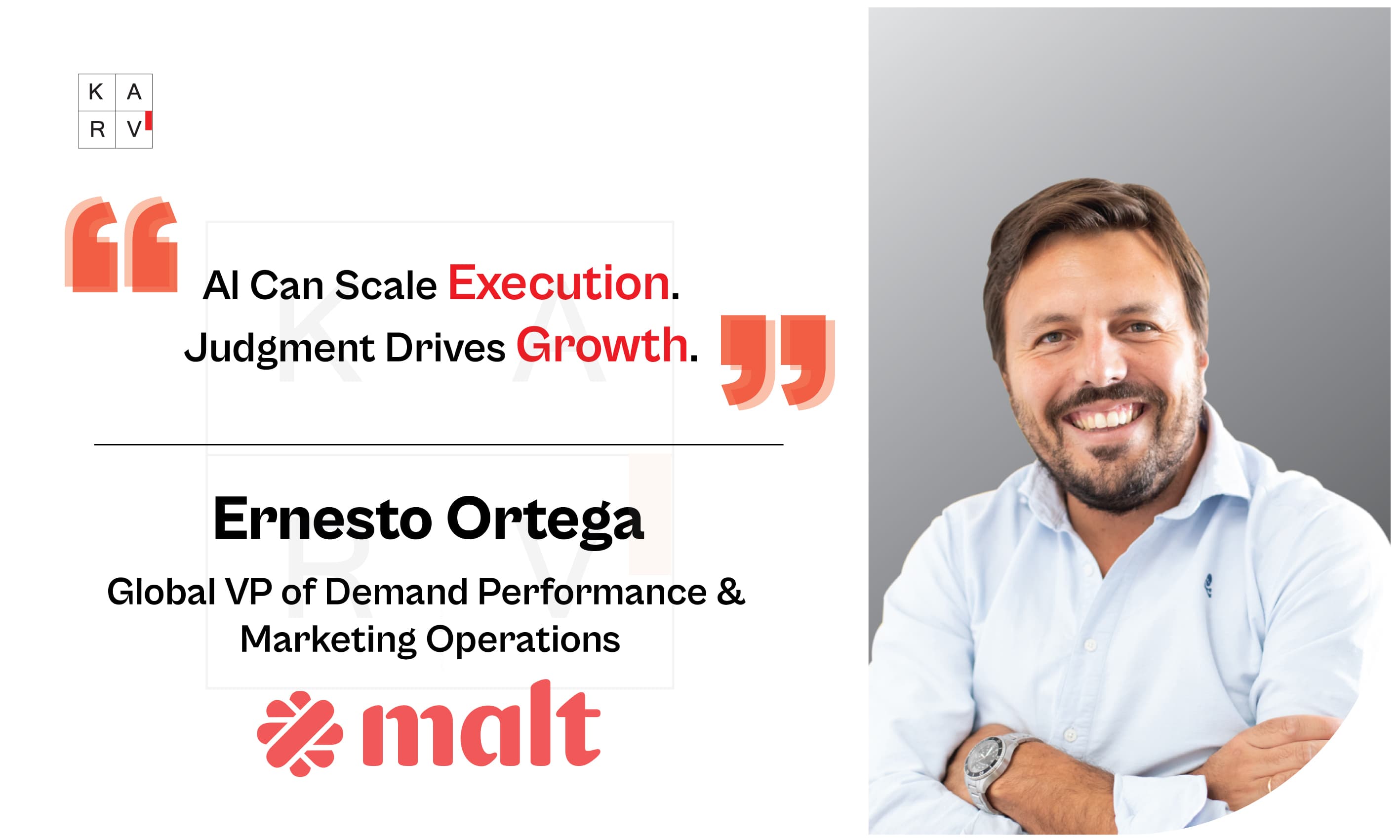
Article content
1. From Local Growth to Global Scale
You joined Malt in Spain and went on to lead Marketing, Community, Customer Care and Sourcing before taking on a global mandate. What did building growth in a local market teach you that now shapes the way you approach marketing at global scale?
A:
I started my journey at Malt leading several customer-facing functions in Spain, which gave me a genuine 360-degree perspective of the business. Marketing, Community, Customer Care and Sourcing/Commercial weren't independent teams, they were different parts of the same growth system.
One lesson became obvious very quickly: acquiring new clients or attracting great independent talent means very little if the experience behind it doesn't deliver. Sustainable growth comes from aligning every customer-facing function around the same objective rather than optimising each department separately.
The second lesson was the importance of proximity. At a local level, you immediately see when a campaign isn't converting, a client is becoming disengaged or an independent professional is leaving the platform. As organisations scale, that feedback naturally becomes slower. One of my priorities in my current global role is recreating that closeness by staying in direct contact with local markets instead of relying exclusively on dashboards.
Finally, Spain taught me that local relevance and global scale are not opposites. Every market has different levels of maturity, culture and customer behaviour, but global organisations create enormous leverage by sharing relationships, knowledge and capabilities across countries, especially when many of your clients are multinational.
2. When Marketing Becomes a Growth System
Demand generation, performance and marketing operations are increasingly interconnected. What does a modern marketing organisation need to put in place to move from running campaigns to building a predictable, measurable growth engine?
A:
The biggest misconception is that a growth engine is built inside marketing. It isn't. It's built at the intersection of marketing, sales, finance and data.
Sales brings customer reality. Finance tells you whether growth is economically sustainable. Data gives you the confidence to understand what's actually working. Without those three perspectives, marketing risks optimising activity instead of business outcomes.
The foundation is shared data and a common definition of business impact. That's where Marketing Operations creates the most value: connecting strategy, execution and commercial outcomes through clean attribution, consistent measurement and the ability to understand which investments are actually generating pipeline.
At Malt, that's particularly visible in our ABM strategy. Demand Generation, Commercial Teams and Marketing Operations have to operate as one system. If each team optimises its own metric, the overall customer opportunity gets diluted.
Ultimately, predictability doesn't come from getting every campaign right. It comes from measuring pipeline contribution, testing continuously and reallocating investment quickly based on evidence rather than assumptions.
3. The Global-Local Growth Equation
Scaling across countries often creates a tension between global consistency and local market realities. How should marketing leaders decide what needs to be standardised globally and where local teams should have the freedom to adapt?
A:
I use one simple principle: standardise where scale creates an advantage; localise where proximity creates an advantage.
Globally at Malt, we align on our core positioning as the “Home of Independent Work”, our brand foundations, measurement, technology and operating principles. Those are the elements that let every market learn from one another and scale what works. A simple test I apply here is whether something protects brand integrity or simply serves a one-off outcome: integrity stays global, outcomes adapt locally.
Locally, teams need the freedom to adapt messaging, partnerships, community initiatives and go-to-market execution according to their own reality. The maturity of freelancing in Germany, Spain or the UAE isn't identical, so the activation strategy shouldn't be either.
A good example was the integration of Comatch (German company we acquired in 2022 specialised in high level independent consultants) into Malt Strategy. The strategic vision was global, but the pace of adoption varied significantly across markets. Respecting those different timelines was just as important as maintaining one common framework.
4. Data, Operations and the End of Marketing Silos
Marketing operations has evolved from a largely technical function into a strategic layer connecting data, technology, attribution and revenue. Where do you believe organisations are still leaving value on the table, and what does true operational maturity look like?
A:
Too many organisations still treat attribution as a reporting exercise instead of a decision-making tool. The objective isn't knowing which channel received credit for a conversion, it's knowing where to invest the next euro.
The second gap is the disconnect between marketing and revenue. Even sophisticated companies often lose visibility once a lead enters the sales process, leaving marketing optimising for leads while commercial teams optimise for revenue. True operational maturity means sharing exactly the same definition of value from first touch to closed business.
There's also a growing AI trap. Many organisations are rushing to automate workflows, but AI doesn't fix poor data quality or broken processes, it simply scales them. I'd rather have a smaller technology stack that's genuinely connected than dozens of tools generating different versions of the truth.
Today, Marketing Operations has evolved from a technical function into the connective tissue between strategy, execution and commercial performance.
5. AI Is Changing the Cost of Growth
AI is making it possible to research, create, personalise and optimise marketing at unprecedented speed. If execution becomes increasingly automated, where should marketers invest their time and talent to create differentiation that AI alone cannot?
A:
I believe the biggest threat isn't AI, it's stagnant thinking. As research, content creation and optimisation become increasingly automated, execution becomes cheaper. Judgment becomes more valuable.
In my role, what I actually do all day is make decisions. Whether it's approving a budget, prioritising a market or choosing between two strategic directions, my responsibility isn't to have all the answers, it's to make the best possible decision with imperfect information.
AI is an extraordinary advisor, but it isn't accountable. Anyone can generate a hundred versions of an ad; deciding which one strengthens the brand, which risk is worth taking and which shortcut quietly erodes trust still depends on human judgment and experience.
That's why I don't think the future of marketing is about replacing people with AI. It's about giving talented people more leverage by removing repetitive execution.
That's also why real proximity to communities and a genuine understanding of human needs are becoming rarer and more valuable. Malt's role, as a home for independent professionals, is to give that high-impact talent the space to apply their judgment and creativity where it matters most.
6. From Lead Generation to Business Impact
Traditional metrics such as leads, clicks and campaign volume tell only part of the story. Which measures should modern marketing organisations prioritise to understand whether they are actually generating business value?
A:
We need to move from measuring activity to measuring business outcomes. Leads, clicks and campaign volume are useful operational metrics, but they don't tell us whether the business is creating sustainable value.
I look first at pipeline contribution and the efficiency of turning marketing investment into revenue. Retention matters just as much: in an ecosystem like Malt's, success depends on lasting, trusted relationships between companies and independent experts, not one-off transactions. But I also care about something more practical: can we clearly connect marketing activity to commercial success?
For example, being able to demonstrate that an MSA originated from a Field Marketing event, or that ABM target accounts are growing materially faster than the rest of the portfolio, is far more meaningful than simply reporting lead volume.
The most valuable marketing organisations don't just report results, they can explain why those results happened and use that learning to improve the next investment decision.
7. Marketing in the New World of Work
Malt sits at the intersection of technology, talent and the rapidly changing world of work. How do you see this shift changing the way businesses think about marketing, skills and growth?
A:
I don't think the future is employees versus freelancers versus AI. The future is organisations becoming better at orchestrating all three.
Permanent teams provide continuity and institutional knowledge. Independent experts bring highly specialised capabilities exactly when they're needed. AI removes repetitive execution and increases the productivity of both.
The reality is that today's CMO can't realistically be an expert in every discipline. Performance, brand,Content, Product Marketing, AI, analytics and operations. The smartest organisations accept that and build flexible capability models rather than trying to own every skill internally.
I've also seen companies cut marketing investment to improve short-term EBITDA. The financial impact looks positive immediately, but rebuilding awareness and commercial momentum later is usually far more expensive than the savings achieved. Marketing should be viewed as a growth accelerator, not a discretionary cost.
8. The Next Generation of Growth Leaders
Looking three to five years ahead, what will distinguish the companies that build truly scalable growth engines from those that simply produce more campaigns, more data and more content?
A:
Three things.
First, better decisions. AI will make content abundant, but judgment will become the true competitive advantage.
Second, ruthless prioritisation. The companies that win won't be those doing the most, they'll be those consistently allocating resources to the highest-value opportunities.
Third, faster learning. The strongest organisations will combine technology, data and independent experts to challenge assumptions, test quickly and continuously improve how they invest (leaning on outside perspective is often what stops a team from simply repeating what worked last time).
Ultimately, scalable growth isn't about producing more campaigns or more data. It's about building an organisation that learns faster than its competitors.
About Ernesto Ortega
Ernesto Ortega is the Global VP of Demand Performance & Marketing Operations at Malt, where he leads the company’s global marketing strategy with a strong focus on business growth and data-driven decision-making. His role helps Malt scale its marketing impact across markets and build more effective and efficient growth strategies. Ernesto is a Telecommunications Engineer with a Master’s degree in Business and more than 15 years of experience across sales, business development, and marketing, including previous roles at Vodafone and Telefónica. Throughout his career, he has built and led both national and international teams in highly transformative environments.
About Malt
Malt is Europe's leading freelance management platform, co-founded in 2013 by Vincent Huguet (CEO). Over 100,000 companies of all sizes source, contract, and manage external talent from Malt’s community of more than 1,000,000 highly qualified independent experts across every field - from tech & data to marketing and communication to management consulting. Finding the right freelancer takes just seconds with Malt AI Search; contracting and payment are seamless, with built-in reporting and compliance, making Malt an end-to-end solution for freelance management.
Explore Another Exclusive Leader Interview
If this conversation resonated with you, you may also want to explore our exclusive Leader Interview with Elsa Trang, Managing Director APAC at xpln.ai.
Elsa Trang on AI, Attention and the Future of Media Measurement
Read the full interview: Elsa Trang, Managing Director APAC at xpln.ai