
Leader InterviewsMarTech Platforms & Strategy
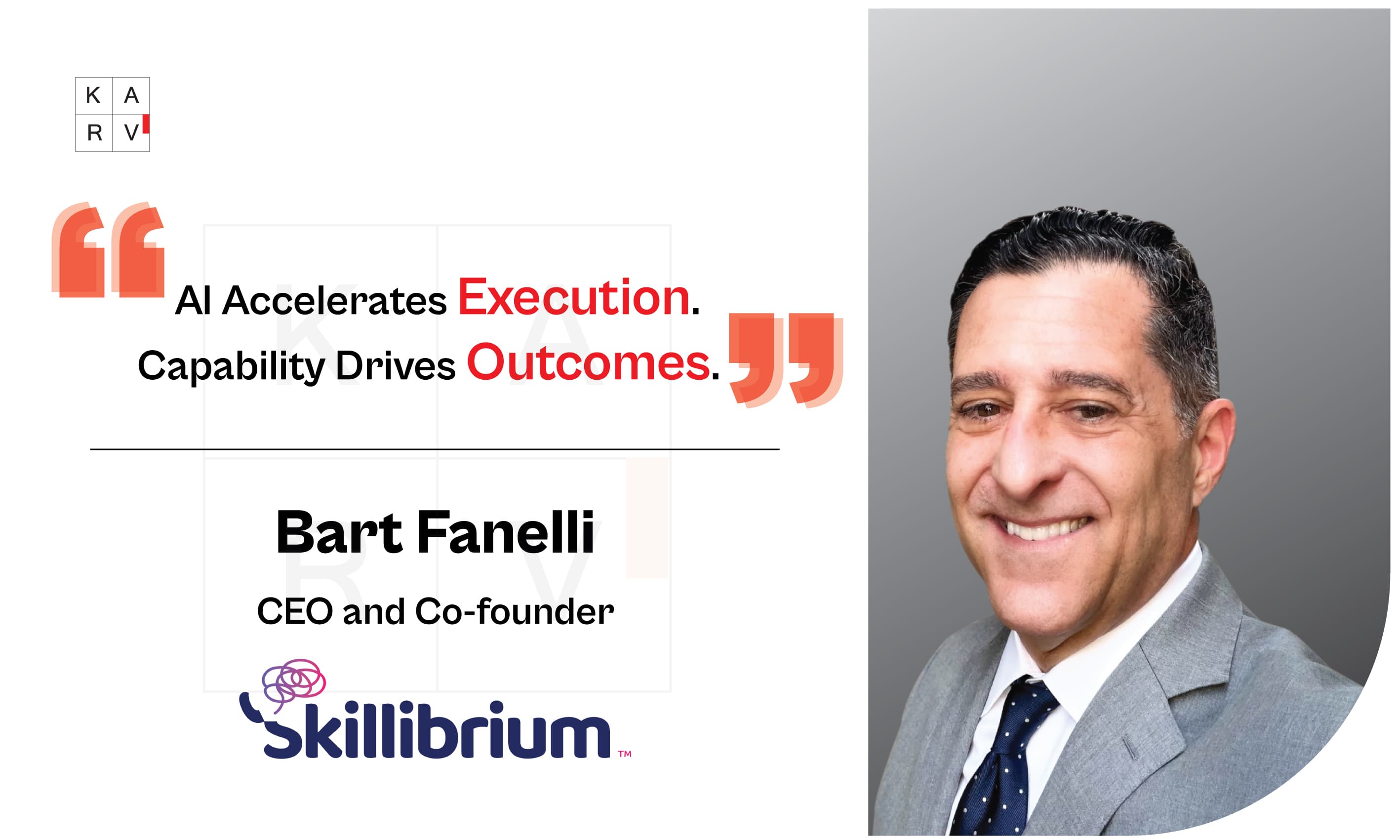
Bart Fanelli on Skills, AI, Capability and the Future of Workforce Readiness
Article content
1. The Problem Worth Building For
Every meaningful company begins with a problem its founder believes the market is not solving well enough. What did you see in the relationship between skills, people and business performance that convinced you Skillibrium needed to exist?
A:
I spent most of my career on the revenue side, designing, building, carrying a bag, running teams. Most recently, before Skillibrium, I sat in the CRO seat and took the company from roughly $100M to north of $300M in 3 years. Every year, I watched the same disconnect: leadership would look at a miss and ask, “What happened to the number?” when the real question was, “What did we actually know about our people going into the quarter?” We had visibility into the pipeline, the opportunities, the so-called funnel from marketing. We had almost zero visibility into the skill and the will sitting behind it.
Performance is a lagging indicator. It tells you what already happened. Skill and will are the leading indicators; they tell you what's about to happen, and nobody was measuring them with any rigor. Companies were investing millions in enablement and training, and still running the business on gut feel about who could actually execute and who couldn't. That gap, between what we assumed about our people and what was actually true about our people, was costing organizations everything: missed forecasts, bad hires kept too long, good reps promoted past their skill, with no training to help them, and no cadence to follow.
Skillibrium exists because we know patterns work, and that we could help well-funded companies succeed rather than fail at the same layer, quarter after quarter, for a completely solvable reason. If you can make capability visible and embed it in the business operating system on a cadence instead of bolting it on as a separate enablement initiative, you change the outcome. We’ve done this for ourselves, and for many - that's the company.
2. From Skills to Business Outcomes
Organisations have invested heavily in learning and development, yet many still struggle to connect employee development with measurable business impact. What needs to change for skills development to become a genuine driver of organisational performance?
A:
Here's the honest problem with L&D as it's traditionally been built: it's measured on long-form learning, vertical, so to speak, and not embedded in the flow of work. When this is the case, the learning falls off fast, and since the topics are typically product-related or non-connected ideas, correlating cleanly with revenue, retention, or productive capacity is nearly impossible - and everybody knows it, but it's a hard problem to fix. Boards fund it because “we have to invest in our people,” not because anyone can draw a straight line from the investment to the outcome.
What has to change is where skills development lives. It cannot be a separate track that competes with the day job for a rep's or leader's time. It has to be embedded directly into the cadences that already run the business — the 1:1 and team meeting, the pipeline review, the deal strategy session, the QBR. Those are the moments where skill and will show up in real work, in real time, and where coaching has the highest leverage. When you tie skills development to the specific behaviors that drive specific business outcome: can this rep build self gen pipeline at the executive level, can this rep find and develop a real champion in the process, can this leader develop another leader by coaching to a 4-box instead of just reviewing a forecast number, you stop treating training as a cost center and start treating it as a leadership discipline. That's the shift. Connect the skill to the flow of work, connect the flow of work to the number, measure leading and lagging indicators, and repeat.
3. The Skills Gap Is Becoming an AI Gap
AI is rapidly changing the tasks people perform and the capabilities organisations need. Do you believe companies should focus on teaching employees how to use AI, or rethink the underlying skills and roles they will need in an AI-enabled workforce?
A:
I think that's a false choice, and it's the question I get most often from boards and CROs right now. Teaching people to use an AI tool without first fixing the underlying skill and process gap just means you get bad decisions made faster. If a rep doesn't know how to build a real Value Map and present it to a room of executives, an AI copilot doesn't fix that; it just helps them produce something they cannot defend. Would you have the leader and rep present to your own executives that way? Never.
So the cadence matters. First, get honest about the underlying skills and roles you'll actually need: what does a seller, a leader, a sales engineer, a customer success rep need to be able to do when AI is doing the research, the drafting, the summarizing, the busywork that used to eat sixty percent of the day? Then bring in the tools to subtract that work, not to add another layer on top of a broken process. I've always believed in subtracting, not adding. If a tool doesn't let a person spend more time on the highest-skill part of their job, the human judgment part, the relationship part, it's not actually helping. AI should raise the floor on execution and raise the ceiling on what a skilled person can do with their time. Companies that treat AI adoption as a training checkbox, and don’t complete the last mile (literally standing and delivering as a skill at every step in the cadence) will be exactly as unprepared in two years as they are today, just with a more expensive tech stack.
4. Making Skills Visible
One of the biggest challenges for organisations is knowing what capabilities they actually have inside the business and where the gaps are. How can leaders move from assumptions about workforce capability to a more accurate, data-driven understanding of their people?
A:
Most organizations run on assumptions. They assume the top performer from two years ago is still the top performer. They assume the manager who was a great rep is automatically a great leader and coach. They assume a self-reported competency survey “self rate yourself 1 to 5 on” tells them something real. It doesn't, unless another party rates them against a standard. It tells you how confident someone is, not how capable they are of representing your brand, and those are frequently two very different things.
The way out is to stop asking people to grade themselves and start observing capability in the actual flow of work, in real work, meetings, opportunity reviews, forecast calls, and QBRs. Real coaching conversations, real objectivity, and doing it against a consistent framework, not in a passive way. Skillibrium uses a simple 4-box: will versus skill, and the data-driven version of this isn't a personality assessment. It's structured, repeatable observation of real behavior, captured consistently enough that a leader can finally answer the question “what do I actually have” instead of “who do I like” or “who yelled loudest in the QBR.” Even better, it’s nested in descendant views - meaning a large organization can pinpoint skill and will at the individual or team level in a deep org chart with a click of a button. Even better - when the skills are shared, and aligned with the flow of work, and reinforced on cadence while you actually run the business, you reinforce performance through the operating model principles, and continue to improve.
5. The Founder's Balancing Act
Building a company requires constantly balancing vision with commercial reality, product development with customer needs, and long-term ambition with immediate execution. What has building Skillibrium taught you about the realities of turning a strong idea into a scalable business?
A:
Nothing has humbled me more than building Skillibrium, and I say that as someone who thought running a $300M+ revenue org had already taught me humility. As an operator, I was accountable for rebuilding what I inherited, and executing while breaking down guardrails that already existed. As a founder, there are no guardrails. You build the guardrails, you second-guess the guardrails, and some mornings you tear them down and start over before lunch. The good news is that before my CRO stint rebuilding the revenue organization and operating model, I had an amazing run building and learning with some of the best executives in the industry.
The biggest lesson has been that conviction and flexibility aren't opposites; they have to coexist in the same person, in the same week. I believe deeply in the problem we're solving. I have to hold that belief with total confidence in front of a customer or an investor. And in the same breath, I have to be willing to hear that the way I packaged the solution, priced it, or sequenced the roadmap is wrong, and change it fast without treating that as a threat to the conviction underneath it. A strong idea doesn't become a scalable business because the founder is right. It becomes a scalable business because the founder is willing to be wrong quickly, in public, repeatedly, without losing the thread of why the company exists in the first place. I’ve seen the opposite firsthand, along with the damage caused by unchecked ego.
The other thing building this company has reinforced is something I've said for years: to live and to give. I don't separate the person from the operator. The way I lead this company, the way I show up for my team, the way I travel and stay present with my family across two continents, that's not a work-life balance philosophy; it's one integrated life, and it's made me a better founder, not a distracted one.
6. Beyond Traditional Learning
The traditional model of learning often separates development from the flow of everyday work. What should the next generation of workforce development look like if learning, skills assessment and performance are increasingly embedded into how people actually work?
A:
The old model has a training, a certification, and a shelf. Someone attends a two-day sales methodology training, gets a certificate, and a week later runs deals exactly as they did before the training, because nothing in their daily environment reinforced or measured the new behavior. That model was already weak. In an AI-enabled workforce moving this fast, it's obsolete.
The next generation has to collapse the distance between learning, assessment, and performance to zero. Skill development should happen inside the operating model, the system - its must show up in the flow of work, not instead of it. Coaching should happen inside the 1:1 and team meeting, the self-gen pipeline day, the opportunity strategy session, not in a separate calendar hold nobody protects. The QBR shouldn't just be a report-out on what happened; it should be the moment a leader assesses whether the team has the underlying capability to make next quarter's number and coaches directly against that gap. When learning, skill measurement, and actual performance are running through the same operating cadence instead of three disconnected systems, development stops being something that happens to people and starts being something that happens through the work itself.
7. Building for a Changing Workforce
The modern workforce is becoming more fluid, with employees, contractors, independent professionals and AI increasingly working alongside one another. How should organisations rethink talent strategy and workforce planning when the definition of a “job” itself is changing?
A:
The word sales “job” was always a proxy for someone needed to fill a seat and deliver an outcome. We're finally being forced to admit that real professional leadership and selling skills matter. Full-time employees, contractors, fractional executives, independent specialists, and AI agents are all now legitimate ways to source a given capability, but, drop them in with no system or operating cadence, and you get noise, and lits of it. Further, so does your brand.
Leaders need to stop planning workforce around headcount and start planning around skill capability portfolios and willingness to learn. What skills and capabilities does this initiative require, and what's the right blend of employee, contractor, partner, and AI to deliver, and how fast can we be productive? That requires the same thing every answer in this interview keeps coming back to: A repeatable system, a cadence, and visibility into what capability you have, in real time, instead of a static job description written two years ago for a role that's already changed underneath the person sitting in it. The companies that win this transition will be the ones that can see their capability gaps clearly enough to fill them with whoever, or whatever, is best suited — employee, contractor, or AI — instead of defaulting to “let's post a req” because that's the only lever they know how to pull. Then, the real work begins - source them, onboard them, ramp them, develop them, remediate any skill gaps, remove the unwilling, and repeat at scale. Otherwise, how will you determine and influence productive capacity?
8. The Future of Work Starts With Capability
Looking three to five years ahead, what will distinguish organisations that successfully prepare their people for an AI-driven economy from those that discover too late that their workforce was not equipped for the pace of change?
A:
Between now and three years out, the gap won't be between companies that “have AI” and companies that don't; everyone will have access to roughly the same tools. The gap will be between companies that built a real system for seeing and developing human capability, and companies that kept running on assumptions while the tools around their people got more powerful. We are coming full circle to human capital as the competitive differentiation.
An unskilled team with great AI tools moves faster toward the wrong outcome. A skilled team with great AI tools compounds. The organizations that get this right will treat capability the way the best revenue leaders already treat pipeline, as something you measure constantly, forecast against, and actively manage, not something you hope is fine because the number was fine last quarter. The ones that get it wrong will discover, as underprepared sales orgs always do, in the worst possible moment - the QBR, a board meeting, a missed quarter, a key account churning that they built a fast, expensive engine on a workforce nobody has actually looked at closely in years.
My bet, and the reason we built Skillibrium, is that the companies who make capability a first-class, continuously measured discipline, not a once-a-year performance review, not a training budget line, are the ones still standing, still growing, and still able to say they took care of their people on the way there. #ONETEAM isn't a hashtag to me. It's the only way I know how to build something that lasts.
ABOUT BART FANELLI
Bart Fanelli is CEO and Co-founder of Skillibrium. He has held operations, leadership development, sales, and executive-level roles during his 25-year tech career. His expertise includes global sales leadership, strategy, and all areas of field and revenue operations. Bart is an executive advisor, entrepreneur, and co-author of the best-seller, The Success Cadence: Unleash Your Organization’s Rapid Growth Culture.
Over his career, Bart has perfected a system for generating exceptional, predictable sales performance that helped Splunk scale from ~$60M to ~$1.5B over seven years; his HBR article, How a Fast-Growing Startup Built Its Sales Team for Long-Term Success, highlights that success. After Splunk, he helped OutSystems grow from ~$100M to ~$300M over three years, then decided to build Skillibrium to democratize his proven approach and help sales, revenue, and go-to-market leaders build high-performing teams at scale.
Bart frequently writes and speaks about operational scalability and sees the lack of operating alignment, repeatable frameworks, and sales execution discipline across the sales cycle between teams and individuals. Predictability and results improve when the whole revenue team is aligned, operating on cadence and collaborating using a revenue operating system.
Bart is passionate about mentoring and helping others. When he's not working, Bart spends time with his wife, Erica, and their three sons in Atlanta. They frequently travel together to catch their favorite band, Pearl Jam, in concert.
ABOUT SKILLIBRIUM
Skillibrium is the performance operating system for commercial teams, helping organizations turn leadership systems into scalable execution. The company codifies tribal knowledge into repeatable systems, giving revenue organizations a way to drive consistent execution, accountability, and growth through productive capacity. Skillibrium's AI-powered platform connects learning, coaching, and execution for go-to-market leaders and contributors, and is complemented by applied consulting for teams that want additional support. Founded by leaders who have scaled high-growth companies, Skillibrium is built on the belief that structure, focus, and consistent leadership turn a revenue team's potential into performance.
Explore Another Exclusive Leader Interview
If this conversation resonated with you, you may also want to explore our exclusive Leader Interview with Eric Buckley, Co-Founder & COO at LeadSpot.
Eric Buckley, Co-Founder & CEO of LeadSpot, on AI discoverability, LLM visibility and the future of content.
Read the full interview: Eric Buckley, Co-Founder & COO at LeadSpot