
Leader InterviewsMarTech Platforms & Strategy
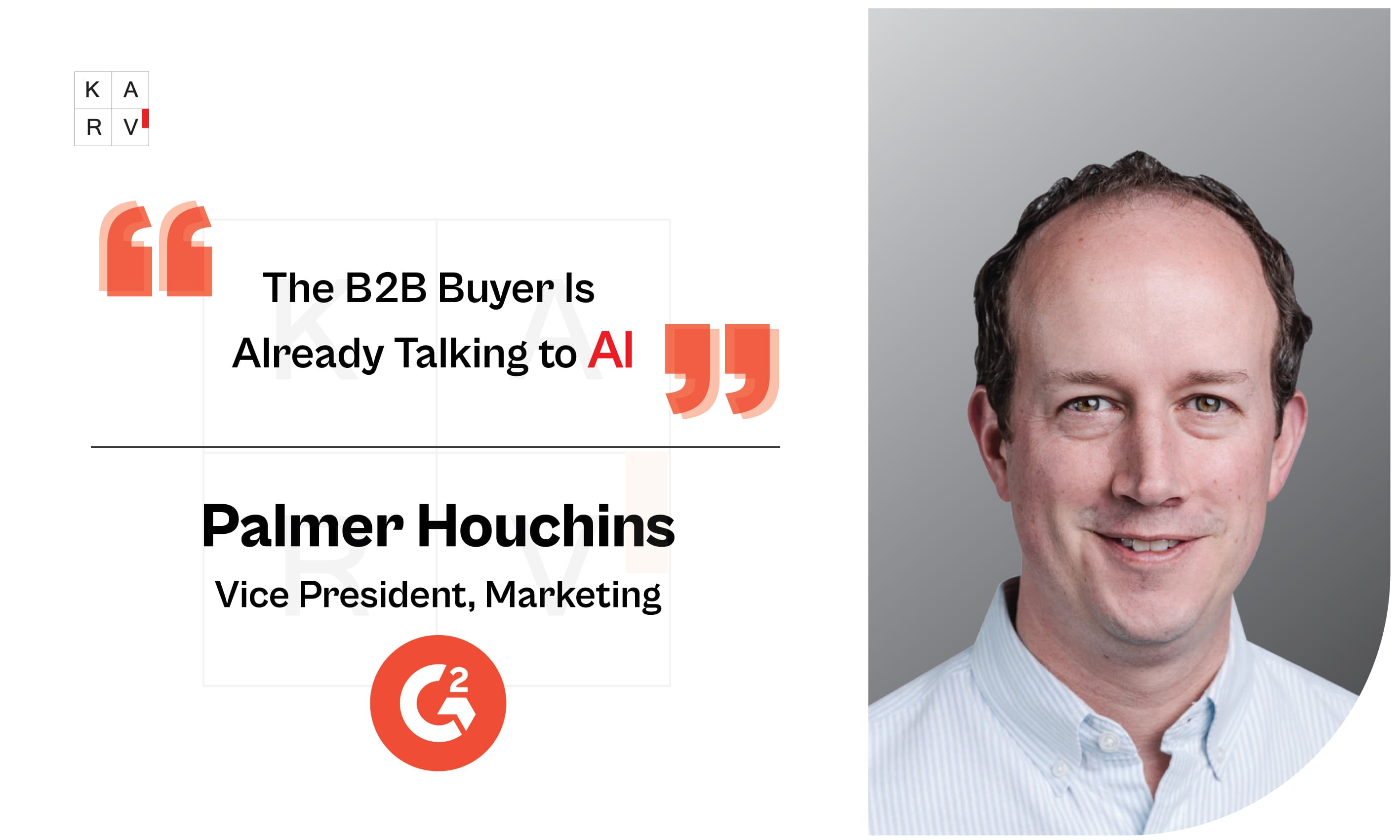
Palmer Houchins on AI-driven discovery, trusted customer intelligence, modern B2B marketing, and the future of go-to-market.
Article content
1. A Career Shaped by Modern B2B Marketing
Your leadership journey has taken you through high-growth organizations including Mailchimp, CallRail, and now G2, where you've helped shape marketing at different stages of scale. Looking back, what experiences have most influenced your leadership philosophy, and how has your perspective on modern marketing evolved as buyer expectations continue to change?
A:
My path here was never a straight line. I studied history and journalism in college and genuinely thought I'd end up a writer or a journalist. I stumbled into marketing almost by accident, through college concert promotion and artist management - probably the earliest form of growth marketing I ever practiced, just with worse hours and much less reliable business!
That led me to a digital music startup right out of college that laid most of us office within a year - an early, useful lesson in startups that I’m glad I experienced at 23 vs 33. From there I moved through agency and digital marketing work before landing at Mailchimp, where I spent almost eight years, joining early as a brand manager and leaving after we'd become one of the most recognized brands in software.
The biggest lesson from that stretch: creative risk-taking and business results aren't in tension - done well, they're the same job. One of my favorite examples: a mispronunciation of "Mailchimp" slipped into our ad on the mega-popular Serial podcast, and we then built an entire campaign around it. It felt like a strange bet at the time. But the campaign won a Cannes Lions Grand Prix and helped drive one of our best quarters ever.
CallRail sharpened that further. Running demand gen, brand, communications, and customer marketing under one roof taught me those functions work best as a single motion, not four separate scoreboards that occasionally sync up.
What's evolved most in my own thinking: B2B marketers have to stop treating buyers like line items in a funnel and start treating them like the humans they actually are.
2. Why G2, Why Now?
The way businesses discover and evaluate software is changing rapidly, driven by AI, peer insights, and digital-first buying behaviors. What attracted you to G2, and why do you believe trusted customer intelligence has become one of the most valuable assets in today's software economy?
A:
I actually came to G2 twice before I ever worked here - first at Mailchimp, then at CallRail, both times as a customer trying to understand my own market. So joining wasn't really a leap of faith; I'd already seen the value from the buyer's seat.
I love telling G2's origin story because it still explains why we exist: our founders wondered why you could read a thousand reviews before booking a $100 hotel room, but couldn’t find a single vetted, verified review before spending $100,000 on software. That gap - informed, peer-driven decision-making for something as consequential as enterprise software - is still the whole reason G2 exists.
But now AI has made trust a scarce resource. Content is infinite and nearly free to produce; verified, real customer experience is not. Our own numbers bear this out - 87% of B2B software buyers say AI chatbots have already changed how they research, and G2 has become the most-cited source for software questions across every major AI engine. Everyone's chasing the AI story right now. We've spent over a decade building the thing AI, buyers, and sellers can all actually rely on: trusted, verified customer intelligence.
3. The New Era of B2B Buying
For years, marketers focused on generating leads and driving website traffic. Today, buyers are increasingly influenced by AI assistants, review platforms, communities, and independent research before ever speaking with a vendor. How do you see this shift redefining the role of marketing, and what should organizations do differently to remain relevant throughout the modern buying journey?
A:
For years the job was straightforward: generate leads, drive traffic, hand off to sales. But with AI, that model is increasingly irrelevant. Buyers are doing the bulk of their research before we ever know they exist, inside AI assistants, review platforms, and communities we don't control.
One stat that reframes this for me: roughly half of B2B software buyers now start their research in an AI chatbot instead of a search engine. If your visibility strategy is still built entirely around search rankings and gated PDFs, you're increasingly invisible to that behavior.
The mental shift I'd push marketers toward: only a small slice of your total market is actively shopping at any given moment, but the rest are quietly forming opinions all the time - in Slack communities, LinkedIn threads, or a single ChatGPT conversation. Every one of those moments is your brand now, whether or not you're in the room.
What organizations need to do differently is stop treating brand and demand as separate disciplines competing for budget. In an AI-mediated world, they're the same signal. The companies that win will be the ones that show up as a credible, cited, verifiable source everywhere buyers already are.
4. AI, Trust, and the Future of Customer Influence
As generative AI transforms how buyers search for information and make purchasing decisions, trust has become more important than ever. How do you see AI reshaping customer influence, and what role will authentic customer voice, transparency, and credibility play in helping brands stand out in an increasingly automated digital landscape?
A:
Trust has always mattered in B2B, but the bar for it has never been higher, because buyers can spot AI hype from a mile away. When every pitch drops "AI-powered," it turns into noise fast. The real gap isn't showing off what your AI can do, it's proving you understand the problem well enough that the AI matters at all.
One shift I find genuinely interesting: brand trust now includes AI trust. Buyers ask how a system was built, who owns it, how secure it is - questions that weren't part of an RFP a year ago. There's also a new stakeholder in the room: internal "AI councils," cross-functional groups governing how a company adopts and approves new tools, not to mention CFOs keeping a close eye on token spend. Knowing their direction is good. Influencing it is great.
Underneath all of this is a truth I think will only matter more: authentic customer voice is the one input AI can't fabricate and can't function without. Every verified review, every honest piece of feedback, becomes a data point AI systems increasingly rely on when they answer a buyer's question. Authenticity isn't just a trust signal anymore, it's a discovery advantage.
The brands that stand out won't be the ones with the flashiest AI features. They'll be the ones with the clarity and credibility to earn the benefit of the doubt.
5. Beyond Demand Generation: Building a Revenue-Centric Marketing Organization
Marketing leaders today are expected to influence pipeline, revenue, customer retention, and long-term growth, not just awareness. How has this evolution changed the way high-performing marketing organizations operate, and what separates truly revenue-driven marketing teams from the rest?
A:
The scope of most marketing team’s has genuinely gotten bigger. A few years ago, if you'd asked me, I'd have said our job was acquisition - get leads in, get pipeline created. We're still doing that, but we've put just as much energy into retention and expansion, because growth doesn't only come from the top of the funnel anymore, especially as the growth at all costs days of B2B SaaS are clearly in the rearview mirror.
At G2, that shows up structurally, not just as a mindset. Every part of our marketing org - revenue marketing, brand and communications, product marketing, lifecycle and community, partner marketing - carries metrics tied to pipeline and revenue, not just its own channel-level KPIs. Revenue-centric marketing isn't a philosophy you announce; it's an org chart and a set of shared metrics - for us, OKRs - you actually hold people to.
We also lean hard on customer-led growth - treating customers as your best advocates and building the muscle to turn that advocacy into pipeline, not just a quote on a landing page.
What separates the best teams from the rest, in my experience, is business fluency. Marketers who understand the actual financial model of their company, alongside their craft, make sharper calls about where to invest. And they can tell a real ROI story, qualitatively and quantitatively, instead of hiding behind vanity metrics.
6. The Next Generation of Go-to-Market Strategy
The traditional boundaries between marketing, sales, customer success, and product continue to blur. As organizations adopt AI and data-driven decision-making, what do you believe will define successful go-to-market organizations over the next five years, and how should leaders prepare for this shift?
A:
The lines between marketing, sales, customer success, and product were already blurring before AI accelerated it. At G2, we run a genuinely unified go-to-market organization - marketing, sales, customer success, partnerships, enablement, and revenue operations under one strategy, rather than seprarate ones that occasionally sync up.
We also like the horizons framework. Near-term, it's about defending the trust and discoverability advantage you've already built. Mid-term, it's about embedding AI directly into how you create content and run your platform, not bolting it on. Longer-term, AI itself becomes a go-to-market channel.
One concrete shift leaders should prepare for: buying committees now include AI governance stakeholders who didn't exist a couple of years ago. That forces marketing, sales, and product to build shared messaging earlier in the process instead of handing a lead down a line.
My advice: build one shared scoreboard for the whole GTM org, not separate ones for MQLs, quota, and NPS. The organizations that win over the next five years will treat go-to-market as one motion with shared accountability, not a relay race.
7. Building Teams That Thrive Through Constant Change
Technology continues to evolve at an unprecedented pace, yet sustainable growth still depends on people. What leadership principles have been most valuable in building high-performing teams, fostering innovation, and helping organizations embrace change while staying relentlessly customer-focused?
A:
Technology moves fast; people don't always, and shouldn't be expected to. The principles I come back to most are ones we've built into how we operate at G2: choose ambition, build talent density, give people freedom paired with real responsibility, and lead consciously rather than reactively.
That last one shows up in the smallest moments more than the big ones. I've learned to separate the facts of a situation from the story I'm tempted to tell myself about it, especially when giving feedback, keeping things candid without making it personal. I also pay close attention, in hiring and in day-to-day work, to whether someone is running toward something they're genuinely motivated by.
The other principle I hold onto: proactivity has to be part of the culture, not just an expectation. Entrepreneurial spirit is one of our core values; the folks who thrive here are the ones who go get it themselves. None of this replaces having a real point of view on strategy - but no strategy survives a team that isn't equipped, trusted, and genuinely bought in.
8. Looking Ahead
As AI continues to reshape software discovery, customer engagement, and enterprise buying decisions, what trends do you believe will have the greatest impact on B2B marketing over the next decade, and what advice would you offer marketing leaders preparing for the next generation of growth?
A:
The trend I think will define the next decade: as AI makes content infinite and nearly free to produce, verification and authenticity become the scarce, valuable thing, not the other way around. Answer engine optimization is already replacing search engine optimization as the discovery model that matters; we've seen our own AI-referral traffic grow roughly tenfold year over year, and we've become the most-cited source for software buying questions across every major AI engine.
I think about this as a choice between two doors. Door one is chasing the AI hype cycle - bolting "AI" onto your pitch and hoping it resonates. Door two is building the kind of durable, verified trust that AI itself ends up depending on. The winners will walk through door two.
My advice for marketing leaders preparing for this: get fluent in your buyers' AI governance conversations, because their internal AI councils are a real stakeholder group now, not a footnote. Invest in your brand and community as literal inputs into how AI systems describe you, not just how humans perceive you. Organize your team around one shared revenue outcome instead of channel silos. And don't lose the human thread in all of this: buyers are still people, influenced by peers and honest experience, no matter how automated the discovery layer becomes.
About Palmer Houchins
Palmer Houchins is VP of Marketing at G2, the world's largest and most trusted software marketplace, where he leads brand, communications, and event strategy for a platform that helps more than 200 million buyers a year make smarter software and AI decisions. Before G2, he led marketing at CallRail and was an early marketing employee at Mailchimp. Palmer graduated from the University of Mississippi. He lives with his wife and two sons in intown Atlanta, GA.
About G2
G2 is the world’s largest and most trusted data source on B2B software, helping businesses reach their peak potential by enabling confident buying and go-to-market decisions. Offering trusted data, authentic peer reviews, and real-time market intelligence, the G2 ecosystem - which includes Capterra, Software Advice, and GetApp - serves more than 200 million annual buyers, representing teams at every Fortune 500 company.
As buyers increasingly shift from traditional search to AI search platforms, G2 has become the most-cited B2B software source across those AI-first channels where software discovery happens. Leading software and services companies like Salesforce, IBM, SAP, Adobe, and Clay also trust G2 to influence discovery, build brand credibility, reach in-market buyers, and accelerate revenue growth. learn more, visit www.g2.com
Explore Another Exclusive Leader Interview
If this conversation resonated with you, you may also want to explore our exclusive Leader Interview with Pat Breen, Area Vice President for ANZ at Cloudflare
Pat Breen on AI, Cybersecurity, Digital Trust and the Future of Enterprise Technology
Read the full interview: Pat Breen on AI, Cybersecurity, Digital Trust and the Future of Enterprise Technology