
Leader InterviewsData & Customer Platforms
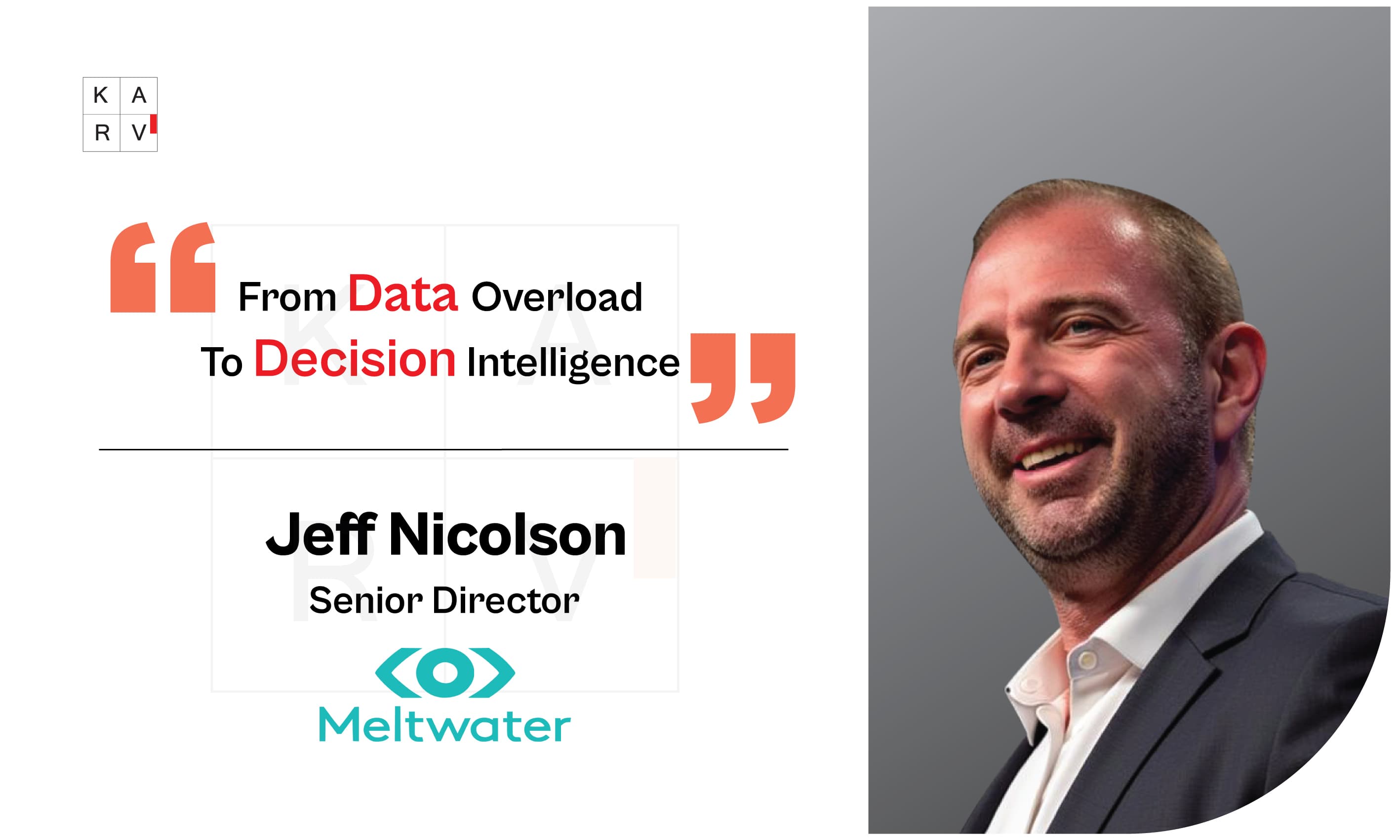
Jeff Nicolson on Data, AI, Intelligence and Better Business Decisions
Article content
1. From Data to Decisions
You’ve spent more than 18 years helping marketing, communications and PR teams turn media and social data into business outcomes. What has changed most in the way leaders need to use data to make better decisions today?
A:
The biggest change is that access to data is no longer the advantage. Almost everyone has data now. The advantage is knowing what matters, understanding it in context, and being able to act on it quickly.
When I started working in this industry nearly two decades ago, particularly here in the Middle East, one of the challenges was getting enough reliable information to understand what was happening around a brand or an industry. Today, we have almost the opposite problem. There is an extraordinary volume of information coming from traditional media, social platforms, creators, consumers, competitors and now AI-generated environments.
So the leadership question has changed from “What does the data say?” to “What decision does this help me make?”
That sounds like a subtle difference, but I think it is fundamental. The best leaders I work with aren't necessarily looking at more dashboards. They are trying to shorten the distance between a signal appearing and the organisation understanding what it means.
That might be recognising an emerging reputational issue before it becomes a crisis, understanding why consumer sentiment is shifting, identifying a competitor's change in strategy, or seeing an opportunity in a market before everybody else does.
In a region like the Middle East, that ability is particularly important. Markets here can move incredibly quickly. Consumer behaviour is diverse, conversations happen across multiple languages and channels, and organisations are operating in an environment of enormous economic and technological change.
Data therefore has to do more than describe what happened yesterday. It has to help leaders decide what to do tomorrow.
2. When Data Becomes Noise
Today’s marketing and communications teams have access to more data than ever, but often across disconnected platforms. How can leaders distinguish between simply having more information and having intelligence that actually helps them decide what to do next?
A:
For me, the distinction is relatively simple: information tells you what happened; intelligence helps you understand why it matters and what you should do about it.
Organisations have invested heavily in technology over the last decade. The unintended consequence is that many teams now have a collection of very sophisticated platforms, each presenting a different version of the world.
You have media data in one place, social listening somewhere else, web analytics, customer data, influencer data, competitive intelligence and increasingly AI visibility data. Every platform can generate another dashboard and another metric.
The danger is that more measurement can create the illusion of greater understanding.
I often ask teams a very basic question: What decision will you make differently because you know this?
If nobody can answer that, then the data probably isn't intelligence yet.
The real value comes when you connect signals and introduce context. A spike in mentions by itself is interesting. A spike in mentions combined with negative sentiment, a particular audience, a competitor action and a change in search or AI visibility starts to tell you something very different.
Leaders therefore need to move away from measuring everything simply because it can be measured. The objective isn't more data. It's greater clarity.
3. The Rise of Unified Intelligence
Media, social and AI signals are increasingly interconnected. What changes when organizations bring these signals together rather than analyzing them in separate silos, and how can this improve the way marketing and communications teams operate?
A:
Consumers don't experience brands in silos, so organisations shouldn't analyse them that way either.
Someone might first hear about a company through a news story, see the conversation develop on social media, watch a creator discuss it, search for the company and increasingly ask an AI platform about it. To that individual, this is one information journey. Inside many organisations, however, those interactions are still measured across multiple teams, platforms and datasets.
What makes the next phase particularly interesting is that I think we're moving beyond simply bringing those signals together on another dashboard.
We're beginning to see organisations build their own internal intelligence engines using large language models, connecting proprietary company data with trusted external intelligence sources.
Technologies such as APIs and Model Context Protocol, or MCP, are making it easier for AI systems to securely interact with different enterprise tools and data sources. The technology itself isn't really the important part. The important change is what it allows a business user to do.
Instead of opening five platforms and trying to connect the dots themselves, imagine a marketing leader simply asking: “What changed in our market this month, why did it change, and what should I be paying attention to?”
An internal intelligence layer could potentially examine commercial performance, CRM data and customer behaviour alongside media coverage, social conversations, consumer sentiment, competitor activity and AI visibility.
That's a fundamentally different relationship with data. For most of the last twenty years, we've built tools that help humans find insights in data. I think we're entering a period where increasingly the insight comes to the human.
And that makes trusted data even more important, not less. An LLM is only as useful as the information and context it can access. If you connect an incredibly capable model to incomplete, unreliable or disconnected information, you can simply arrive at the wrong conclusion faster.
So I think the competitive advantage will increasingly come from combining three things: high-quality data, intelligent technology and human judgment.
That's where unified intelligence becomes much bigger than marketing measurement. It starts becoming part of the decision-making infrastructure of the organisation.
4. AI Visibility and the New Brand Landscape
As consumers increasingly use AI platforms to discover information, brands are beginning to think beyond traditional search and social visibility. How should marketing and communications leaders approach AI visibility, and what new questions should they be asking about how their brands are represented in AI-generated conversations?
A:
I think AI visibility represents one of the most important changes in brand discovery since the emergence of search and social media.
For years, organisations have invested heavily in understanding where they rank in search, how visible they are in the media and how consumers talk about them on social platforms. Now there is another layer.
People are increasingly asking AI systems questions such as: What is the best company for this? Who are the leaders in this industry? Which brands can I trust? What are the alternatives?
The response may shape a perception or purchasing decision without that person ever visiting the brand's website.
That creates a completely new set of questions for marketing and communications leaders: Does AI know who we are? How does it describe us? Which sources are influencing that description? Are our competitors appearing in conversations where we should be present? Are there inaccuracies or outdated narratives being repeated about our brand? And perhaps most importantly: what information ecosystem are AI systems learning about our organisation from?
This is why I don't see AI visibility as simply the next version of SEO. It sits across marketing, communications, reputation, content and brand.
For communications leaders in particular, I think this is significant. Earned media, credible third-party sources and authoritative content potentially become even more strategically important when machines as well as people are consuming and interpreting that information.
We are moving from managing how a brand appears in search results to understanding how a brand exists within an AI-generated answer. That is a major shift.
5. From Marketing Reports to Business Impact
You describe your work as helping teams create decisions that move revenue rather than reports that sit in a folder. Why do you think marketing and communications teams still struggle to connect intelligence with measurable business impact, and what needs to change?
A:
I think our industry has historically been very good at measuring activity: mentions, reach, impressions, engagement and share of voice.
Those metrics have value, but the boardroom rarely wakes up worrying about the number of mentions the company received yesterday. Leadership is thinking about revenue, reputation, customers, competitors, risk and growth.
So one of the biggest opportunities for marketing and communications teams is to translate their intelligence into that language.
Instead of saying, “Our share of voice increased by 12%,” the more interesting question is: Why did it increase, amongst which audiences, against which competitors, and did it change anything that matters to the business?
The same applies to reputation. A communications team might identify a change in sentiment weeks before it appears in customer behaviour or commercial performance. That is incredibly valuable intelligence, but only if the organisation connects those dots.
I think measurement therefore has to evolve from proving activity to informing decisions.
One principle I have increasingly come to believe is this: If an insight doesn't have the potential to change a decision, ask why you're measuring it.
The organisations that make that transition elevate marketing and communications from reporting functions into genuine strategic intelligence functions.
6. The Human Advantage in an AI-Driven World
AI can process enormous volumes of information and identify patterns at speed. Where do human judgment, context and experience remain most important when turning intelligence into decisions?
A:
AI is extraordinarily good at processing information at a scale and speed humans simply cannot match. But identifying a pattern and understanding its significance are not always the same thing.
Context matters enormously.
I have spent most of my career in the Middle East, and it is a good example of why. A conversation happening in Saudi Arabia, the UAE or Egypt can have completely different cultural, linguistic and commercial meaning even when the underlying data appears similar.
Language itself can be nuanced. Arabic sentiment can change depending on dialect, context, humour or cultural reference. Add English and the many other languages spoken across the region and suddenly a simple positive-or-negative classification doesn't necessarily tell you very much.
That is where human judgment remains critical.
AI can tell you that something unusual is happening. Experienced people can ask: Why is it happening? Does it matter? What are we missing? And what are the consequences if we act - or don't act?
I actually think AI makes human judgment more valuable, not less.
As the cost of producing analysis falls, the premium moves towards asking better questions, challenging assumptions and making better decisions.
The future isn't humans competing with AI to analyse more information. It's humans using AI to understand more of the world, while applying the judgment, curiosity and experience required to decide what to do with that understanding.
7. Finding the Competitive Edge
You’ve witnessed Meltwater’s evolution from startup to a global business serving thousands of organizations. From that perspective, what separates companies that use intelligence to gain a genuine competitive advantage from those that simply collect and monitor more data?
A:
The difference is rarely the amount of data they have. It is the culture around how they use it.
I've had the privilege of seeing this industry evolve enormously over nearly two decades, and one pattern has remained remarkably consistent: the best organisations are curious.
They don't use intelligence simply to validate what they already believe. They use it to challenge assumptions.
They ask why a competitor is suddenly gaining attention. Why a particular narrative is resonating. Why one audience is behaving differently. What conversations are emerging outside their traditional category. What might happen next.
And importantly, they get that intelligence to the people who can act on it.
You can have the most sophisticated intelligence platform in the world, but if the insight stays within one department or ends up buried on page 37 of a monthly report, it has very little competitive value.
Competitive advantage comes from connecting signal, context and action faster than the organisation next to you.
Technology is an important part of that equation, particularly as AI allows us to analyse exponentially more information. But technology alone isn't the differentiator.
The differentiator is an organisation's ability to learn and act faster than its competitors.
8. The Future of Marketing Intelligence
Looking ahead, how do you see AI, media intelligence and social data changing the role of marketing, communications and PR leaders over the next three to five years, and what should organizations be doing now to prepare?
A:
I think we are going to see the boundaries between marketing intelligence, media intelligence, consumer intelligence and business intelligence become much less distinct.
Historically, teams have owned channels. The social team understood social. Communications understood media. Marketing understood campaigns. Research teams understood consumers. AI is making it possible to connect those worlds at a scale that wasn't practical before.
I also think every large organisation will begin developing some form of internal intelligence layer where employees can interrogate internal and external data conversationally. The interface to intelligence is becoming simpler, but that makes the quality, provenance and governance of the data underneath it even more important.
As a result, I think the role of the senior marketing and communications leader becomes much more strategic. Their value won't simply be managing channels or campaigns. It will increasingly be helping the organisation understand what is happening outside the business and what it means inside the business.
We're also going to move from retrospective intelligence towards increasingly predictive and real-time intelligence.
Instead of asking, “How did our campaign perform?” leaders will increasingly ask: What narratives are beginning to emerge? Where is consumer behaviour changing? What reputational risks are developing? What are competitors doing differently? How is AI representing our organisation? Where is the next opportunity?
The organisations preparing well for that future aren't simply buying more AI tools. They are getting their foundations right: connecting their data, reducing silos, improving data quality, developing AI literacy and, critically, deciding where human judgment needs to remain in the loop.
AI may commoditise the interface to intelligence; it doesn't commoditise the quality of the intelligence underneath it.
After almost two decades in this industry, I have never seen the pace of change we are experiencing today. But I also think the fundamental objective remains remarkably consistent: understand the world around your organisation better than your competitors do - and turn that understanding into better decisions.**
About Jeff Nicolson
Jeff Nicolson is a Director at Meltwater in the Middle East with close to two decades of experience working at the intersection of media, technology, data and business intelligence.
Throughout his career, Jeff has worked with organisations across the region to transform media, social and consumer data into intelligence that supports better strategic and commercial decision-making. His perspective has been shaped by witnessing both the extraordinary transformation of the Middle East and the evolution of the media intelligence industry from traditional monitoring to today's AI-powered intelligence landscape.
He is particularly focused on how AI, unified intelligence and emerging forms of digital discovery are changing the way organisations understand their markets, manage reputation and make decisions.
About Meltwater
Meltwater is a global leader in media, social and consumer intelligence, helping organisations understand and act on signals across the external information landscape.
Founded in 2001, Meltwater has evolved from an online media monitoring company into a global intelligence platform serving thousands of organisations around the world. Its technology brings together media intelligence, social listening and analytics, consumer insights, influencer marketing, media relations and emerging AI-driven capabilities to help organisations better understand their brands, audiences, competitors and markets.
As the information landscape becomes increasingly fragmented across traditional media, social platforms, creators and AI-generated environments, Meltwater helps marketing, communications and business leaders turn that complexity into actionable intelligence and better-informed decisions.
Explore Another Exclusive Leader Interview
If this conversation resonated with you, you may also want to explore our exclusive Leader Interview with Natalie Cole, Head Of Content Marketing at One New Zealand.
Natalie Cole on AI, Content Marketing, GEO, and the Future of Modern Marketing
Read the full interview: Natalie Cole on AI, Content Marketing, GEO, and the Future of Modern Marketing