
Leader InterviewsAI Business & Ecosystem
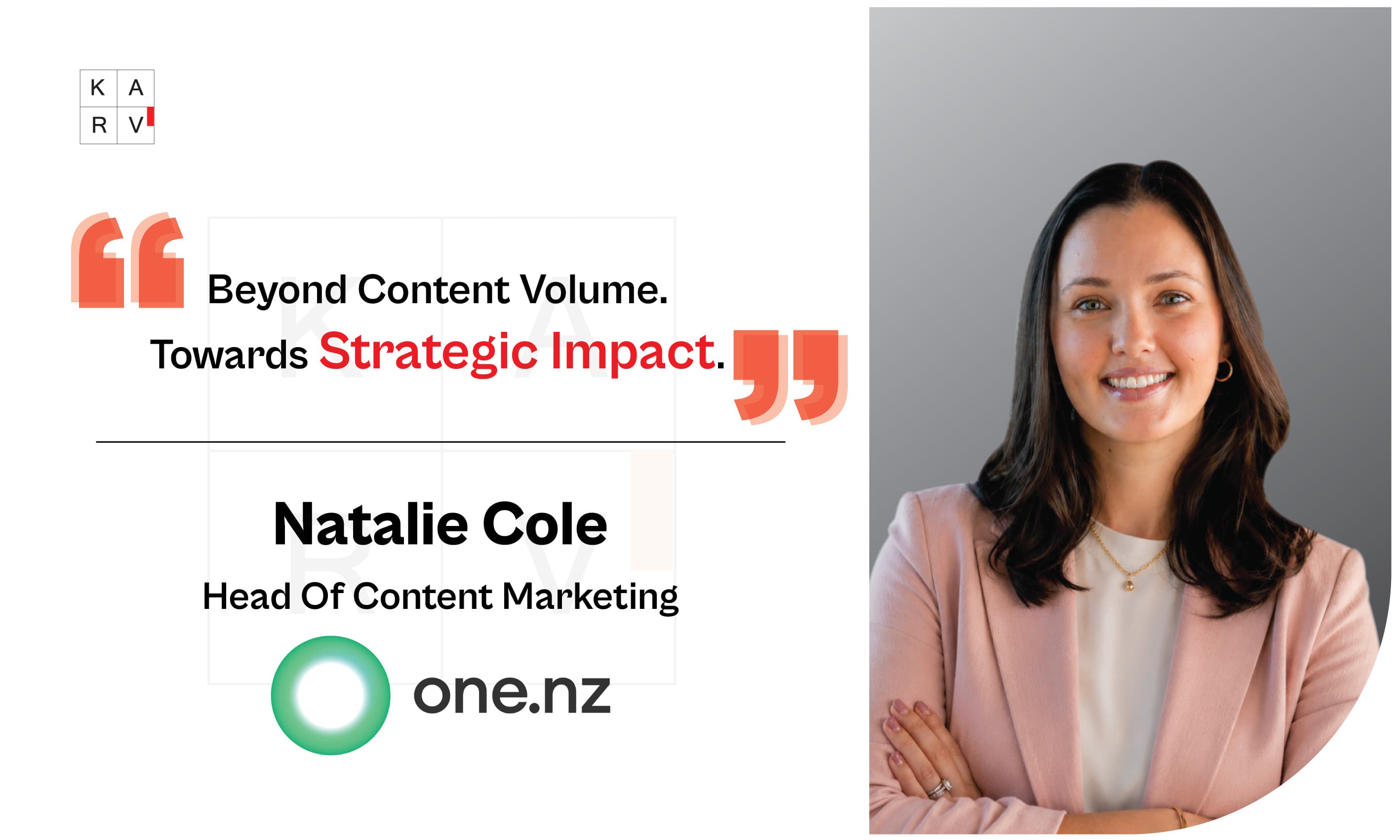
Natalie Cole on AI, Content Marketing, GEO, and the Future of Modern Marketing
Article content
1. From AI Transformation to Content Leadership
You have worked across consumer marketing, channel marketing and AI transformation before stepping into your current role as Head of Content Marketing at One NZ. How has that journey changed the way you think about the relationship between technology, customer behaviour and modern marketing?
A:
I’ve had an unusual but unfortunate opportunity in my career to work across many areas and its been entirely deliberate. My time in commercial, sales and transformation roles has only made me a stronger marketer. I’m always looking for what I can learn from each opportunity and each role has taught me a different perspective or way of looking at the same problem we’re trying to solve.
Customers don’t experience your org chart and it can be really easy to lose sight of that when your thinking gets tunnel visioned. The journey has made me a sharper, systematic thinker and the day I stop learning is probably the day I stop growing as a leader.
When i led our AI marketing transformation strategy at One NZ, my mind was completely blown away at the what the technology could do. We scaled a a lot of use cases across the marketing function and it freed up real time, but the thing that actually moved the needle was giving people back the headspace to think.
That’s the thinking I’m bringing into my new Head Of Content role; technology should buy back judgment not replace it completely.
2. Rebuilding the Marketing Operating Model
As AI moves from experimentation into planning, execution and measurement, what parts of the traditional market-ing operating model do you believe need to be fundamentally rethought?
A:
AI is like having the most powerful, intelligent 24/7 assistant and it’s accessible to everyone. A lot of the thinking skills remain the same, but the way we work and how we work has fundamentally changed. Where planning, production, measurement used to be seperate stages done by seperate teams, AI collapses that completely.
We can now build and design continuous workflows and systems that are delivered with a mixture of automated tools, tasks and people. A good thing to be really clear on is where you place the most value on high and low stakes tasks. What is the ‘busy’ work that just needs to be done that you can automate and what are the high value tasks that still need human thinking in the loop.
Once you start looking at your operation model as a system, that all works together powered by AI technology you can build an operation model around that. Skills are merging and traditional roles in marketing across martech, digital marketing, social media will come together.
3. The MarTech Stack Is Becoming an AI System
As AI becomes embedded across CRM, automation, analytics and content platforms, how should marketing leaders build a technology ecosystem that connects tools, data and workflows rather than simply adding more AI capabilities?
A:
There is a plethora of AI tools out there now. The choice is almost overwhelming. Adding AI to every tool in the stack is something I’d caution. These tools, can become outdated fast as the technology advances and commercially they often charge based on a consumption or token based model which can be really hard to budget for on the PNL. When shopping around look for a solution that offers a poc or trial and keep your commercial terms open.
The businesses that’ll win are the ones treating data, workflow and tooling as one connected system rather than a shelf of point solutions and building a strong change management plan around it.
I’d also recommend looking at your intelligence layer that sits underneath it. If you could build workflows that sit on top of this as your one source of ‘truth’ that can be very powerful. You can build these in-house or partner with companies to achieve this.
4. When Search Stops Being Just Search
As consumers increasingly discover brands through AI-powered answers and recommendations, how should marketers rethink discoverability beyond the traditional search results page?
A:
How customers search has fundamentally changed. Discoverability used to mean owning a results page and ensuring you were ranked high enough to be found. Now it means being the answer, not just a link on the way to one. That changes what ‘good content’ looks like; it’s all about being well structured, credible and the dark arts like PR and earned media suddenly hold a lot more weight to these LLM tools.
In my new role, discoverability across SEO, GEO and LLM visibility sits alongside our editorial, social and channel strategy team for this exact reason; you have to think about the way these channels work together and your digital trail. I’m super excited about this space.
Make sure you’re keeping your content strategy diversified across multiple mediums and also don’t forget your own domain. A lot of the SEO fundamentals for your own website still remain across GEO.
5. From SEO to GEO and LLM Visibility
As marketers move from SEO toward GEO and LLM visibility, what principles should brands understand to remain discoverable, credible and trusted across this emerging landscape?
A:
The principle that matters most here is trust. You can’t game your way into an AI-generated answer the way you could before. These systems are synthesising from what’s credible, consistent and genuinely useful. And they have a long memory. If your brand is scattered with poor customer reviews across Reddit and review sites, you can’t hide from this.
My learning in this space is its a lot of small changes that make a noticeable difference. Publishing some helpful FAQs, looking at your SCHEMA across high traffic pages, posting regular helpful content, creating a PR calendar; all shift the needle.
Start with a small list, look at what prompts you want to measure and build from there.
6. Technology Can Scale Content. Judgment Creates Value.
AI can dramatically increase the speed and volume of content creation. As content becomes easier to produce, where do humans remain indispensable, and how should leaders ensure technology amplifies rather than replaces human judgment?
A:
This is something i feel strongly about. AI has made content production nearly frictionless and way easier to produce which means there’s a big scale of content out there that ranges from AI slop to amazing work.
Anyone can generate content now, but the people generating slop were probably generating slop before AI tools were here to make it easier. What can’t be automated is the human experience, the customer insight, the creative judgment of someone who knows what good work looks like.
I’ve seen incredible work being produced with AI. I’ve used AI to help craft content. I find it most powerful when it’s my idea, and the AI tool is just finessing the edges.
As a leader, my job is to keep my team’s instinct sharp enough so we’re using these tools in the right way. And be really clear on our ethics and values on how we use it.
7. Turning Data and Technology Into Better Customer Experiences
With customer data, AI, content, analytics and technology increasingly interconnected, how can marketing leaders ensure these capabilities create genuinely better customer experiences rather than simply more activity?
A:
More data and more automation can easily produce more noise. We’ve all seen this before. What is different now is that you have a machine that can mine through 1000s of data points that you’d either have a data analyst or insights agency mining before. The customer interviews, the sales interaction notes, the market data can now all be looked at together and served up in seconds.
The question i always try to come back to is simple: does this data help me make the customers experience easier, better or simpler. If it doesn’t; it’s probably just a distraction.
8. The Next Chapter of Marketing Technology
Looking three to five years ahead, what will fundamentally change in how marketing teams operate, measure performance and engage customers as AI becomes embedded across the MarTech landscape?
A:
I’m a big believer in what isn’t evolving or growing is being left behind.
The way customers search, buy and experience brands is fundamentally going to change in the next 3-5 years. I’m not placing any bets but i think ecommerce is going to shift to become highly personal and integrated across LLMs and social channels.
Direct Marketing is going to see the role of email change. Customers will expect to interact with brands in a 2-way dialogue with agents and as Salesforce say, the ‘Do Not Reply’ will be gone.
More and more content will be created with AI and hopefully we see some of our governments and tech companies start to regulate this especially when it comes to protecting peoples identities and IP.
Teams will scale down in certain areas and scale up as new roles are created. There will be more emphasis in finding talent with strong critical thinking skills, strong strategy and strong judgment.
The future is exciting, i think ;)
About Natalie Cole
Natalie Cole is a marketing leader passionate about building modern brands, high-performing teams, and the capabilities organisations need to thrive in a rapidly changing world.
Her experience spans marketing, sales, customer, commercial, and transformation leadership, with a particular focus on helping organisations navigate change.
Over the past few years, she has become increasingly focused on the intersection of marketing, technology, and AI. She has led AI transformation initiatives that have delivered measurable productivity gains, embedded new ways of working, and helped teams adopt emerging technologies with confidence. She believes the future belongs to organisations that combine human creativity, critical thinking, and technology to unlock new forms of value.
What energises Natalie most is developing people. Whether building capability frameworks, growing future leaders, or creating cultures where teams can do their best work, she believes great businesses are built by investing in their people.
Outside of work, she is a proud mum of three girls, loves a good adventure, and is passionate about continuous learning, leadership, and the future of marketing.
About One NZ
One NZ is one of New Zealand’s largest telecommunications companies, providing mobile, broadband and business connectivity to Kiwis nationwide. Since its rebrand from Vodafone, the company has repositioned itself around a bold mission: to be fearless in creating more value and connecting all of Aotearoa. One NZ is known for pairing that ambition with innovation; from its SpaceX satellite partnership to a growing focus on AI-driven marketing and customer experience.
Explore Another Exclusive Leader Interview
If this conversation resonated with you, you may also want to explore our exclusive Leader Interview with Pat Breen, Area Vice President for ANZ at Cloudflare.
Pat Breen on AI, Cybersecurity, Digital Trust and the Future of Enterprise Technology
Read the full interview: Pat Breen on AI, Cybersecurity, Digital Trust and the Future of Enterprise Technology