
Leader InterviewsAI Business & Ecosystem
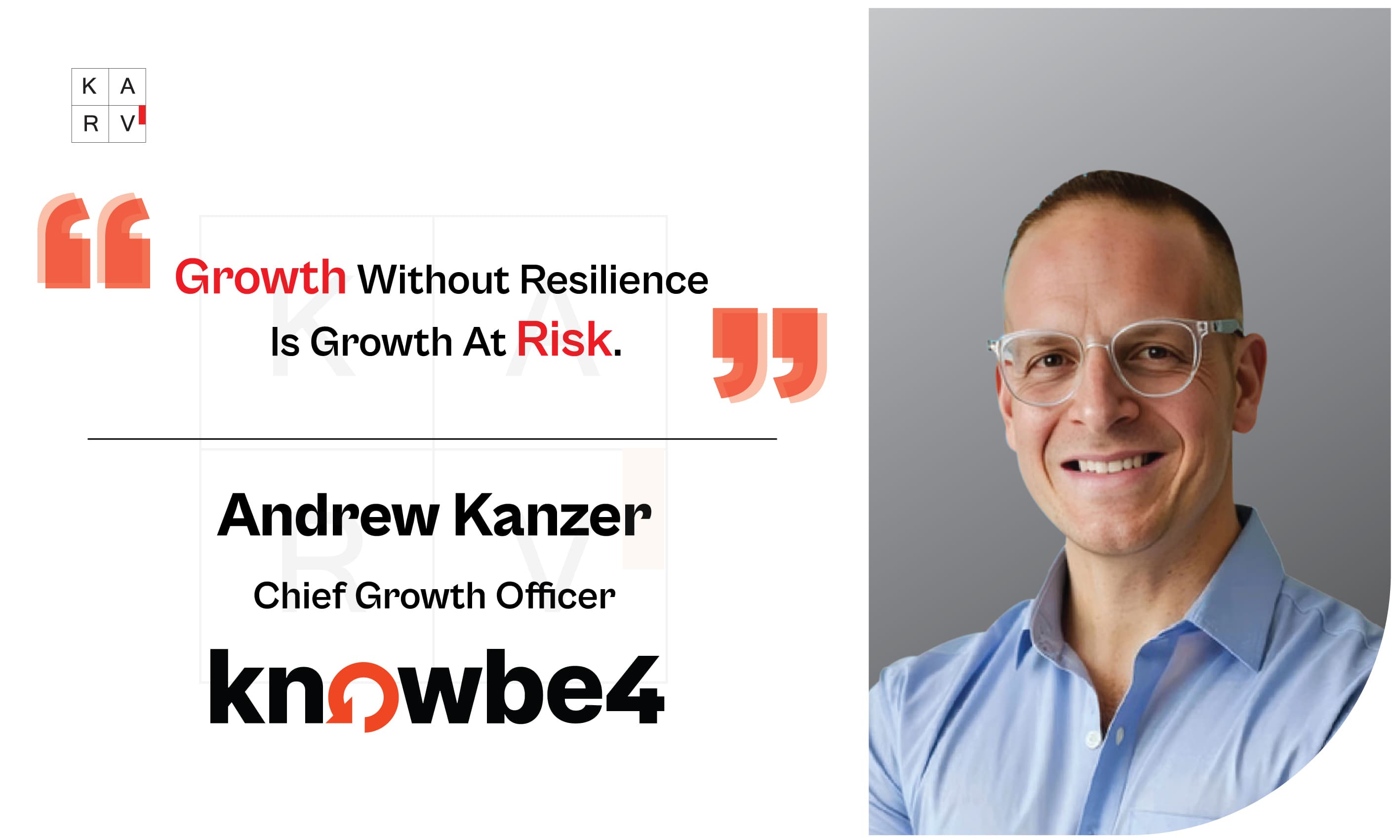
Andrew Kanzer on AI, Cybersecurity and the Future of Digital Workforce Security
Article content
1. From Scaling SaaS to Scaling Security
You've spent more than two decades scaling high-growth software businesses across companies such as Xero, Intuit, PayPal, and Swift Financial. Now, at KnowBe4, you're applying that experience to cybersecurity. What has this transition taught you about the connection between growth, resilience, and the way organizations approach security?
A:
Every company I've scaled had one thing in common: growth needs outpaced the ability of legacy thinking. There is always new surface area, whether that's new users, new markets, or now, AI agents joining the workforce. What I learned across all of those is that resilience isn't a brake on growth, it's what lets you keep growing. If people or agents don't trust the system, they don't adopt it, and adoption is the whole game in SaaS. Bringing that lens to KnowBe4 has been a natural fit: our thesis is that the fastest-growing organizations will be the ones that build security into how their entire digital workforce, human and AI, operates from day one. Growth and security aren't in tension when you design for both together.
2. When Your Workforce Becomes the Security Layer
Security awareness is increasingly being recognized as more than a compliance exercise. From your perspective, why does building a resilient security culture across your entire digital workforce, both human and AI, need to become a strategic business priority rather than simply an IT responsibility?
A:
Security awareness used to mean an annual training video and a checkbox. That model is gone and the focus is on behavior change. Breaches still overwhelmingly trace back to people, and increasingly to the AI agents working alongside them, making decisions with real access and real consequences. It is growing everyday as organizations report incidents tied to how employees are using AI tools, often with no oversight at all. If leadership treats that as "an IT problem," they've already lost the game. It's a business continuity issue, a customer trust issue, and increasingly a growth issue. Boards should be asking not just whether their people are trained, but whether they have visibility and control over every identity, human or agentic, operating inside their business. That's the strategic priority.
3. Growth Without Fragility
High-growth companies often prioritize speed, expansion, and market opportunity, while cybersecurity is designed to manage risk and resilience. How can leaders build organizations that pursue aggressive growth without creating new vulnerabilities along the way?
A:
Speed and risk aren't opposites, but unmanaged speed creates blind spots. I've watched high-growth companies bolt on tools, integrations, and now AI agents faster than they can inventory them. That's how you end up with shadow IT, and today, shadow AI. The leaders who get this right build resilience into the operating model itself, not as a gate that slows the business down, but as a discipline: know what's running in your environment, know who and what has access to what, and build feedback loops so risk shows up as a number on a dashboard instead of a surprise. We push this internally as much as we advise it externally. Growth without visibility is essentially exposure with a good quarter attached.
4. Building a Modern Growth Engine
As Chief Growth Officer at KnowBe4, you lead global go-to-market strategy across revenue, partnerships, and product innovation. What does it take to build a growth engine that can scale rapidly without sacrificing customer value, operational discipline, or long-term sustainability?
A:
A growth engine that scales without breaking has to be built on the same principle you'd apply to any resilient system: alignment over speed for its own sake. Sales, strategy, and engineering can't operate in silos chasing separate metrics, that's how you sacrifice customer value. My approach has been to build growth around the customers’ lifecycle to create durable trust, whether that's trust that a product delivers ROI or, in KnowBe4's case, trust that we're helping organizations manage risk across their entire workforce. Sustainable growth is really just repeatable trust at scale.
5. Where AI Changes the Equation
AI is reshaping both sides of cybersecurity, giving defenders new capabilities while also giving attackers more sophisticated ways to target organizations and people. How do you see AI changing the security awareness landscape, and what should business leaders be preparing for now?
A:
AI has changed the attacker's economics more than almost anything we've seen. The large majority of phishing emails now use some form of AI, deepfakes are cheap to produce and hard for people to detect, and attackers are moving beyond email into voice and video. But the bigger shift for leaders to prepare for is what's happening inside their own walls: employees adopting AI tools faster than security teams can track them, and now autonomous AI agents operating with real permissions. That's a new and increasingly prominent attack surface. Business leaders should be asking whether they even have an inventory of the AI agents running in their environment today, because you can't secure what you can't see. The organizations that get ahead of this will treat their AI agents the way they treat employees: with guardrails, training, and a measurable risk profile, not blind trust.
6. Aligning Product, Sales and the Market
You've built your career around connecting big-picture strategy with operational execution. In a cybersecurity market that is becoming increasingly crowded, how should companies align product innovation, sales, marketing, and customer needs to create meaningful differentiation?
A:
In a crowded market, differentiation doesn't come from a feature list, it comes from a point of view that customers can feel is genuinely yours. That only happens when product, sales, and marketing are solving the same problem from different angles instead of optimizing their own metrics in isolation. Practically, that means product roadmaps informed by what customers are actually struggling with, sales teams who can speak to outcomes instead of features, and marketing that tells one consistent story about the problem you exist to solve. Alignment internally is what lets you show up externally with one clear, differentiated story. For us, that's securing the entire digital workforce, humans and the AI agents now working alongside them, in a market where many vendors are still only talking about people or only talking about AI, not both. Nor do they have a decade of in-production AI experience like we do.
7. The Next Generation of Security Culture
KnowBe4's proposition has evolved from securing people alone to securing and training the entire digital workforce, human and AI. As threats and workplaces continue to evolve, what do you believe the next generation of security culture will look like?
A:
The next generation of security culture won't be measured only by whether employees can spot a phishing email, it'll be measured by whether an organization has real visibility and trust across every identity operating inside it, human and AI. We're already seeing AI agents take on real work: drafting communications, accessing systems, making decisions with real consequences. A security culture that only accounts for people is only accounting for part of the workforce. The organizations that get this right will build the same habits of awareness, accountability, and continuous learning into how they manage their AI agents as they do their people, backed by real risk data instead of gut feel. Culture has always been about shared norms; the next generation just has a wider definition of who, and what, needs to share them.
8. Looking Ahead: The Resilient Growth Company
Looking three to five years ahead, what will distinguish companies that successfully combine growth, AI adoption, and cybersecurity from those that discover too late that speed without resilience comes at a cost?
A:
Three to five years out, the companies that win will be the ones that stopped treating growth, AI adoption, and security as three separate conversations. They'll have real-time visibility into their entire human and AI workforce, with risk quantified rather than assumed. The ones that lose will be the ones that scaled fast, adopted AI faster, and never built the muscle to see what was actually running in their environment until something went wrong. Speed without resilience is like borrowed time. The companies that last will be the ones that made security an enabler of growth from the start.
About Andrew Kanzer
Andrew Kanzer brings more than two decades of global experience in optimizing and scaling high-growth software organizations to his role as Chief Growth Officer at KnowBe4. Recognized as a seasoned systems thinker with a founder's instincts, he has spent his career mastering the complexities of global enterprise expansion, guiding organizations through periods of rapid scaling, technology transformations, and aggressive market disruption. His expertise lies in building highly agile, data-driven revenue engines.
Role & Responsibilities at KnowBe4: Kanzer leads the organization’s overarching global go-to-market strategy, commanding cross-functional alignment to accelerate sustainable market growth.
About KnowBe4
KnowBe4 empowers the whole workforce to make smarter security decisions every day. Trusted by more than 70,000 organizations worldwide, KnowBe4 is the pioneer of digital workforce security, securing both humans and AI agents. The KnowBe4 Platform provides attack simulation and training, email & collaboration security, and agent security powered by AIDA (Artificial Intelligence Defense Agents) and a proprietary Risk Score. The Platform leverages 16-years of behavioral data to combat advanced threats including social engineering, prompt injection, and shadow AI. By securing humans and agents, KnowBe4 leads the industry in workforce trust and defense. More info at knowbe4.com.
Explore Another Exclusive Leader Interview
If this conversation resonated with you, you may also want to explore our exclusive Leader Interview with Sammy Zoghlami, Senior Vice President, EMEA at Nutanix.
Sammy Zoghlami on AI, Hybrid Multicloud and the Future of Enterprise Technology.
Read the full interview: Sammy Zoghlami, Senior Vice President, EMEA at Nutanix