
Leader InterviewsAI Applications & Use Cases
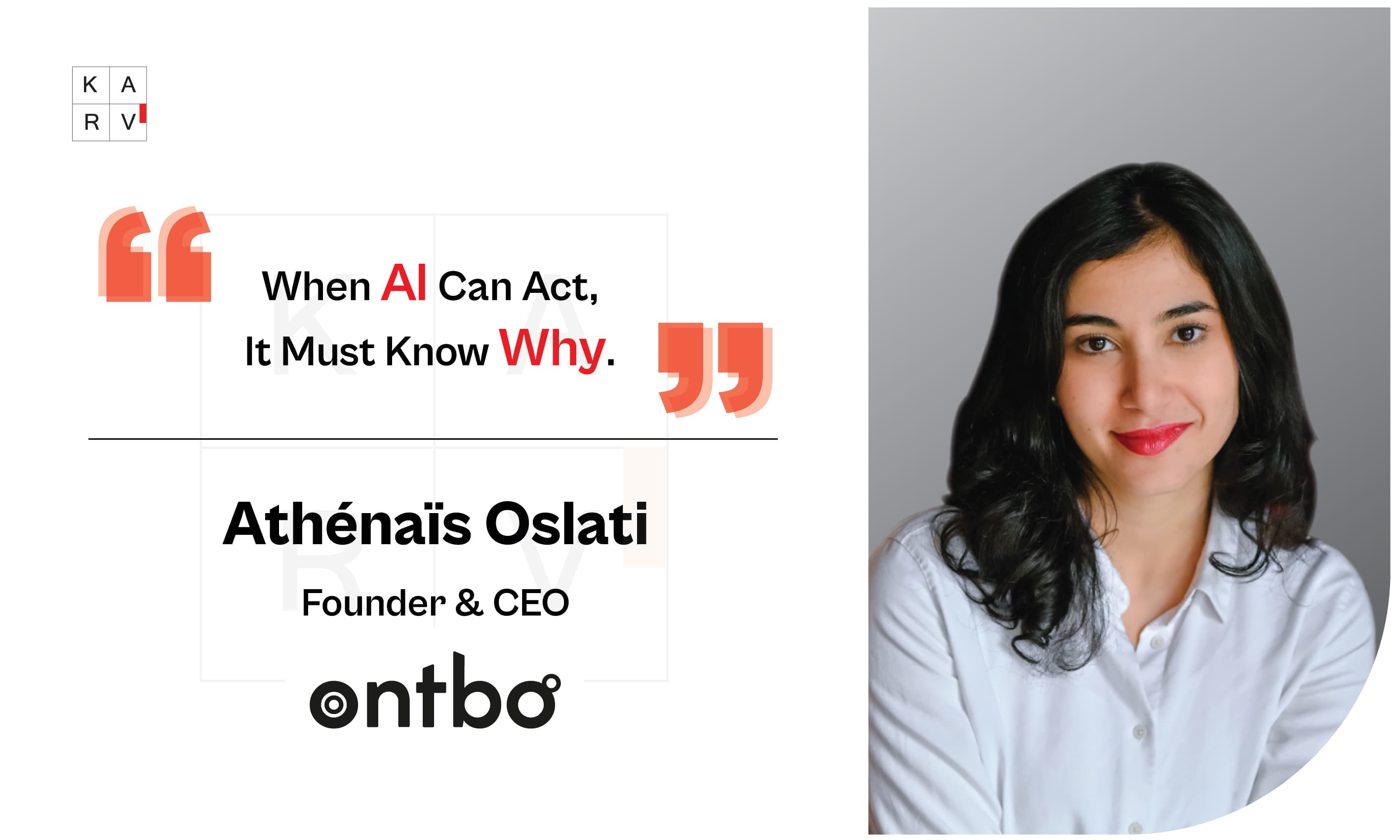
Athenais Oslati on Cognitive AI, Memory, Reasoning and the Future of Intelligent Machines
Article content
1. From Intelligence to AI
You’ve moved across medicine, science and engineering before founding ONTBO. What experiences shaped your understanding of intelligence, and ultimately led you to build a company focused on rethinking how machines understand and interact with the world?
A:
Look at a junior doctor vs. a veteran surgeon. The veteran isn't 'smarter.' They just run a closed cognitive loop at lightning speed, almost unconsciously: Perceive. Remember. Validate. Project. Act.
You perceive the immediate reality.
You remember to get context.
You validate against rules.
You project the outcomes.
Then you act.
That's what medicine taught me about intelligence. It’s an architecture, not a calculation.
Then I moved to engineering, and I built this project where I controlled a drone using my own EEG brainwaves. Standing there, watching hardware respond to microvolts in my head... that was the spark. I saw that human biology and machines are fundamentally built on the exact same signaling logic.
But here’s the problem with AI today: we threw that architecture out the window. We built statistical pattern-matchers that bypass perception, context, and projection entirely. They guess the next word. They don't understand the world.
That gap kept me up at night. I founded ONTBO to stop brute-forcing data and start building machines around the actual, biological mechanics of intelligence with Cognitive AI.
2. The Missing Layer in AI
AI models are becoming increasingly powerful, yet challenges around memory, context and continuity remain. What do you believe today’s AI systems are fundamentally missing, and why does solving this matter for the next generation of AI?
A:
Without memory, the present is just a suspended instant. A fleeting abstraction that’s impossible to truly interpret.
That’s the missing layer in AI today. We built systems trapped in a permanent present.
Right now, the industry is obsessed with explaining building statistical causal chains from raw data. But explanation isn't comprehension. To truly understand a human or a complex situation, you can't just analyze a single data point in isolation. You have to immerse it in a bath of past experiences, habits, relationships, and context.
Memory is the prerequisite for comprehension.
But context isn't just a window of past tokens. Action or intent doesn't belong to a single memory; it belongs to an entire world, a dense, multi-dimensional web of memories reflecting off one another.
Current LLMs don't have a world. They have a rolling context window. When the window closes, their world dies.
Solving this isn't about making context windows larger; it’s about giving machines a dynamic, evolving world-model. If we want the next generation of AI to move beyond sophisticated text generators and become true cognitive agents that act meaningfully in reality, we have to give them a past.
3. Defining Cognitive AI
ONTBO is building around the concept of Cognitive AI. How do you define Cognitive AI, and what makes it fundamentally different from conventional AI systems and today’s large language models?
A:
Cognitive AI is an architecture that emulates human thought. It pairs long-term episodic and semantic memory with prospective scenario simulation and constrained logical reasoning. The goal? Autonomous, explainable decisions grounded in real-world context.
We aren't trying to biologically replicate the human brain or build consciousness, this is pure computational logic. We’re instilling machines with common sense, logic, and situational intelligence so they can navigate the real world and handle the unknown.
Why Cognitive AI, and why right now?
Historically, humans had to learn the rigid language of machines. Cognitive AI flips the dynamic so technology adapts to us. We move from asking "What text should the system generate?" to "What must the system understand before it acts?"
Instead of focusing on output quality, Cognitive AI focuses on the system's internal state its real-world representation, contextual awareness, and logical reasoning. Conventional LLMs are passive executors; Cognitive AI is a proactive, reliable system.
There are major signals that show why this transformation is happening today. Multimodal systems have reached a level of maturity where they can digest diverse inputs simultaneously. At the same time, hardware innovations enable processors to handle complex loops of perception, logic, and simulation in real time. Together, these advances accelerate the rise of agentic AI, moving the industry from interactive chat prompts to proactive, goal-driven execution.
4. Making AI Agents Truly Intelligent
As AI evolves from responding to prompts toward acting autonomously, what capabilities will be essential for agents to understand context, learn over time and operate reliably in real-world environments?
A:
To make an AI agent reliable, you have to build it around a tight, continuous five-stage loop, and you have to audit every single stage.
First, the system needs to Perceive multi-stream environmental data while using its memory to Remember context across sessions. You test this by pushing its contextual memory to the limit, making sure it doesn't drop initial constraints three hours into a long session.
Next comes the critical phase: the agent must Validate its options against strict logic boundaries, then Project future outcomes like a chess player before making a move. Here, the metric to track is execution fidelity, how many plans run completely drift-free? And a vital rule: never rely on internal self-checking. It’s a flawed safety net. You always need an independent reviewer system to catch what the agent misses.
Finally, the agent has to Act autonomously and feed the real-world results straight back into perception. To evaluate this step, just look at your human escalation rate. If it’s too low, your agent has a dangerous overconfidence problem. If it’s too high, it’s simply not bringing any value to the table.
5. Memory, Context and AI Eciency
Persistent memory and contextual intelligence are becoming increasingly important as AI systems scale. How can these capabilities make AI not only more intelligent, but also more efficient, cost-effective and practical for enterprise adoption?
A:
People constantly confuse memory with document retrieval. They set up a basic RAG pipeline, pull in a few PDFs, and assume they've solved context. RAG gives an AI reference material that gives zero operational state. Think about it. If an agent is running a complex 15-step process over three days and hits an anomaly, a search retrieval tool won't help. Without persistent memory, the execution state completely collapses. The agent resets, and you're stuck paying to re-run the exact same steps all over again.
Persistent state fixes the actual unit economics through three simple realities.
First, it stops compute waste. When an agent tracks its own state, it isn't constantly re-evaluating static environment rules or re-calculating logic it finished ten minutes ago.
Second, it locks down your constraints. You don't need to re-verify business rules on every micro-action; the contextual boundaries stay active. That eliminates the constant and expensive risk of workflow drift.
Third, it allows real asynchronous work. Enterprise tasks don't happen in a single, continuous chat box. Persistent memory lets an agent pause, wait for a human approval or an API callback, and resume hours later right where it left off.
6. From AI Experimentation to Enterprise Adoption
Many organizations are moving from AI pilots toward autonomous systems that can perform increasingly complex tasks. What needs to happen for businesses to move from experimentation to genuinely trusting AI agents in critical workflows?
A:
To cross that bridge, leaders need to realize that the problem was never about generating faster answers or actions, it was about how much trust you can actually afford to place in them.
Moving to enterprise adoption isn't about getting "better answers" or deploying an AI boosted on algorithmic steroids. It requires fundamental shifts in the architecture:
Shift from Generation to Delegability.
Trust happens when you stop viewing AI as a chatbot and start viewing it as a delegable system. Cognitive AI shifts the core question from "Can it write this?" to "Can we safely hand over this decision?"
Enforce Deterministic Proof over Probability.
Today’s LLMs operate on probabilities, which makes them inherently unreliable for critical tasks. Enterprise trust requires a hard operational rule from the machine: "I will never tell you something without being able to prove it."
Build Explainable Audit Trails.
Businesses can't delegate responsibility to a black box. Agents must expose their logical reasoning, constraint checks, and memory states so human operators can inspect why a decision was made before or after execution.
Cognitive AI changes the very nature of what humans reasonably hand over to a machine. That is what unlocks real enterprise adoption.
7. Building Human-Centered AI
As AI becomes more autonomous, personalized and capable of understanding users over time, how should businesses balance intelligence and personalization with human control, privacy and responsible AI?
A:
The main issue is often a confusion between control and micromanagement. Keeping oversight over autonomous systems does not mean checking every single action they take. It means setting clear limits from the start and knowing when a human needs to step in.
Bounded operational authority
Agents should be able to act freely when the risk is low. But once an action has real consequences, such as moving money, changing production code, or contacting a client, the system should stop and ask for human approval.
Contextual isolation for privacy
Personalization also does not mean collecting as much user data as possible. In many cases, the system only needs a few preferences and enough context to complete the task. Sensitive data can stay where it already is, protected by the company’s existing security systems.
Mandatory decision auditability
If an autonomous system makes an important business decision, “the model decided” is not a good enough explanation. There should be a clear record of what information was used, what rules were applied, what decision was made, and why.
The goal is to give it autonomy where it makes sense and keep human control when it matters.
8. The Next Chapter of AI
Looking ahead, what do you believe will define the next major phase of AI: increasingly powerful foundation models, or the intelligence layers around them such as memory, context, reasoning and agentic capabilities? And what should leaders be preparing for now?
A:
Most people are watching the wrong race. Billions are being poured into making foundation models slightly faster, larger and more capable, while the real shift is happening elsewhere. As models become increasingly interchangeable, the value moves to the systems built around them.
By 2027, the strongest advantage will come from architectures able to combine different forms of intelligence in a coherent way: probabilistic models, deterministic logic, causal reasoning and spatial understanding working together rather than inside a single monolithic system.
At the same time, AI is becoming a geopolitical issue as much as a technical one.
In that context, sovereignty is less about recreating a domestic version of every major model and more about preserving freedom of choice across the stack. That means being able to select infrastructure and models independently, understand exactly where data is stored and how it moves, and avoid becoming structurally dependent on a single provider or jurisdiction.
About Athénaïs Oslati
Athénaïs Oslati is an entrepreneur and engineer specializing in cognitive artificial intelligence. Her background, spanning medicine and engineering, has led her to explore a central question: how can we enable machines to better understand, remember, and reason over time?
Her ambition is to help evolve artificial intelligence from a system that predicts into one capable of understanding, remembering, and reasoning.
Recognized by Forbes 30 Under 30, the Tilder Award for Women Engineers in AI, and named among the scientists to watch in 2026, she is emerging as one of Europe’s leading voices in cognitive AI.
About ONTBO
At ONTBO, we build cognitive AI infrastructure. We pair neural perception with explicit, rule-based reasoning, forcing models to execute inside absolute physical, safety, and regulatory constraints.
We’re closing the gap between probably right and probably right. Because when health, safety, or legal liability are on the line, a confident guess is still a failure. You need mathematical proof. 0%Hallucination, +200% model creation speed. Raised +2M pre-seed
Explore Another Exclusive Leader Interview
If this conversation resonated with you, you may also want to explore our exclusive Leader Interview with Natalie Cole, Head Of Content Marketing at One New Zealand.
Natalie Cole on AI, Content Marketing, GEO, and the Future of Modern Marketing
Read the full interview: Natalie Cole on AI, Content Marketing, GEO, and the Future of Modern Marketing