
Leader InterviewsContent & Customer Experience
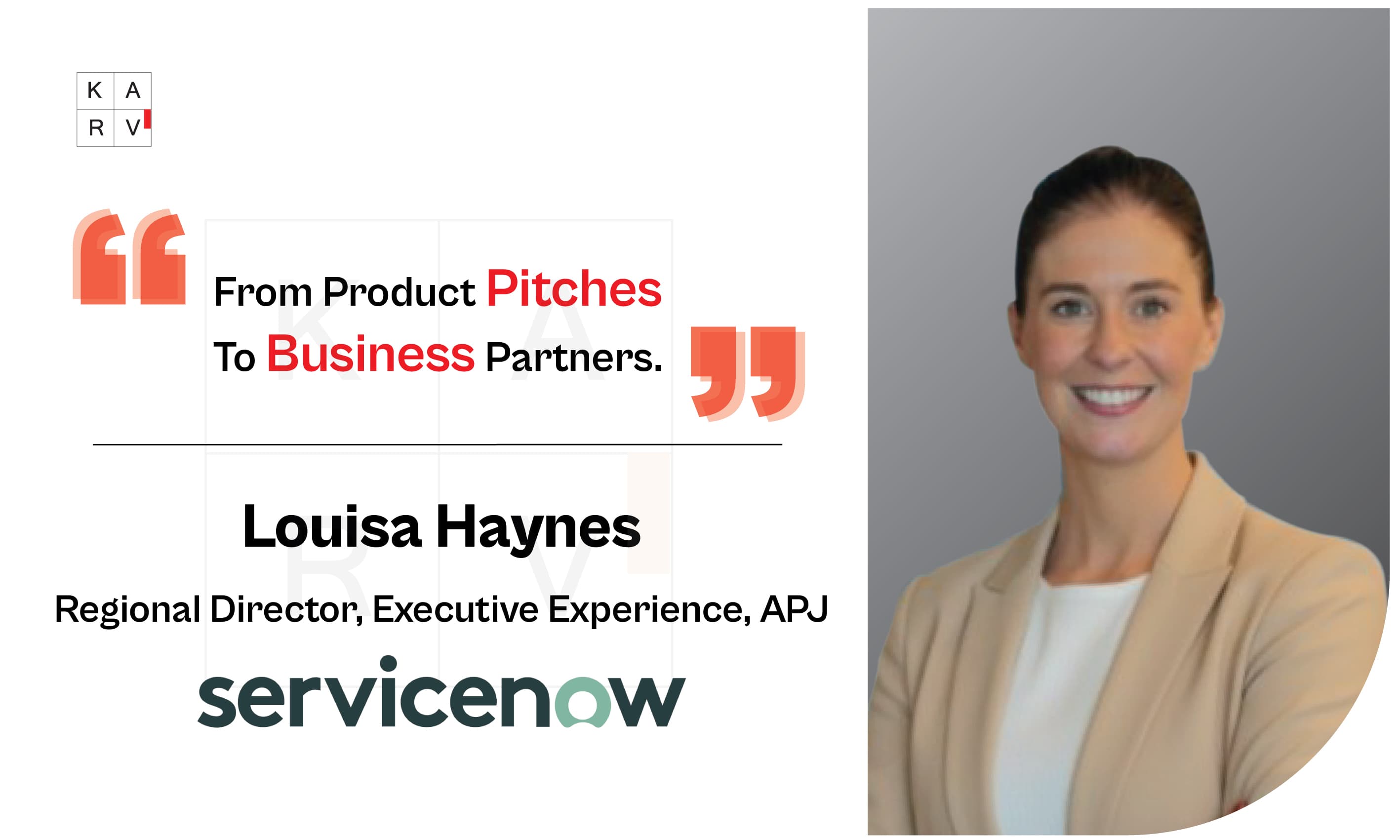
Louisa Haynes on Executive Experience, AI, Human Connection and Customer Relationships
Article content
1. Building Meaningful Executive Relationships
Throughout your career, you've worked closely with enterprise leaders across diverse industries and markets. Looking back, what experiences have most shaped your approach to executive engagement, and what attracted you to leading the Executive Experience Program at ServiceNow?
A:
People want the same two things from a conversation – to feel understood, and to leave with something they didn’t have before.
The executive engagements that didn’t go so well have shaped me the most. One lesson that stuck: Arriving with a seemingly flawless agenda and realising halfway through none of it was landing because I’d studied the company and not the person sitting across from me.
What pulled me the executive briefing program at ServiceNow was the people – genuine, authentic and hungry to drive impact – embodying two things I’m deeply passionate about: real human connection and the results those relationships drive. We're in conversation with CXOs every single day, and authenticity is the whole basis of our success. These are people whose time is fought over and whose trust is hard-won - you don't earn a place in their thinking with a polished pitch, you earn it by being genuinely curious and genuinely honest. Building this program across APAC and Japan has shown me that at scale, in a region where relationships aren't a nice-to-have - they're the most valuable part of any business.
2. Redefining Executive Experience
Executive engagement has evolved far beyond traditional briefings and customer events. How do you define a meaningful executive experience today, and why has it become an increasingly strategic part of enterprise relationships?
A:
For me, a meaningful executive experience is one where the leader leaves thinking differently about a problem they own – not one where they leave impressed by us. That's the shift. The old model measured success by how good the day looked: the venue, the speakers, the production. What actually matters is what changes in their business afterward.
And it comes back to the same thing – authenticity. Executive time is a scarce resource in any enterprise, and how a leader chooses to spend it says everything about what they value. When a CIO or a CEO gives you two hours, they're not there for a demo – they're deciding whether you're someone worth thinking with. That's the same bar I talked about earlier: you don't clear it with a polished agenda, you clear it by being genuinely curious about their world and honest enough to earn a real exchange rather than a polite one.
3. Leadership in an AI-Driven Enterprise
Enterprise leaders today are navigating rapid advances in AI while balancing business transformation, governance, and customer expectations. From your conversations with executives across the region, what leadership priorities are emerging most consistently?
A:
The most consistent thing I hear isn't excitement about AI – it's the tension underneath it. Every leader in the region is being asked to move fast on AI while simultaneously proving it's safe, governed, and actually tied to outcomes. Those two pressures pull in opposite directions, and most of them are navigating it without a playbook.
What's emerging is a real hunger for clarity over hype. Executives are no longer asking “what can AI do” but more importantly “how do I do this responsibly, at scale, and without breaking trust with my board, my regulators, and my people." The other theme is that transformation is now a leadership problem, not a technology problem. The tech is moving faster than the organisations’ ability to absorb it – so the constraint isn't capability, it's change. The leaders who get that are the ones pulling ahead.
4. Creating Experiences That Drive Business Outcomes
The most successful executive engagements often influence long-term partnerships rather than individual transactions. What separates organizations that create memorable executive experiences from those that simply deliver presentations or demonstrations?
A:
The difference is whether you've done the work to understand what the customer is trying to achieve before they arrive. Presenting is just performing; creating something memorable is listening. We talk a lot about facilitation over presentation in our program, and how important it is to build an engagement around the customers objectives, not our own product roadmap. That curation and customisation is what’s memorable.
And the real tell is in the follow-through. A transactional engagement ends when the customer leaves the building. A relationship-driven one is the start of something - there's a reason to talk again next week, a problem you're now solving together, a person on their team who trusts a person on yours. Memorable isn’t spectacle, it’s about relevance and continuity.
5. Human Connection in the Digital Era
As AI, automation, and digital collaboration reshape business interactions, how can organizations preserve authentic human relationships with customers and executive stakeholders while embracing new technologies?
A:
I don't think technology is the threat to human connection – complacency is. It's easy to let automation quietly take over the parts that should have stayed human and then wonder why the relationship feels thin. The organisations that get this right use technology to buy back time for the human moments, not to replace them.
The way I see it, AI should take the friction out of the work so people can spend more time on the things only people can do. Hearing the concern underneath the question someone's actually asking. Sitting with a leader in a hard moment instead of rushing to fix it. Following up on the thing they mentioned in passing, because you were genuinely listening. None of that scales through a tool, and none of it should. My job – and my team's – is to make sure that as we get more sophisticated technologically, we become more intentional about the human side, not less. That connection has always been the differentiator.
6. Bringing Innovation to Life
ServiceNow continues to help organizations accelerate digital transformation through AI and intelligent workflows. How do executive experience programs help leaders move beyond product conversations to better understand long-term business transformation?
A:
Product conversations answer "what does this do." Business transformation conversations answer "where is my organisation going, and how do I take it there”. Executive experience programs exist to move leaders from the first to the second – and that’s why we lead with facilitation, not presentation.
We start with the customer's challenge – the outcome they're accountable for, the transformation they're trying to drive – and let the technology show up as the means, not the message. When a leader sees their own strategy reflected back to them, and then sees how intelligent workflows and AI make that strategy achievable, the conversation stops being about features and starts being about their future. That's the moment a vendor becomes a partner, and our program is built to engineer that moment deliberately.
7. Leading Across APJ
The Asia Pacific and Japan region represents an incredibly diverse business landscape with different cultures, industries, and leadership styles. What have you learned about building executive relationships across such a dynamic region, and how has it influenced your own leadership approach?
A:
The biggest lesson is there is no such thing as a single “APJ” approach. What builds trust in Tokyo is not what builds trust in Sydney, Singapore or Hyderabad. In Japan, relationships are everything – trust is built patiently and must exist before any real business can begin. Across Australia, India and Asia, the energy and directness are completely different. If you lead with a single playbook, you'll be effective in one market and irrelevant in the rest.
What this has taught me is to lead with curiosity – to slow down and genuinely understand the context before I act on it. The instinct in a fast-moving role is to move quickly and apply what's worked before. This region has taught me to do the opposite: to step back, ask more questions, and take the time to understand the culture and the nuance of each market before acting. The answer is almost never the one I'd have reached on instinct. That patience has made me a better leader - and it keeps coming back to my point earlier: the one quality that travels across every one market is authenticity. People everywhere can tell the difference between someone performing interest and someone who genuinely cares.
8. Looking Ahead
As you look toward the next five years, what trends do you believe will redefine executive engagement, enterprise leadership, and customer experience, and what advice would you offer organizations seeking to build stronger relationships with their most strategic customers?
A:
Three things. First, AI is going to reset the baseline for what "personalised" means – executives will expect engagements shaped precisely around their business, and generic will feel insulting.
Second, the line between pre-sale and post-sale relationship blurs completely; the winners will treat executive engagement as a continuous relationship, not a series of moments.
Third – and this is the counterintuitive one – as everything gets more automated, human trust becomes more valuable, not less. Scarcity does that.
In closing, the organisations that will build the strongest relationships with their strategic customers are the ones that stop optimising for the transaction and start treating the relationship as the asset - because it is.
About Louisa Haynes
Louisa Haynes is a senior executive engagement and SaaS marketing professional with a strong focus on creating meaningful experiences for CXO audiences. At ServiceNow, she works across executive programs, customer engagement and strategic experiences that bring leaders, customers and technology together.
With a career spanning marketing, business development and executive engagement, Louisa is passionate about building trusted relationships and creating experiences that drive meaningful business outcomes. She brings a people-first approach to leadership, customer experience and innovation in an increasingly AI-driven world.
About Servicenow
ServiceNow is an AI platform for business transformation, helping organizations connect AI, data and workflows on a single platform. Its technology enables enterprises to automate processes, improve customer and employee experiences, and bring greater efficiency across IT, CRM, security, HR and other business functions. With its focus on putting AI to work across the enterprise, ServiceNow aims to make work simpler, faster and more connected.
Explore Another Exclusive Leader Interview
If this conversation resonated with you, you may also want to explore our exclusive Leader Interview with Pat Breen, Area Vice President for ANZ at Cloudflare.
Pat Breen on AI, Cybersecurity, Digital Trust and the Future of Enterprise Technology
Read the full interview: Pat Breen on AI, Cybersecurity, Digital Trust and the Future of Enterprise Technology