
Leader InterviewsAI Business & Ecosystem
Otso Karvinen on Agentic AI, the Future of Marketing and the Rise of AI-Native Growth Teams
Article content
1. Beyond AI Automation
Agentic AI is moving marketing beyond tools that assist people toward systems that can plan, execute and adapt. What fundamentally changes when AI agents become part of the marketing operating model rather than simply another software tool?
A:
The fundamental difference is autonomy. To get the full benefit of AI agents, you have to give them a certain level of decision-making power. Not on everything. The owner keeps the final say on the big decisions, and in my own operation the final form of anything high impact, an email, an article, a social media post, is approved by me. But the iterative work that happens in between, the agent owns. If you make it ask permission at every step, you've just built a slower tool.
That's what separates an agent from automation, and from the tools most teams have today. A tool waits. You open it, ask it something, take the output and do something with it. The work still moves at the speed of the person holding the tool. An agent has a job, a set of instructions, access to your real systems, and it runs. Some of ours run on a schedule and some run continuously. The difference shows up in a specific place: the work that never got done before starts getting done.
Two examples from my own operation, which runs on Claude Code. Internal linking on a website is textbook good practice, and in my experience hardly any team does it consistently, because it means reading everything you've published and finding the honest connections. That's now an agent that checks the sitemap, reads the content, proposes the links, and I confirm. It runs all the time. Same with paid account hygiene. "Check the settings are still right" used to happen when someone had a free afternoon. Now it happens every day, in every account.
That's the real shift to me. The list stops being a function of how many hours your team has.
The second change is who decides. Once agents execute, the bottleneck moves upstream to judgment. What should we be doing, and is what came out any good. Which was always the valuable part of marketing, and the part I never had enough time for either.
2. The Agency Model Is Being Rewritten
Traditional agencies have largely sold expertise, capacity and hours. As AI agents dramatically increase what a small team can execute, how do you see the economics and value proposition of the agency model changing?
A:
The old model has a problem it doesn't like to say out loud. It bills for time, so it makes money when things take longer.
Look at the monthly report. In my agency years, roughly 80% of the time that went into a client report went into gathering the data and building the deck. About 20% went into actually thinking about what the numbers meant. The client paid agency rates for both halves. They were buying deck assembly at the price of expertise.
That half is gone. The data pull and the deck build are now automatic, and the strategist spends all of that time on the analysis. What to do more of, what to stop. Same invoice, completely different contents.
So, the value proposition has to move. If you sell hours, agentic AI is a threat, because your product is the thing getting cheap. If you sell outcomes, it's the opposite.
We priced Parvi accordingly. Public tiers on the website, from €3,000 a month, and the price is set by how much of the growth engine we run for you. Not by hours or output volume, and not by how big your company is. Volume never changes the price. That's only possible because volume isn't what costs us anything.
I'd add a caution, because I don't think this is a free ride for agencies like mine either. Once execution is cheap, the client can tell very quickly whether there was a brain behind it. The bad work just arrives faster now.
3. The Human Strategist in an Agent-Powered Organisation
Parvi combines a senior Growth Strategist with specialised AI agents rather than removing the human layer altogether. Why is that human strategic role still essential, and where should human judgement stop and AI execution begin?
A:
Because judgment doesn't scale the way execution does, and because someone has to own the outcome.
Our model is one Growth Strategist plus a team of AI agents, and there's a sentence we hold to internally: Parvi's Strategist directs the agents. The customer does not. That's deliberate. Handing a client a set of agents and wishing them luck is just selling them another tool, and they already have too many.
Where the line sits, concretely. Agents own the work that has a right answer and a lot of volume. Keyword research. Technical audits. Search term analysis and negatives. Data pulls. Meeting prep. Follow-up capture. Drafting to a brief. Anything where the standard is knowable and the cost is repetition.
Humans own the work where being wrong is expensive and the answer is contested. What are we actually trying to win. Is this claim true and can we stand behind it. And the final read on quality before anything goes out with a client's name on it.
The interesting middle is the interview. The best content we produce still starts with a human subject-matter expert saying something only they know. The agent can do the research, the structure, the SEO, the distribution. It can't supply the thing your customer can't get anywhere else. That still comes out of somebody's head.
I'll be honest that this line is moving. It's moved twice in the last year, both times in the agents' favour. But it moves by evidence, one capability at a time, not by enthusiasm.
4. From Headcount to Growth Capacity
Many marketing leaders face more opportunities than their teams can realistically execute. How should organisations rethink capacity when AI agents can expand what existing teams are capable of delivering without adding equivalent headcount or agency spend?
A:
Most marketing leaders I talk to have a list. More channels, more content, warmer leads, more sales activity. They know what's on it. It doesn't move, because every item on it used to translate into a hire or another agency invoice.
The reframe I'd offer is this. Stop asking "how many people would this take" and start asking "is this work judgment or is it repetition."
Concrete example. Adding a social channel used to be a staffing decision. Nobody says "let's do TikTok" without someone asking who's going to run it. On my own brand I went from about five posts a week on one or two channels to thirty-plus a week across eight, with the same one person and no new hires. Adding the ninth channel cost effectively nothing. Channel expansion stopped being a hiring question and became a strategy question. Those are very different conversations to have with a CFO.
Two things I'd flag before anyone gets carried away.
First, this adds to your team, it doesn't stand in for it. The enemy is the backlog, not the people you hired. Every client I've worked with has smart marketers doing work far below their level because someone has to.
Second, capacity you can't govern is just exposure. More output means more surface area for something wrong to go out. You need the review layer built at the same time as the throughput, not bolted on after the first incident.
5. What Happens to Marketing Talent?
If AI agents increasingly handle research, content, campaign execution and other operational work, how will the composition of marketing teams change? Which capabilities will become more valuable, and which traditional roles may need to evolve?
A:
I don't think roles disappear so much as the ratio inside them changes.
Take the SEO specialist. The job used to be substantially manual. Clicking through a site, checking the standard things, exporting keyword lists, building the sheet. Our technical SEO work is now around 90% automated, and the agent validates its own findings against real data before it proposes anything. What's left of that job is the 10% that was always the hard part. Deciding what actually matters for this business, and arguing for it internally.
The capabilities that gain value, as I see it. Judgment under ambiguity, meaning you can tell which of six defensible options is the right one here. Taste, the ability to look at output and say "this is fine but it's not good" and explain why. That's rarer than people think, and it's now the main quality gate. Systems thinking, so you can direct the machine instead of operating one station in it. And subject-matter depth, the thing an agent can't invent. Your actual customer knowledge.
What has to evolve is the role whose value was throughput. The person whose contribution was that they could produce twelve of something a week. That says more about what we asked of them than about them, and it was mostly a waste of a marketer.
The uncomfortable part, and I'd rather say it than not: the traditional junior route into this industry was doing the volume work while you learned. That ladder is being pulled up, and I don't have a good answer for it yet. Neither does anyone else I've heard on the subject.
6. From Tools to an AI-Native Growth Stack
Most organizations are accumulating AI tools without fundamentally changing how marketing and sales operate. What does a genuinely AI-native growth organization look like, and what needs to change beyond simply adding more technology?
A:
Buying tools is the easy part, which is exactly why everyone starts there. You get a line item, a login, a training session and largely the same output as before.
The difference in an AI-native organisation is that the agent absorbs the tool complexity instead of the human doing it. Video editing is the example I keep coming back to. The old answer was to buy an editing tool, and now your marketer has one more thing to learn and log into. Our answer is that an agent runs the edits and the captions. No new tool for anyone to learn. That's the test I'd apply to any AI purchase: did it add work to a human's day, or take it away?
What actually has to change, beyond the tech.
Process first. Agents need clean inputs, defined outputs and somewhere to put the result. If your brand guidelines only exist in someone's head, no agent can follow them. Being AI-native forces you to write down how you work, and a lot of the value shows up right there, before anything is automated.
Then access. An agent with no access to your CRM or your analytics is a chatbot. This is usually where it stalls, and it's usually an IT and governance conversation rather than a marketing one. Start it early.
Then marketing and sales together. Almost every real win we've built crosses that line. Signals from marketing become sales prep. Sales calls become content. If those two functions are separate systems with separate owners, you cap what you can build.
And review as a habit, not an afterthought. Someone accountable, looking at output, on a schedule.
7. Building Trust in Autonomous Marketing
The more responsibility organizations give AI agents, the more important questions around brand, accuracy, governance and accountability become. How should growth leaders decide what agents can execute autonomously and where human oversight remains non-negotiable?
A:
I'd decide it on two questions. What does it cost if this is wrong, and can we catch it before anyone outside sees it?
That produces a fairly clear ladder. Reading, research and analysis run autonomously. Internal writes, like a CRM note or a task, run autonomously with a log. Anything that publishes, sends or spends money has a human on it. We tier every external write, and the higher tiers require explicit human approval before they go, with an audit trail underneath.
Three things I'd put in the non-negotiable column no matter how good the agents get.
Anything a customer sees gets a person's name attached to it.
Anything that's a claim. Numbers, results, statements about what your product does. This is where AI gets people into trouble, and it's an accountability problem more than a technical one.
And anything that spends money. Budget changes get a human.
One design point that's done more for our own trust than any policy: build the checking into the agent. Our technical SEO agent tests its own conclusions against real data before it puts them in front of me. That answers the "it makes things up" objection inside the work rather than in a governance meeting afterwards.
And keep the review load survivable. We run eight channels and the comment triage arrives as one list, once a day. A governance process nobody can actually keep up with is a governance process that gets skipped, which is worse than not having one.
8. The Marketing Organization of 2030
Looking three to five years ahead, how do you expect the relationship between people, AI agents, agencies and marketing technology to evolve? Will the winning growth teams be larger, smaller, or simply structured very differently?
A:
My honest position is that anyone giving you a confident five-year answer here is guessing. So, take this as a direction of travel rather than a forecast.
Smaller teams doing considerably more. The teams don't shrink through cuts. They stop needing to grow linearly with their ambition, and the growth that does happen goes into judgment instead of throughput.
The shape I'd expect is a senior core who set direction and own quality, with a lot of agent execution underneath them. And a very short distance between deciding something and it being live. That last part is underrated. In my experience the slow part is rarely the doing. It's the queue in front of the doing.
Agencies split into two groups. The ones selling access to expertise and outcomes will do well, because clients still need someone who has seen this before. The ones selling hours will have a hard decade, and quite a lot of them will keep selling hours until it's too late, because that's what usually happens.
For marketing technology, I'd expect pressure on any product whose value was a nice interface over a task an agent can now do directly. The products that own the data will hold up better than the ones that just own the interface.
The one thing I'd bet on more firmly than any of the above: the gap between organisations that made this shift and organisations that bought tools and called it a shift will be enormous, and it will show well before 2030. Honestly, it's already starting to.
About Otso Karvinen
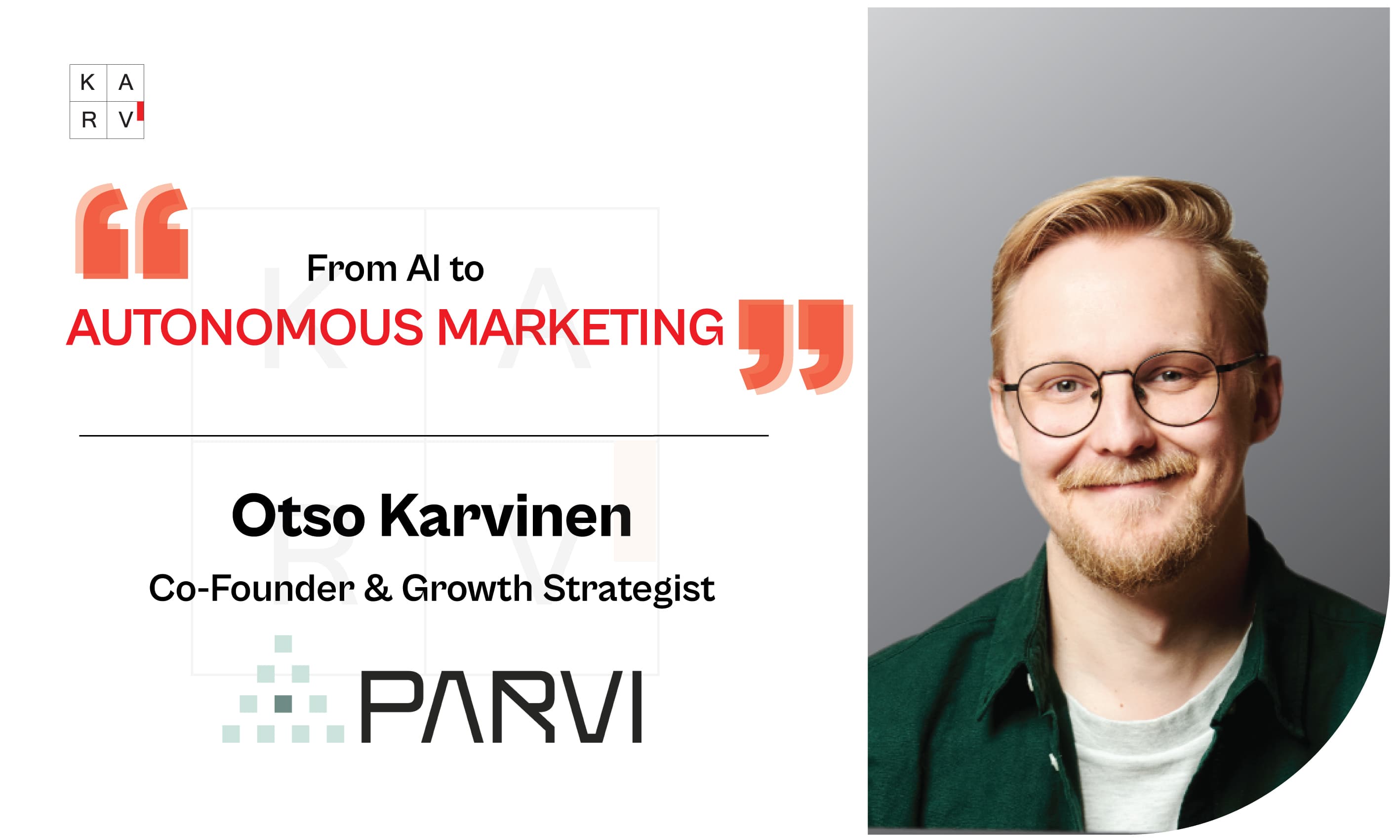
Otso Karvinen is Co-founder and CEO of Parvi & Co, an agentic AI agency for marketing and sales. He spent 15+ years in B2B marketing and sales across paid, SEO, analytics and demand generation before moving from directing tools to building agent systems himself.
Parvi pairs an embedded Growth Strategist with a team of specialised AI agents, enabling marketing and sales teams to increase execution capacity without scaling headcount at the same rate. Otso builds in public from Helsinki.
About Parvi & Co
Parvi & Co is an agentic AI agency for marketing and sales, built for teams whose ambitions outrun their capacity.
Every growth leader has a list of work that never gets done. More channels, more content, warmer leads, more sales activity. Every item on it used to mean more people or another agency invoice.
Parvi partners with the client and embeds a Growth Strategist, plus a team of specialised AI agents, into the company. The Strategist is the single human point of contact, a senior expert who knows the business and directs the agents on the client's behalf. The agents handle the volume work across search, content and social, personal brand, paid, sales support and measurement. The client gets more done in a month than their competitors do in a quarter, on the budget they already have.
Pricing is public and month to month, from €3,000. A Growth Strategist owns the quality of everything that goes out. The client's data stays theirs.
Founded in Finland, launched August 2026. parvi.ai
Strategist-led. Agent-powered.
Explore Another Exclusive Leader Interview
If this conversation on agentic AI, AI-native marketing, marketing automation, human judgment and the future of growth teams resonated with you, you may also want to explore our exclusive Leader Interview with Katie Walker, Director, Global Marketing at Tive.
Katie shares her perspective on B2B marketing, supply chain visibility, AI, IoT, automation, customer insights and building marketing teams around measurable business value.
Read the full interview: Katie Walker, Director, Global Marketing at Tive