
Leader InterviewsAdvertising & Performance Marketing
Priti Ohri on AI, Advertising, Brand Trust, and Building the Future of Adaptive Marketing
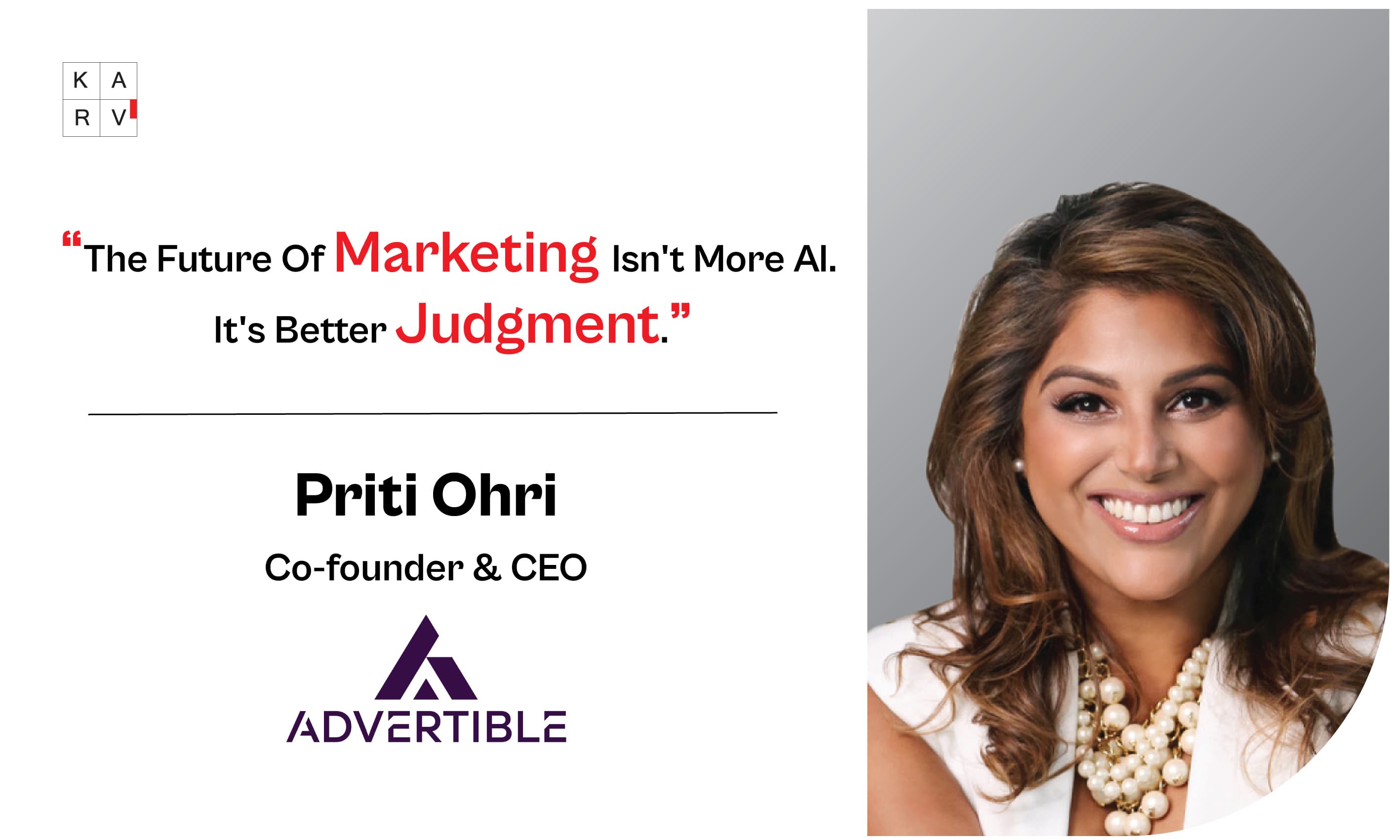
Article content
1. Building a Company Around Innovation
As the CEO and Co-Founder of Advertible, you've been at the forefront of helping brands navigate an increasingly digital and data-driven world. Looking back on your entrepreneurial journey, what experiences have most shaped your perspective on innovation, leadership, and building a company that creates meaningful value for customers?
A:
Innovation is often portrayed as having one brilliant idea. My experience has been almost the opposite. It's about spending enough time close to a problem that you begin to understand why everyone has accepted it as "just the way things are."
Before starting Advertible, I spent nearly two decades working across different parts of the advertising ecosystem. I saw incredibly smart companies forced to compromise because technology had evolved in silos. Creative, supply, demand, measurement, identity. Everyone was optimizing their own piece, but the overall experience became more fragmented.
Advertible was built from the belief that complexity shouldn't be accepted as a permanent feature of digital advertising.
As a leader, I've learned that innovation rarely happens in isolation. It happens in partnership. The hardest challenges our customers and partners face are the ones worth building around. When their problems sit at the heart of what we're solving, and we're doing it to genuinely make them more successful, we all succeed. Some of our best ideas have come from those conversations.
Ultimately, customers don't care how innovative your technology is. They care whether you've made their business meaningfully better. That's the standard we hold ourselves to every day.
2. Why Advertible, Why Now?
Advertising and marketing are undergoing one of the biggest transformations in decades, driven by artificial intelligence, changing consumer behavior, and evolving privacy expectations. What inspired you to build Advertible, and what market opportunity convinced you this was the right time to bring the company to life?
A:
The advertising industry is approaching another major inflection point.
For years, the industry optimized around identifiers, audience targeting, and increasingly specialized technology. Today we're entering a world where AI can understand content, context, creative assets, and consumer intent in ways that weren't previously possible.
At the same time, publishers are under enormous pressure to diversify revenue without compromising the user experience, and advertisers want greater reach without building new assets for every environment. The challenge underneath both is proliferation. There are more environments than ever, and each one demands its own variation of the creative. Scale has become the enemy of beauty.
Instead, we believe creative should intelligently adapt to the environment in which it's being served.
That philosophy became the foundation for Advertible. Rather than asking publishers, advertisers, and DSPs to fundamentally change how they operate, we focused on removing friction between them.
Sometimes the biggest innovations aren't about creating something entirely new. They're about allowing existing systems to work together far more effectively.
3. The Evolution of Modern Advertising
What do you see as the most significant shifts shaping modern advertising, and how should organizations rethink their approach to engaging today's customers?
A:
The biggest shift isn't AI.
It's adaptability.
Consumers move seamlessly between websites, apps, streaming television, gaming, commerce, AI assistants, and experiences we haven't even imagined yet. Marketing organizations can no longer afford to think in terms of channels. They need to think in terms of experiences.
That requires technology that's far more dynamic than the systems many organizations built over the last decade.
I also believe we're moving away from the era of optimizing individual impressions toward optimizing relationships. Success won't come from serving more ads. It will come from delivering experiences that feel relevant without feeling intrusive.
The companies that win won't necessarily have the most data. They'll be the ones that can respond intelligently to changing environments while preserving consumer trust.
4. AI and the Next Generation of Customer Engagement
Artificial intelligence is changing how brands create campaigns, understand audiences, and deliver personalized experiences. Where do you believe AI is creating the greatest opportunities for marketers, and how can organizations embrace AI while maintaining authenticity, creativity, and customer trust?
A:
AI is dramatically lowering the cost of execution.
That's exciting, but I don't think execution is where the greatest opportunity lies.
The real opportunity is helping marketers spend less time on operational complexity and more time making better strategic decisions.
AI can analyze performance, identify patterns, and automate workflows. That's incredibly valuable.
But authenticity still comes from people.
Consumers don't build relationships with algorithms. They build relationships with brands that understand them.
The organizations that succeed will use AI to amplify human creativity, not replace it. They'll automate repetitive work while preserving the empathy, judgment, and imagination that make great marketing memorable.
Trust becomes even more important in an AI-first world.
Consumers should never feel manipulated. AI should make experiences more useful and more relevant, not simply more efficient.
5. Turning Marketing Intelligence into Business Growth
Organizations today have access to more customer data than ever before, yet many struggle to convert insights into measurable business outcomes. From your perspective, what separates organizations that consistently translate marketing intelligence into sustainable growth from those that simply collect data?
A:
Many organizations have confused collecting data with creating intelligence.
They're not the same thing.
The companies seeing the greatest growth begin with clear business questions rather than dashboards. They ask, "What decision are we trying to make?" before asking, "What data do we have?"
Another differentiator is organizational alignment.
Marketing, product, sales, and customer success increasingly rely on the same customer understanding. When those teams operate from different versions of the truth, even the best analytics become difficult to act on.
Finally, speed matters.
Markets change quickly. Organizations that can move from insight to action faster than competitors, especially at today's pace of change, will outperform organizations with significantly larger datasets.
6. Building Brands in an AI-First World
Consumers interact with brands across an expanding ecosystem of digital channels, AI assistants, social platforms, and connected experiences. What principles do you believe remain timeless when building trusted brands, and how should marketing leaders adapt as customer expectations continue to evolve?
A:
Technology changes.
Human psychology doesn't.
People still reward honesty. They still value consistency. They still remember brands that solve real problems.
Those fundamentals aren't disappearing because AI exists.
What is changing is the number of places where brands show up. Customers increasingly encounter brands through recommendation engines, AI assistants, creator communities, connected devices, and countless digital touchpoints.
That means every interaction contributes to brand perception.
Marketing leaders need to think beyond campaigns and start thinking about systems. Every experience should reinforce the same promise, regardless of where or how a customer encounters the brand.
Consistency becomes even more valuable when channels become infinitely more dynamic.
7. Leadership, Innovation, and Building High-Performing Teams
As both a founder and business leader, you've experienced the challenges of building teams while navigating rapid technological change. What leadership lessons have had the greatest impact on your journey, and what qualities do you believe define successful organizations in today's AI-driven business environment?
A:
The lesson that matters most to me is that culture starts with values. Not perks, not process. What a company truly values shows up in how it treats people, and it shows up everywhere. In how we show up for ourselves. For our team. For our customers. Get that right, and most other things follow.
We're a small team, which means there's nowhere to hide. The way we treat each other is the way we treat our customers. Same standards. Same honesty. Same care.
We live by a figure-it-out mentality. We'd rather stay curious and find the answer than pretend we already have it. In a market moving this fast, curiosity is the more durable skill.
I believe AI is one of the great unlocks for small teams. Paired with deliberateness and curiosity, it becomes a genuine superpower. It lets a small group do work that used to require a much larger organization. It doesn't replace judgment. It rewards the people who bring it.
The organizations that lead in this next era won't be the ones with the most resources. They'll be the ones with the clearest values and the deepest curiosity, and they'll turn that curiosity into momentum faster than anyone else.
8. Looking Ahead: The Future of Marketing and Business Growth
As AI continues to reshape advertising, customer engagement, and business strategy, what trends do you believe will define the next generation of marketing, and what advice would you offer to business leaders preparing for this next era of transformation?
A:
I think we're moving toward an era where advertising becomes substantially more adaptive.
Creative will increasingly assemble itself based on context. Media buying will become more autonomous. Measurement will become more predictive than retrospective.
But I also believe the competitive advantage will shift away from simply having access to AI.
Everyone will have AI.
The differentiator will be judgment.
Which problems should AI solve?
Where should humans remain involved?
How do we maintain transparency and trust while delivering increasingly personalized experiences?
Those are leadership questions, not technology questions.
My advice to business leaders is to avoid treating AI as another software implementation.
Instead, ask how AI changes the way your organization creates value for customers. Start there, experiment thoughtfully, and build capabilities that make your people stronger rather than simply making processes faster.
If I had to leave leaders with one idea, it is this. Advertising has spent years trying to fit people into technology. We believe technology should adapt to people instead.
About Priti Ohri
Priti Ohri is Co-founder & CEO of Advertible, the technology company solving advertising's biggest creative challenges at scale. Named the 2025 AdExchanger Awards "Best Industry Startup," Advertible is the product of two decades of operator-side experience and a conviction that creative has always been the most underserved part of the ad stack.
Today, Priti sits at the frontier of what comes next, serving as a cabinet member of agenticadvertising.org, the non-profit defining the future of advertising. She is equally committed to who gets a seat at that table, co-founding DesiUs to amplify South Asian voices in adtech, and earning recognition from AdExchanger's Top Women in Media & Ad Tech, Campaign US's 40 Over 40 and Inspiring Women Awards, as well as the MMA's Smarties Impact Awards.
Priti holds an International MBA from SDA Bocconi in Milan and lives in New York.
About Advertible
Advertible believes advertising should meet people where they are, not the other way around.
The company builds the infrastructure that makes that possible. Every environment is different, and most creatives break when they have to stretch across all of them. Advertible solves that variability in real time, shaping each ad to fit its moment and its surroundings as it's delivered, at any scale, with quality and verification built in. Designed to work fluidly across programmatic and agentic media, Advertible simplifies the complex and brings beauty back to advertising.
Explore Another Exclusive Leader Interview
If you enjoyed this conversation on AI, advertising, customer engagement, and the future of adaptive marketing, you may also like our exclusive Leader Interview with Steven Sidawi, Senior Vice President - Media Delivery, MENA at WPP Media.
Steven shares his perspective on AI-powered media operations, intelligent enterprises, operational excellence, and why organisations that continuously adapt—not just digitally transform once—will define the next generation of business transformation.
Read the full interview: Steven Sidawi on AI-Powered Media Delivery, Intelligent Enterprises, and the Future of Business Transformation