
Leader InterviewsMarTech Platforms & Strategy
Karisa Schroeder on AI, Marketing Intelligence, Creative Intelligence, Product Marketing, and Why Human Judgment Still Matters
Article content
1. From Product Marketing to Market Intelligence
Your career spans product marketing, AI-powered insights, and go-to-market strategy across the advertising technology ecosystem. Looking back, what experiences have most shaped your perspective on product marketing, innovation, and helping organizations make smarter business decisions?
A:
After 15 years in marketing and nearly a decade in product marketing and go-to-market strategy, one theme has shaped my career: connecting data, technology, and human behaviour.
Before I was a product marketer, I was a data researcher, and that fundamentally changed how I think about business. For many marketers, data is how you measure success after the fact. For me, it's where strategy begins.
I started my career in spatial analytics, where I learned that data only creates value when it's connected to context. That lesson followed me into advertising intelligence, where I discovered something even more powerful: advertising isn't just creative or media. It's business strategy made visible.
That's why I often say advertising is the heartbeat of culture. It reflects what brands believe, where they're investing, how they differentiate themselves, and what consumers respond to. Throughout my career, I've had the opportunity to evolve established products, bring AI-native solutions to market, and help define entirely new categories. What connects all of that work is a simple goal: helping decision-makers uncover the insights others miss and turn disconnected data into meaningful business intelligence.
2. Marketing Intelligence in the AI Era
Organizations today have access to more market and competitive data than ever before. From your perspective, how is AI changing the way marketing teams transform data into actionable intelligence and competitive advantage?
A:
AI is making intelligence faster, but it isn't automatically making it better.
That's an important distinction, especially during this stage of AI adoption. Every company seems to be introducing an agentic solution or MCP, but before you can evaluate AI, you have to evaluate the data it’s being fed. The quality of the intelligence will always be limited by the quality of what's fueling it.
The phrase "AI slop" caught on for a reason. Too many organizations are relying on the same models trained on the same public information, producing increasingly similar outputs. As AI becomes more accessible, proprietary data and original thinking become even more valuable.
That's where marketing intelligence is evolving. Our customers are already overwhelmed by all of the information AI brings. They need a trusted filter that surfaces what's credible, differentiated, and actionable.
What drove me to work for MediaRadar is our rich collection of advertising spend and creative intelligence across more than 30 media channels. When you pair proprietary data with AI, you move beyond automation and into building genuine competitive advantage.
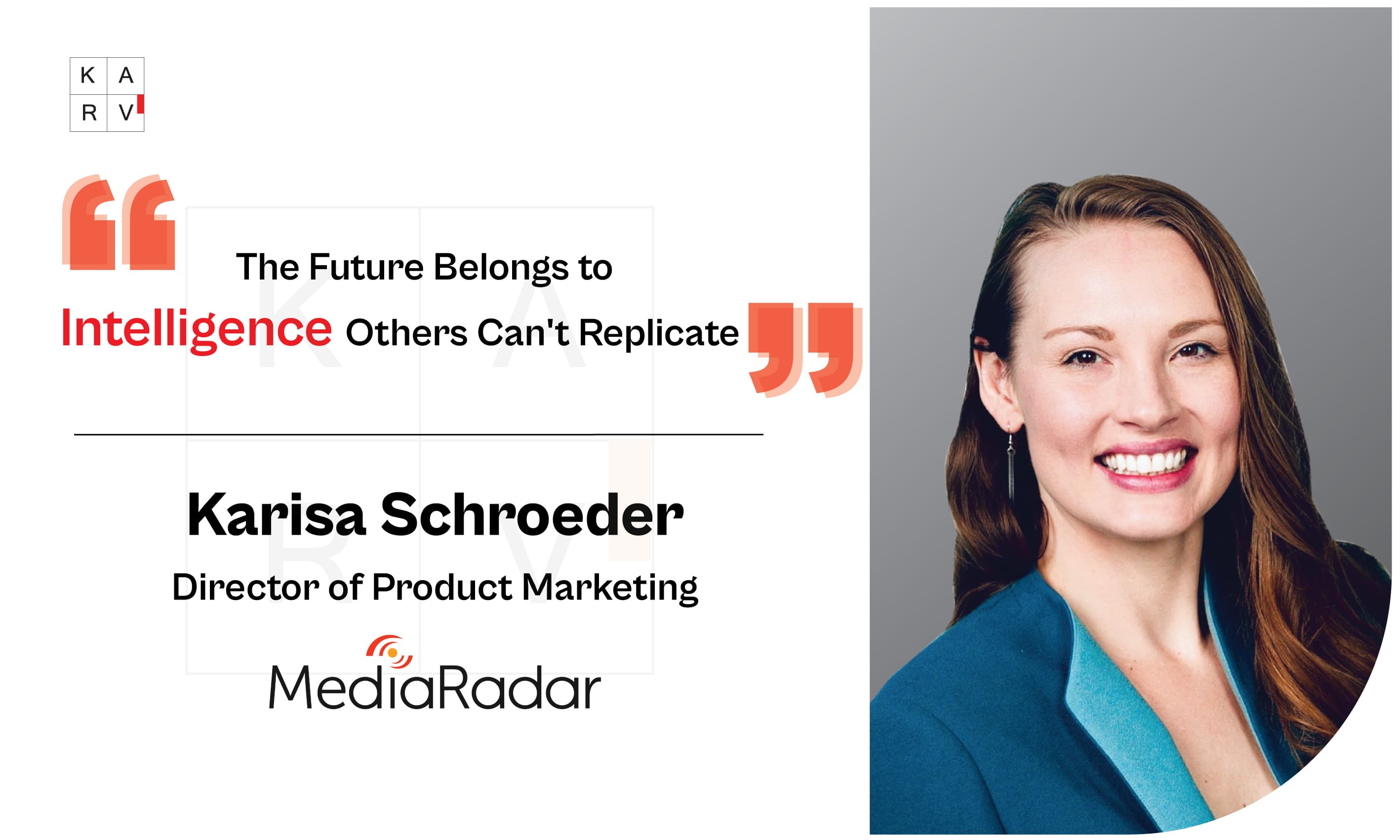
The future doesn't belong to the company with the most or fastest AI. It belongs to the company with intelligence others can't replicate.
3. Helping Marketers Navigate a Complex Media Landscape
MediaRadar helps brands, agencies, and publishers make smarter decisions with advertising intelligence. From your perspective, what challenges are marketing teams facing today, and how is MediaRadar helping organizations navigate an increasingly fragmented and competitive media landscape?
A:
Everything is everywhere, and that's both the opportunity and the challenge.
Consumers don't think in channels anymore, so marketers can't either. Yet most organizations are forced to stitch together data from vendors using different taxonomies, definitions, and measurement methodologies that weren't designed to work together. The result is a fragmented view of the market. As companies automate more decisions with AI, those inconsistencies don't disappear. They become embedded in the models and reinforce assumptions that may go unquestioned.
That's one of the reasons I believe so strongly in MediaRadar's Video Everywhere approach. Instead of looking at television, streaming, social media, and digital as separate ecosystems, we normalize advertising intelligence into a unified view that reflects how people actually experience media.
Live sports are a perfect example. The 2026 FIFA World Cup wasn't a single advertising environment. The same match could air simultaneously on FOX, FS1, FOX One, Telemundo, Universo, and Peacock, but each platform represented a different audience, viewing experience, commercial inventory, and creative opportunity.
Our analysis identified $1.42 billion in advertising investment from 6,737 brands, but simply ranking brands by spend wasn't the interesting part. The bigger question was how brands built a cohesive presence across the tournament by combining media investment with sponsorship activation, in-venue signage visible on broadcast, virtual signage, and team, athlete, and equipment branding.
That realization led my team and me to develop the Total Event Investment™ framework. Rather than measuring advertising in isolation, it evaluates the complete brand ecosystem surrounding an event, connecting media investment, sponsorship, creative strategy, and branded visibility into a single view of competitive presence.
It shifts the conversation from Who spent the most? to Who owned the moment?
4. Product Marketing Beyond Product Launches
Product marketing today extends far beyond launches and messaging. How has the role evolved, and what separates high-performing product marketing teams from those that struggle to connect product innovation with real customer value?
A:
Product marketing has evolved from a marketing function into a business strategy function.
When I started my career, product marketing was often viewed as the team responsible for launches, messaging, and sales enablement. Those responsibilities still matter, but they're no longer enough. The best product marketers influence what gets built long before a product reaches the market.
I've always believed product marketing sits at the intersection of customer needs, market opportunity, product strategy, and commercial execution. It's one of the few functions that has visibility across the entire business. That perspective comes with a responsibility to ask bigger questions. Are we solving the right problem? Is the timing right? Can we credibly win in this market? If the answer is no, no amount of messaging will fix it.
The highest-performing product marketing teams don't just tell the story. They shape it. They bring the voice of the market into product development, identify whitespace opportunities, validate positioning with evidence, and align the organization around a common vision.
I've also come to believe that one of product marketing's most important responsibilities is helping companies see opportunities they didn't know existed. Some of the work I'm most proud of hasn't been launching products. It's been helping define new categories and giving customers a new way to think about their business.
That's when product marketing creates its greatest value, not by explaining innovation, but by helping the market evolve at the pace of innovation.
5. The Future of Advertising & Creative Intelligence
Creative has become one of the most valuable competitive signals for marketers. How do you see AI, creative intelligence, and competitive intelligence reshaping advertising and customer engagement over the next few years?
A:
Creative has always been one of the purest forms of human expression. AI doesn't replace that. It changes how we understand it.
For decades, creative was treated as something subjective. Today, it's becoming measurable. Every ad reveals something about a brand's identity: the emotions it wants to evoke, the audience it's pursuing, the values it represents, and how it chooses to compete. When you analyse creative at scale, you begin to see patterns that reveal not just what brands are saying, but how entire categories are evolving.
That's where creative intelligence becomes incredibly powerful. By analyzing creative across channels, we can identify shifts in messaging, visual themes, brand positioning, and competitive strategy. Creative is no longer just an output of marketing. It's one of the richest sources of competitive intelligence we have.
At the same time, I think we're seeing the pendulum swing when it comes to creating the work itself. When generative AI first emerged, there was tremendous excitement around producing images, videos, and campaigns in seconds. Today, audiences are becoming more discerning, and work that feels overly AI-generated is often viewed as generic, disconnected, or lacking originality.
That's an important reminder for brands and agencies. AI can absolutely accelerate production and help teams do more with limited resources, but efficiency alone doesn't create connection. The brands that stand out will be the ones that use AI to enhance the creative process while preserving the distinct human qualities that make ideas memorable.
As AI makes content easier to produce, authentic creativity becomes more valuable, not less.
6. Building High-Performing Marketing Organizations
As technology continues to reshape marketing, what leadership principles have helped you build successful go-to-market initiatives, and what skills do you believe will define the next generation of product marketing professionals?
A:
Technology is changing too quickly for marketing organizations to wait for perfect answers. The teams that win are the ones willing to take action, embrace calculated risk, and have the judgment to know when to pivot and when to double down.
One of the leadership principles I've embraced is creating an environment where people have the autonomy to experiment. We have a phrase on my team: GEMO, which stands for "Good Enough, Move On." It doesn't mean lowering the bar. It means recognizing when an idea is ready to test instead of endlessly debating or polishing.
We're constantly trying new ideas, creating new experiences, and optimizing based on what we learn. I frame go-to-market much like a scientific experiment: every initiative begins with a hypothesis. Some validate what we believed. Others challenge our assumptions. Both outcomes make us better because they help us make smarter decisions faster.
That mindset also creates accountability. Autonomy only works when people have the confidence to make decisions, the curiosity to measure outcomes, and the humility to change course when the data tells a different story.
I think those qualities will define the next generation of product marketers. Technical skills will continue to evolve, but curiosity, adaptability, sound judgment, and the courage to act will separate average marketers from great ones. It isn't enough to create a strong idea. Product marketers have to earn buy-in, influence decisions, and help people see a possibility that has never existed before.
7. Looking Ahead: The Future of AI, Marketing & Business Growth
If you could leave today's marketing and business leaders with one piece of advice as AI transforms marketing, advertising, and customer engagement, what would it be?
A:
Don't mistake acceleration for transformation.
AI will make every organization faster. It will help us analyze more data, create more content, automate workflows, and make decisions at extraordinary speed. But faster doesn't automatically mean better.
The companies that lead won't be the ones with the most AI. They'll be the ones with the best data, the clearest strategy, and the courage to think differently. AI can surface patterns, but it can't replace judgment. It can generate ideas, but it can't define purpose.
My advice is simple: use AI to amplify human potential, not replace it. The future belongs to organizations that combine the speed of technology with the imagination, judgment, and creativity that only people can bring.
About Karisa Schroeder
Karisa Schroeder is a marketing and go-to-market leader working at the intersection of technology, data, and advertising. With more than a decade of experience spanning product marketing, market strategy, location intelligence, and advertising technology, she has built a career around turning complex data and emerging technologies into clear, actionable business value.
At MediaRadar, Karisa focuses on bringing data-driven solutions to market and helping businesses navigate an increasingly intelligence-led advertising landscape. Her work sits at the intersection of product, marketing, and strategy, giving her a perspective on how AI, data, and changing consumer behaviour are reshaping the way brands and businesses make decisions.
In her leadership journey, Karisa has consistently focused on one central challenge: making sophisticated technology meaningful to the people and businesses using it.
About MediaRadar
MediaRadar equips marketing, sales and analytics leaders with the intelligence they need to stay ahead. Our platform delivers always-on, AI-enabled Creative, Competitive, Commercial and Market Intelligence, spanning ad strategy, media spend, creative assets and brand messaging across 30+ media channels and five million brands.
With deep insights into more than 35 million ad and campaign assets and $280 billion in media spend, MediaRadar provides a single, interoperable source of truth that plugs seamlessly into enterprise analytics and AI systems. The result: faster, cleaner and more actionable intelligence that drives competitive advantage. (Contact: press@mediaradar.com)
Explore Another Exclusive Leader Interview
If this conversation on AI-powered marketing intelligence, advertising strategy, creative intelligence, and the changing role of product marketing resonated with you, you may also want to explore our exclusive Leader Interview with Dominic Del Giudice, Managing Director, Australia and New Zealand at Iron Mountain.
Dominic explores a different side of the AI transformation, sharing his perspective on trusted information, enterprise readiness, data governance, organisational change, and why the quality of information will increasingly determine how effectively businesses can put AI to work.
Read the full interview: Dominic Del Giudice, Managing Director, Australia and New Zealand at Iron Mountain