
Leader InterviewsAI Business & Ecosystem
Dominic Del Giudice on AI, Trusted Data, Enterprise Transformation, and Leading Through Change
Article content
1. Leading Through Transformation
You've recently joined Iron Mountain after leading commercial growth and transformation across global organisations. Looking back, what experiences have most shaped your leadership philosophy, and what excites you most about this next chapter?
A:
I’ve spent the past 25 years working across consulting, technology, and outsourcing services, and across that time I’ve had the opportunity to lead businesses and teams through some significant periods of growth and transformation.
Probably the biggest lesson I’ve taken from those experiences is that transformation is ultimately about people and outcomes, not technology alone. Technology can be a powerful enabler, but you still need people who understand where you’re going, believe in what you’re trying to achieve and feel empowered to make decisions.
I think that has shaped my leadership style. I believe strongly in being clear about the direction, creating accountability and then trusting good people to execute. I also think leaders need to stay close to their customers and their teams. You learn a lot more by listening to the people doing the work.
I was attracted to Iron Mountain’s combination of an incredibly trusted brand and a business that is itself evolving. Since coming into the role, I’ve been struck by the breadth of what we can do for our clients and the opportunity we have to help them manage the convergence of physical and digital information.
With AI accelerating that change, I think we’re at a particularly interesting point in the market. Information and trusted data are becoming more strategically important, not less, and that creates a tremendous opportunity for our clients and for Iron Mountain.
2. Information as a Strategic Asset
As AI accelerates, organizations are recognizing information as a competitive asset. What must leaders do differently to unlock its full business value while maintaining governance and trust?
A:
Historically, a lot of the conversation was about storing it, protecting it and meeting regulatory requirements. Those things remain critically important, but AI is fundamentally changing the value equation.
Information and trusted data are now enterprise assets that can drive better decisions, improve customer experiences, automate processes and create entirely new sources of value.
But you can’t simply put AI on top of fragmented or poorly governed information and expect a good outcome. Organisations need to understand what information they have, where it resides, who can access it, how it is governed and whether it can be trusted.
When I talk to clients, I think some of the most important questions are actually quite fundamental: What information do you have? Where is it? Who has access to it? Can you trust it? And importantly, how much valuable information is sitting inside the organisation that you simply can’t access or use effectively today?
That’s why I believe information management, governance and AI strategy increasingly need to become part of the same conversation.
3. AI, Data & Enterprise Readiness
Many organizations are investing in AI, but far fewer are truly AI-ready. What separates businesses building lasting AI capabilities from those simply adopting new technology?
A:
I’ve spent a large part of my career around major technology transformations, and one pattern tends to repeat itself; buying technology is usually the easy part. Changing the organization around it is much harder.
I think we’re seeing exactly that with AI.
There’s a big difference between experimenting with AI and becoming an AI-enabled enterprise. The organizations making the most meaningful progress aren’t starting with the technology. They’re starting with the business problem.
They’re asking where AI can materially improve productivity, customer experience, revenue, risk management or decision-making, and then working backwards from that outcome.
They’re also putting the foundations in place; trusted information, governance, security, skills and the right operating model.
Personally, I think we’re moving into a much more interesting phase of AI now. The experimentation has been important, but increasingly boards and executive teams will want to know: What value are we actually creating?
That shift from experimentation to measurable value and enterprise-scale adoption will separate the organizations that are genuinely AI-ready from those simply deploying another generation of technology.
4. Customer Trust in the Digital Economy
Innovation is moving faster than ever, but so are expectations around trust and security. How can organisations balance AI adoption with responsible data governance and customer confidence?
A:
I’ve never viewed innovation and governance as opposing forces. In my experience, good governance actually gives organisations the confidence to move faster.
That becomes even more important with AI.
Customers rightly expect organisations to understand where their information is, how it’s being used and how it’s protected. AI increases both the opportunity and the responsibility that comes with managing that information.
For me, trust has to be designed into the way organisations adopt AI from the beginning. It can’t be something that gets added at the end as a compliance exercise.
That means clear accountability, strong information governance, appropriate security controls and transparency about how information and AI are being used.
Iron Mountain has spent decades being trusted by organisations with their most important information. What I find particularly exciting is the opportunity to take that foundation of trust into a world where information is increasingly digital, distributed and being used to power AI.
Trust takes years to build and moments to lose. I think the organisations that understand that will ultimately be able to innovate faster, because their customers and their people will have greater confidence in what they’re doing.
5. Leading Businesses Through Change
Technology may enable transformation, but people make it happen. What leadership principles have helped you successfully lead organisations through complex change?
A:
For me, successful change starts with clarity.
I’ve led teams across different organisations, markets and cultures, and my view is people generally want the same things during periods of change. They want to understand where the organisation is going, why the change is necessary and what their role is in making it successful.
The second principle is empowerment. I believe in setting a clear direction and establishing accountability, but then giving capable people the space and authority to execute. If every decision has to travel back up the organisation, you don’t really have an empowered organisation.
Communication is the other big one. During significant change, I don’t think you can communicate too much. And that communication needs to be authentic. Sometimes as a leader you don’t have every answer, and I think it’s perfectly reasonable to say that while remaining clear about the direction you’re taking.
I’ve also always believed leadership needs to be visible. You can’t lead transformation exclusively through presentations, emails and organisational structures. You have to spend time with your people, your customers and the teams actually doing the work.
That’s something I’ve tried to practise throughout my career and something that remains very important to me in leading Iron Mountain across Australia and New Zealand.
6. The Future of Intelligent Enterprises
Looking ahead, which technology and business trends will have the greatest impact on enterprise organisations over the next five years, and how should leaders prepare today?
A:
AI will clearly be one of the defining forces, but I think the more interesting question is what AI ultimately does to the operating model of the enterprise.
Over the coming years, I expect AI to become much less visible as a standalone technology because it will increasingly be embedded into workflows, customer interactions and everyday decision-making.
I have spent a lot of time around enterprise transformation, and find it fascinating, because it has implications far beyond the technology function.
It changes how organisations think about information, skills, cybersecurity, infrastructure, customer experience and even how work itself gets designed.
It also creates an enormous opportunity around information that organisations already possess. Most large enterprises have decades of physical and digital information, much of which has historically been difficult to access or use at scale. AI potentially changes that.
At the same time, there’s a physical dimension to this transformation that can sometimes get overlooked. AI requires significant technology infrastructure, and that creates questions around data centres, hardware, sustainability and how organisations manage technology assets throughout their lifecycle.
So rather than simply asking, “What’s our AI strategy?”, I think leadership teams should be asking a much bigger question: “How does AI change the way our business operates and competes?”
7. Building High-Performing Organisations
As AI reshapes the workplace, how do you build teams that remain innovative, adaptable, and focused on delivering long-term business value?
A:
Building and leading teams has always been one of the parts of leadership I enjoy most.
I want people to be curious, accountable and comfortable challenging the status quo. Particularly in an environment changing as quickly as this one, you don’t want an organisation where every idea or decision has to come from the top.
AI will clearly change roles and the way work gets done, but I actually think that makes human capabilities more important. Judgement, creativity, leadership, empathy and the ability to build trusted relationships with customers become incredibly valuable.
The opportunity I see is to use AI to remove some of the repetitive, lower-value activity from people’s working lives and create more capacity for the things humans do particularly well, like solving difficult problems, making decisions, innovating and building relationships.
There’s also a responsibility on leaders. We can’t simply tell people that AI is changing their jobs. We need to invest in helping them understand the technology, develop new skills and see how they can be successful in that environment.
For me, the objective isn’t simply to build a more efficient organisation. It’s to build a more capable organisation.
8. Looking Ahead
If you could leave today's business leaders with one piece of advice on leading through the AI era, what would it be?
A:
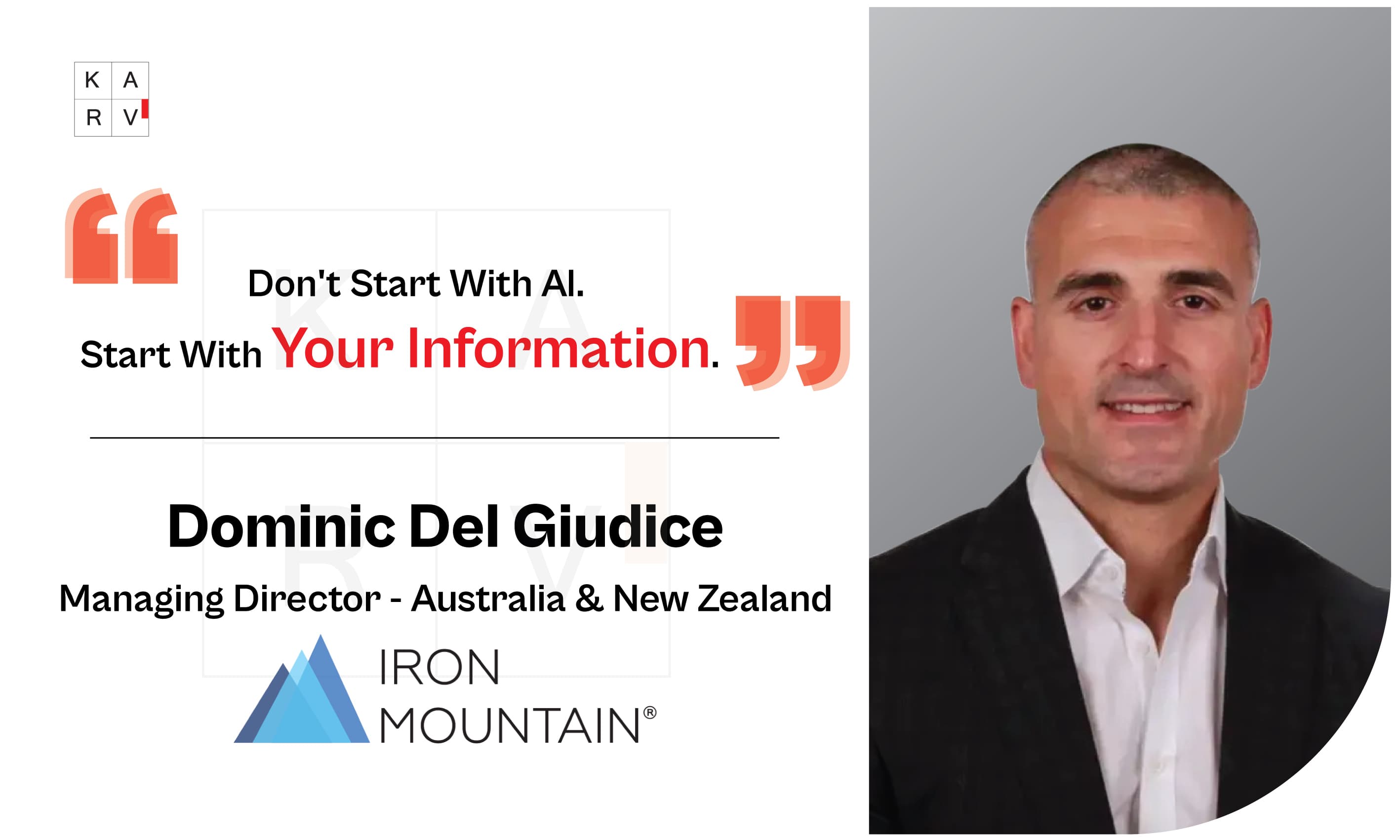
My view is, don’t start with AI. Start with the business outcome you’re trying to create.
I’ve seen many technology cycles during my career, and there is always a risk that organisations become captivated by the technology rather than the problem they’re trying to solve. The level of excitement around AI is justified, but the same principle still applies.
Be really clear about the problem or opportunity. Understand what information you need. Make sure you can trust that information and have the appropriate governance around it. And importantly, bring your people with you.
Then be ambitious about applying AI where it can genuinely create value.
I’m very optimistic about what AI can do for businesses. But ultimately, I don’t think the organisations with the most AI will necessarily win. I think the organisations that apply it with the greatest purpose and connect it to real business outcomes will.
About Dominic Del Giudice
Dominic Del Giudice is Managing Director for Australia and New Zealand at Iron Mountain, where he leads the business across both markets. He brings more than 25 years of experience spanning consulting, technology and outsourcing services, with a career focused on commercial growth, business transformation and enterprise leadership.
Throughout his career, Dominic has led organisations and teams through significant periods of growth and change, with a leadership approach centred on clarity, accountability, customer focus and empowering teams to execute. In his current role, he is focused on helping organisations navigate the convergence of physical and digital information as AI reshapes how enterprises manage, access and use information.
About Iron Mountain
Iron Mountain is a global information management and data centre company helping organisations protect, manage and unlock the value of their information and technology assets. Its services span information management, digital transformation, data centres, asset lifecycle management, secure storage and destruction, and information governance.
With decades of experience managing critical information for organisations around the world, Iron Mountain combines physical and digital capabilities to help customers manage information securely while supporting their evolving technology and AI strategies.
Explore Another Exclusive Leader Interview
If you enjoyed this conversation on AI readiness, trusted information, enterprise transformation, data governance, and the future of intelligent organisations, you may also like our exclusive Leader Interview with Tim Pfaelzer, CEO & Regional Vice President EMEA at Veeam.
Tim shares his perspective on Data and AI Trust, cyber resilience, enterprise transformation, and why trusted data is becoming fundamental to how organisations operate, innovate and make decisions in the AI era.
Read the full interview: Tim Pfaelzer, CEO & Regional Vice President EMEA at Veeam.