
Leader InterviewsAI Business & Ecosystem
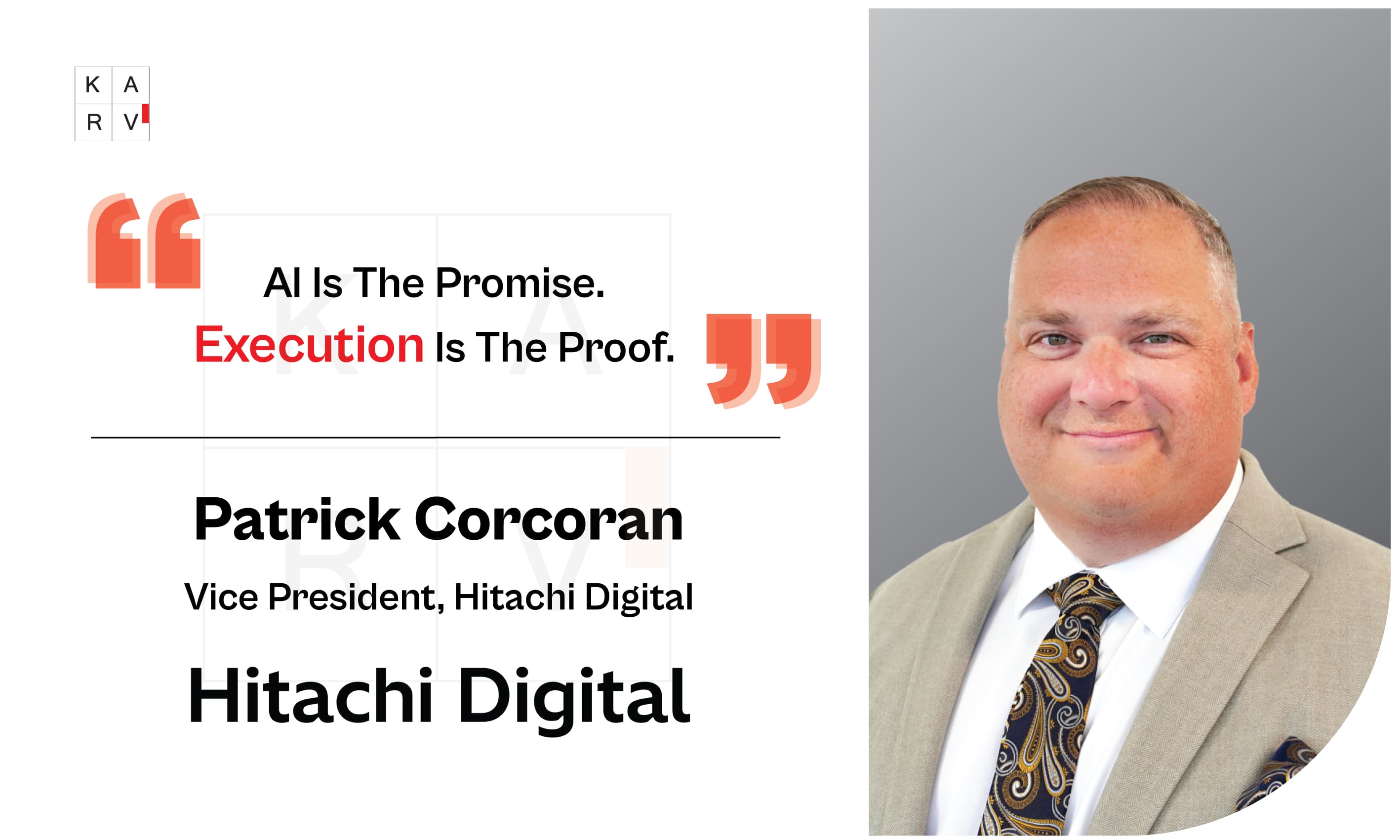
Patrick Corcoran on Enterprise AI, Business Outcomes and the Power of Market Influence
Article content
1. From Analyst Relations to Global Marketing Leadership
Your career has spanned analyst and advisor relations, strategic partnerships, go-to-market strategy, and now global marketing and external relations. How have those experiences shaped your approach to building market influence and positioning a technology business for growth?
A:
I have worked on enough sides of the table to know that my priorities are not automatically everyone else’s. I start by understanding what matters to the customer, then build agreement inside the business around what we can deliver. I have found that influence comes from being credible and useful when a decision is on the line. I work to build that standing long before I need to call on it.
2. Marketing What the Market Cannot Easily See
Hitachi Digital operates across complex areas including AI, cloud, data, digital engineering, and mission-critical systems. How do you simplify a highly technical value proposition into a story that resonates with executives, customers, partners, and the broader market?
A:
I start with the decision the customer needs to make. What improves? What does it take? Why should they trust us to deliver? My job is to make the business case clear enough to act on and use our technical depth to support it. If the customer has to translate our story into business value, I haven’t finished the job.
3. From Digital Transformation to AI-Driven Transformation
The enterprise conversation has shifted from digital transformation to AI-led transformation, but many organizations are still struggling to turn AI experimentation into measurable business outcomes. What do you believe separates companies that successfully operationalize AI from those that remain stuck in experimentation?
A:
I look for a clear answer to one question: who owns the business result? Until we have that, we risk running pilots without making progress. I want a measurable outcome and a team prepared to change how the work gets done. I also believe we need the discipline to stop an experiment when the evidence no longer supports it.
4. The Rise of Physical AI
Physical AI is moving intelligence beyond software and into factories, transportation, energy, and other mission-critical environments. What changes when AI is no longer simply generating an answer, but influencing real-world operations where reliability, safety, and trust are non-negotiable?
A:
When AI influences a factory or an energy system, I want to know how it behaves when conditions go wrong. Who can intervene? Who is accountable? Those are questions I believe we must settle early. We earn the right to scale by proving reliability. I want the people responsible for running those operations involved from the beginning.
5. Marketing in an AI-Mediated Buyer Journey
AI is changing how buyers discover companies, evaluate expertise, and make technology decisions. How should enterprise marketers rethink brand visibility, thought leadership, analyst relations, and external influence when the buyer journey itself is increasingly mediated by AI?
A:
I assume we are being evaluated before our sales team gets a call. That changes how I think about visibility and influence. I want our expertise clearly expressed, our claims verifiable and our customers, analysts and partners equipped to speak credibly about our work. We won’t always be there to explain ourselves. I see being understood correctly as part of competing effectively.
6. Building Trust Around AI
For mission-critical industries, trust cannot be treated as a marketing message alone. How can marketing and external relations help organizations communicate AI innovation with credibility while addressing the realities of governance, security, human oversight, and responsible adoption?
A:
I believe in saying what we can do, being clear about the limits and showing who is accountable. I want our statements on governance, security and human oversight backed by how we actually operate. My responsibility is to keep our public promise grounded in what we can deliver. I would rather answer a difficult question today than explain an unsupported claim tomorrow.
7. Partnerships as a Growth Engine
Your background in strategic partnerships and external ecosystems has been a consistent part of your career. As AI increasingly requires collaboration across technology providers, hyperscalers, partners, and industry ecosystems, what makes a partnership genuinely strategic rather than simply another route to market?
A:
I ask what we can accomplish together that neither side could accomplish alone. Then I want specifics on investment, ownership and results. I consider a partnership strategic when both sides commit resources and make decisions they otherwise would not make. The announcement is the easy part. I judge the relationship by whether we stay committed when priorities compete and difficult choices arise.
8. The Next Generation of Marketing Leadership
As marketing becomes increasingly connected to business strategy, technology, customer experience, and corporate reputation, what capabilities do you believe the next generation of marketing leaders will need to build, and what will distinguish the organizations that lead the next phase of enterprise technology?
A:
I expect marketing leaders to understand how the business wins, makes money and earns trust. I see it as part of my job to challenge a weak proposition before we spend money promoting it. If I want a voice in business strategy, I need to bring a commercial argument and accept responsibility for the result. I believe the strongest organizations will expect that same standard from their marketing leaders.
About Patrick Corcoran
Patrick Corcoran has been with Hitachi for over five years, bringing more than a decade of experience across analyst, advisor, and partner relations, as well as go-to-market strategy and sales enablement. Prior to Hitachi, Patrick led the Advisor Relations program at DXC Technology. Before DXC, he was with Luxoft, where he served as Head of Marketing and Global Communications until the company’s acquisition by DXC. Throughout his career, Patrick has focused on building strong external ecosystems and driving growth through strategic market engagement.
Patrick holds a bachelor’s degree in History from Saint Joseph’s University and a master’s degree in International Affairs from The New School. He is based in New York and, outside of work, enjoys boating and golfing. Known as a true road warrior, Patrick is deeply people-centric in his approach to leadership, relationships, and responsibility.
About Hitachi Digital
Hitachi Digital, a wholly owned subsidiary of Hitachi, Ltd., is a global digital services company that helps organizations in complex, mission-critical industries turn cloud, data and AI into measurable business outcomes. Formed by uniting GlobalLogic and Hitachi Digital Services, the company brings digital engineering and operations together, from enterprise AI to Physical AI, with approximately 35,000 professionals in 27 countries. Hitachi Digital engineers what the world depends on.
Visit: www.hitachidigital.com
Explore Another Exclusive Leader Interview
If this conversation resonated with you, you may also want to explore our exclusive Leader Interview with Tammy Gollotti, Senior Vice President, Global Marketing at Hitachi Vantara.
Tammy Gollotti on AI, Brand Trust and the Future of Enterprise Marketing
Read the full interview: Tammy Gollotti on AI, Brand Trust and the Future of Enterprise Marketing