
Leader InterviewsAI Applications & Use Cases
Tim Pfaelzer on Data and AI Trust, Cyber Resilience, and Leading Through Complexity in EMEA
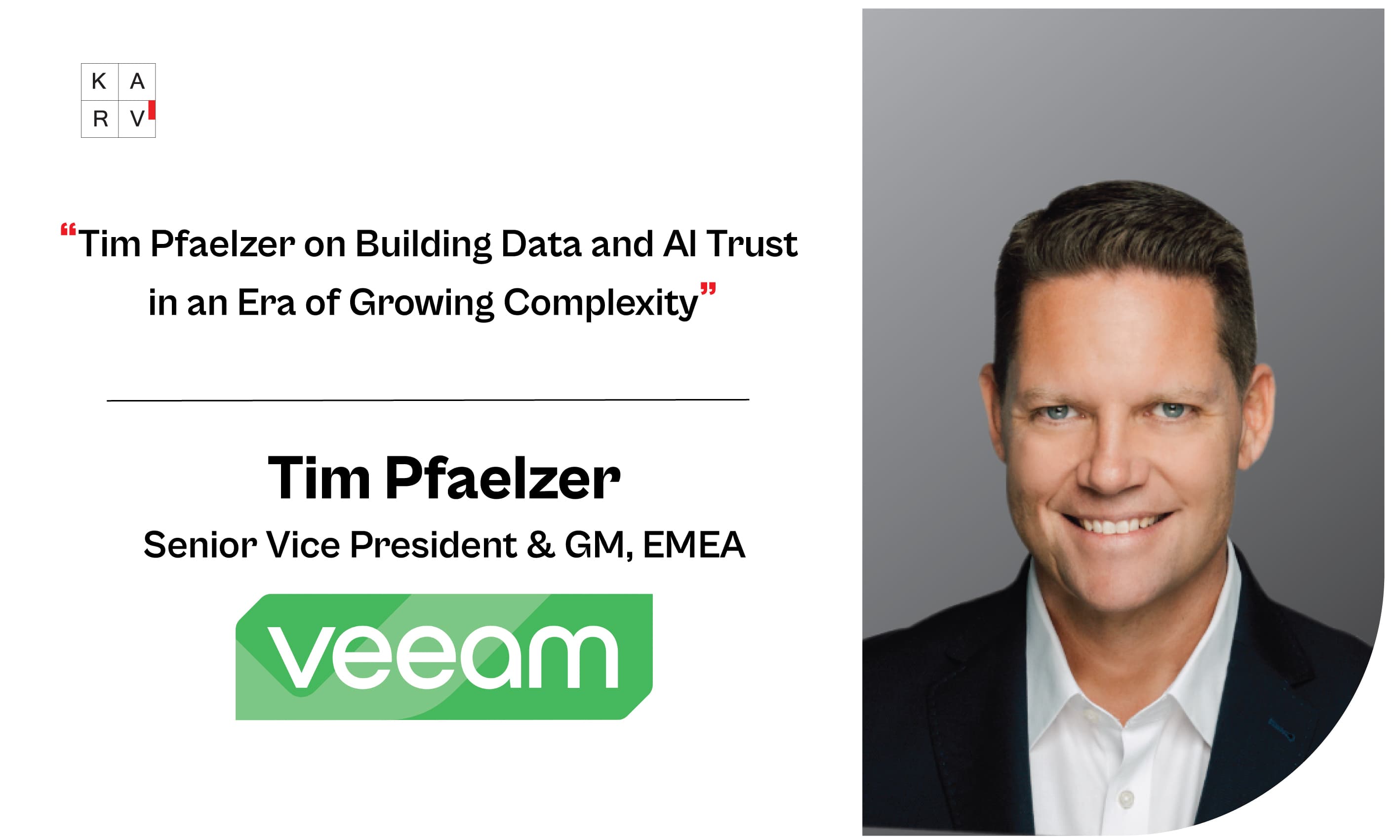
Article content
1. A Career Across Some of Technology’s Most Influential Companies
Your career has spanned leadership roles at Dell, Adobe, Autodesk, Salesforce, and now Veeam. Looking back, what experiences have most shaped your leadership philosophy and your approach to building high-performing teams across diverse markets?
A.
I’ve been fortunate to work across a number of companies that have each defined a category in their own way. The common thread across Dell, Adobe, Autodesk, Salesforce, and now Veeam is that they were all operating at moments of structural change in the market.
What has shaped my leadership philosophy most is the importance of clarity in those moments. When markets shift, complexity increases, but high performing teams need the opposite. They need a very clear understanding of what matters, what does not, and how they create value for customers.
The role of culture has also been of critical importance. Across diverse markets, particularly in EMEA, you cannot apply a single operating model everywhere. Building high performing teams is about creating alignment around purpose and outcomes, while giving local teams the autonomy to execute in a way that reflects their market.
One thing that has become increasingly clear across all of these experiences is the role of trust. Technology has evolved from enabling operations to driving decisions, and now increasingly automating them. That shift makes trust in data absolutely fundamental, both for customers and for the teams delivering that technology.
2. Why Veeam, Why Now?
Having worked across multiple areas of enterprise technology, what attracted you to Veeam, and why do you believe data resilience and cyber recovery have become boardroom priorities for organizations today?
A.
What attracted me to Veeam is very simple. It sits at the centre of one of the most important conversations in enterprise technology today, which is trust in data and, increasingly, trust in AI.
Every organisation is becoming a data-driven organisation. At the same time, the risk landscape has fundamentally changed. Ransomware, operational disruption, and now AI-driven complexity mean that data resilience is no longer a technical concern. It is a business priority.
What is different now is that systems are not just storing data, they are acting on it. That raises the stakes significantly. If the data is compromised, incomplete, or lacks context, the consequences are immediate and often irreversible.
That is why this conversation has moved into the boardroom. It is no longer about backup. It is about ensuring organisations can operate, recover, and innovate with confidence. This is where Data and AI Trust becomes critical, bringing together resilience, security, and governance into a single outcome.
3. Leading One of the World’s Most Diverse Technology Regions
As Senior Vice President and General Manager for EMEA, you oversee a region that spans mature digital economies and rapidly growing markets. What are the biggest opportunities and challenges technology leaders face across EMEA today?
A.
EMEA is one of the most dynamic and complex regions in the world. You have highly mature digital economies alongside some of the fastest growing markets globally, each with different regulatory environments, levels of cloud adoption, and approaches to AI.
The opportunity is significant. We are seeing strong demand driven by digital transformation, AI adoption, and increasing focus on data sovereignty. Organisations are investing in modern infrastructure while also reassessing how they manage and control their data.
The challenge is managing that complexity. Data is more distributed, regulations are tightening, and organisations face constant pressure to move faster without increasing risk.
Across the region, the same tension consistently emerges. Businesses want to accelerate innovation, particularly with AI, while maintaining control, security, and resilience. Enabling that balance relies on building Data and AI Trust into the foundation of how organisations operate.
4. The New Reality of Cyber Resilience
Cyber threats, ransomware, and operational disruptions continue to increase in frequency and sophistication. How should organizations rethink resilience, and what separates businesses that recover quickly from those that struggle to respond effectively?
A.
The way organisations think about resilience needs to evolve.
In the past, resilience was about recovering from failure. It then became about responding to breaches. Today, the environment is more complex. In an AI driven world, the risk is often about loss of control, lack of visibility, or decisions being made on data that is not fully trusted.
The organisations that respond effectively are those that build resilience into their design, not just their response. They understand where their data is, how it moves, and how it can be recovered quickly and securely.
What separates them is discipline. They invest in visibility, they continuously validate their ability to recover, and they recognise that resilience and security must be tightly connected.
Ultimately, resilience is no longer just about recovery. It is about ensuring the data behind every decision is trusted, which is why it plays such a central role in broader Data and AI Trust strategies.
5. AI, Data, and the Future of Enterprise Operations
Artificial intelligence is reshaping how organizations operate, innovate, and make decisions. How do you see AI influencing data protection, business continuity, and enterprise technology strategies over the next few years?
A.
AI is accelerating one of the most significant shifts we have seen in enterprise technology.
What is different this time is that AI does not just support decision making, it increasingly drives it. That means the quality, security, and availability of data becomes critical to business outcomes.
Over the next few years, organisations will move from experimentation to embedding AI into core operations. At the same time, the volume and complexity of data will continue to grow, particularly across unstructured environments.
The challenge is that the ability to deploy AI is advancing faster than the ability to govern and control it. That creates a growing gap between innovation and trust.
Closing that gap requires a focus on Data and AI Trust. Organisations need to ensure that data is secure, resilient, and governed in a way that allows AI to operate safely at scale. Without that foundation, the value of AI cannot be fully realised.
6. The Power of Ecosystems and Strategic Partnerships
Throughout your career, you've worked closely with customers, partners, and technology ecosystems. What role do channel partners and strategic alliances play in helping organizations navigate today's increasingly complex technology landscape?
A.
No organisation can navigate today’s technology landscape alone.
The complexity of modern environments, spanning hybrid cloud, SaaS, and AI platforms, means that ecosystems are more important than ever. Partners play a critical role in helping organisations translate strategy into execution.
The most effective partners are evolving beyond transactional roles and becoming strategic advisors. They are helping customers design resilient architectures, meet regulatory requirements, and adopt AI in a way that is secure and sustainable.
From a Veeam perspective, our ecosystem is central to delivering Data and AI Trust at scale. It allows us to combine global capability with local expertise and ensure that customers can operationalise these principles in real environments.
7. The Modern Technology Leader
Technology leaders today are expected to balance innovation, security, operational efficiency, and business growth. How do you see leadership evolving, and what qualities will define successful leaders in the next decade?
A.
Technology leaders today are expected to balance innovation, security, operational efficiency, and business growth. That requires a different mindset to what many were trained for.
The most effective leaders are those who can operate across domains. They understand the technical landscape, but also the commercial, regulatory, and risk context in which decisions are made. They are capable of simplifying complexity and aligning teams around clear priorities.
Trust is becoming an increasingly important leadership attribute. That includes trust in teams, trust in decision making, and critically, trust in how data and AI are governed across the organisation.
As AI becomes more embedded in business operations, leadership will be defined by the ability to build and maintain that trust at scale.
8. Looking Ahead: What’s Next for Resilience and Growth?
As organizations continue their digital transformation journeys, what trends do you believe will have the greatest impact on enterprise technology, cyber resilience, and business growth over the next three to five years?
A.
Over the next three to five years, several forces will shape enterprise technology.
AI will continue to accelerate and become embedded across all areas of the business. Data sovereignty and regulatory requirements will increase, particularly across regions like EMEA. Hybrid and multi-cloud environments will continue to add layers of complexity.
The organisations that succeed will be those that can navigate these forces with control and confidence. That means having a clear understanding of their data, the ability to secure and recover it, and the governance frameworks to manage how it is used by AI.
About Tim Pfaelzer
Tim Pfaelzer is Senior Vice President and General Manager for EMEA at Veeam, where he leads the region’s strategy, growth, and go-to-market execution. He is focused on helping organizations build true data resilience and confidently navigate the intersection of AI, cybersecurity, and cloud innovation.
A seasoned technology leader, Tim brings experience from global organizations including Apple, Adobe, Autodesk, Salesforce, and Dell. Across his career, he has built a reputation for driving transformation at scale, unlocking new growth through strategic partnerships, and delivering measurable outcomes for customers in complex, highly regulated markets.
Passionate about the role of trusted data in the AI era, Tim works closely with customers and partners to help organizations build Data and AI Trust, ensuring their data is resilient, secure, and ready to power innovation. He is known for his energetic leadership style, strong partner focus, and commitment to helping organizations innovate with confidence and stay ahead in a rapidly evolving digital landscape.
About Veeam Software
Veeam Software is the global leader in data resilience, helping organizations protect, recover, and unlock the full value of their data across cloud, virtual, physical, SaaS, Kubernetes, and hybrid environments. Its solutions enable businesses to ensure data availability, strengthen cyber resilience, and maintain business continuity in an increasingly complex digital world.
Trusted by hundreds of thousands of customers worldwide, Veeam empowers organizations to recover quickly from disruptions, defend against cyber threats, and build the trusted data foundation needed to accelerate innovation, digital transformation, and AI adoption.