
Leader InterviewsAI Business & Ecosystem
Linda Zebian on AI, Trust, GEO and Why Communications Has Never Been More Strategic
Article content
1. A Career Bridging Journalism and Corporate Communications
Your career has taken you from one of the world's most respected news organizations to leading communications at Muck Rack. Looking back, what experiences have most influenced your perspective on storytelling, media relationships, and the role communications plays in building lasting trust?
A:
The biggest advantage I've had in communications is that I learned how news works before I learned how PR works.
I started my career as a journalist, so I understand firsthand how stories are reported, how editors make decisions, what makes something newsworthy and how journalists evaluate sources. That experience fundamentally shaped the way I approach communications.
I then spent more than a decade leading communications inside media organizations, including at The New York Times. Working inside newsrooms gave me an even deeper appreciation for how stories are prioritized, how reporting gets done and the essential role a free and independent press plays in society.
That perspective has made me a more empathetic communicator. I understand the pressures journalists are under because I've been on the other side of the pitch. I know how to find the story, anticipate difficult questions, spot risks before they become headlines and help organizations communicate with transparency and credibility.
Ultimately, communications is about earning trust. And the best way to do that is to understand how trust is built in the first place. For me, that started with journalism.
2. Why Muck Rack, Why Now?
Muck Rack has become a trusted platform for communications professionals navigating an increasingly complex media landscape. What attracted you to the company, and what aspects of its mission resonate most strongly with you as the communications industry continues to evolve?
A:
Throughout my career, I had countless conversations with communications leaders who felt like they were constantly being brought in too late. We'd launch a product, secure incredible coverage and then watch the thank-you email go out to marketing, engineering, product and everyone else, while the communications team that helped shape the narrative was left off entirely.
Communications has historically been undervalued because it hasn't always had the tools or the data to demonstrate its impact and most executives don't spend a lot of time on work they cannot measure.
Muck Rack was building technology specifically for communicators. It wasn't asking us to borrow marketing's tools or fit into someone else's workflow. It was investing in the profession itself.
That was incredibly compelling to me. I also loved the research, the thought leadership and the opportunity to build the company's first communications team.
One of the best parts has been working for a CEO who truly understands communications. Greg Galant understands how news works, how relationships with journalists are built and why reputation matters. That's rare, and it allows communications to be a strategic partner instead of a support function.
Today, as AI reshapes communications, I think our profession has never been more important. Reputation has never mattered more, and communicators finally have the opportunity, and increasingly the data, to earn a real seat at the executive table.
3. Communications as a Strategic Business Function
Corporate communications have evolved far beyond media relations. Today, it influences reputation, visibility, customer confidence, and even business growth. How do you see the role of communications leaders changing, and why should communications have a stronger voice in strategic business decisions?
A:
Communications has become one of the most strategic functions in business because trust has become one of the most valuable assets a company has.
Organizations today are under constant scrutiny. Everyone has a platform, information travels instantly and reputations can be built or destroyed in a matter of hours. At the same time, customers increasingly choose brands they trust and whose values align with their own.
AI is accelerating that shift even further as how people discover information rapidly shifts to AI search.
Our research found that the overwhelming majority of citations in AI-generated answers come from earned media, with owned content making up much of the remainder and paid content accounting for only a very small share. People aren't just Googling anymore. They're asking ChatGPT, Gemini and Claude. And those systems are largely relying on credible journalism and authoritative third-party sources to build their answers.
That means earned media is directly influencing what AI tells millions of people about your company.
4. AI, Authenticity and the Future of Communications
Artificial intelligence is reshaping how organizations create content, monitor conversations, and engage with stakeholders. As AI becomes part of everyday communications, where do you see the greatest opportunities, and how can organizations balance automation with authenticity while maintaining trust?
A:
The biggest opportunity with AI isn't replacing communicators. It's eliminating the work communicators never wanted to do in the first place.
AI is incredibly valuable for research, monitoring, summarizing information, identifying patterns and helping teams move faster. It allows communications professionals to spend less time on repetitive tasks and more time doing the work that actually creates value.
What AI can't replace is judgment. It can't build relationships with journalists. It can't advise a CEO during a crisis. It can't understand organizational culture or make difficult decisions when reputation is on the line.
That's why authenticity shouldn't disappear just because AI enters the workflow. Authenticity comes from your organization's values, your people and your leadership, not from the technology you use.
The organizations that will succeed are the ones that use AI to become more efficient while keeping humans at the center of every important decision. AI should amplify good communicators, not replace them.
5. Measuring Reputation in a Data-Driven World
Communications has historically been viewed as one of the hardest business functions to measure. How is technology changing the way organizations evaluate reputation, media impact, and business value, and what metrics do you believe matter most today?
A:
For years, we could show the coverage we earned, but it was much harder to demonstrate how that coverage influenced reputation or business outcomes.
That's changing rapidly. Technology, and especially AI, is giving communicators access to data and insights we simply didn't have before. We can analyze enormous amounts of information, identify patterns and connect our work to tangible business results in ways that weren't possible even a few years ago.
One of the biggest shifts is the emergence of AI visibility metrics through Generative Engine Optimization, or GEO. We're now able to measure how often a brand appears in AI-generated answers, how that visibility changes over time, how it compares to competitors, what sources are influencing those answers and even the sentiment reflected across different large language models.
Those metrics matter because they connect directly to the work communicators have been doing for years. Our research has found that earned media accounts for the vast majority of citations across major AI platforms. That means the journalism and third-party coverage we earn isn't just shaping public perception, it's shaping what AI tells millions of people about our companies.
For the first time, we can draw a much clearer line between earned media, reputation and AI visibility.
At the same time, I think it's time to move beyond some of the metrics our industry has relied on for decades. Simply counting articles or impressions doesn't tell you whether communications had an impact. A feature profile isn't the same as a passing mention. Positive coverage isn't the same as negative coverage. And an article reaching a million people doesn't necessarily mean it changed anyone's perception or drove business value.
The metrics that matter today are much more nuanced. I look at share of voice, competitive positioning, key message pull-through, sentiment, which AI has made dramatically more accurate, topic ownership, referral traffic and, increasingly, AI visibility.
Ultimately, the future of measurement is about connecting communications to broader business outcomes. The more we can integrate earned media data with analytics, CRM platforms, web traffic and other business systems, the stronger the case we can make that communications is driving measurable business value.
6. Trust in the Age of AI
Businesses today are competing for attention across traditional media, social platforms, creators, podcasts, newsletters, and increasingly AI-generated answers. What do you believe separates organizations that consistently earn trust from those that simply generate visibility?
A:
One of the biggest misconceptions today is that visibility and trust are the same thing. They're not.
Visibility simply means you're showing up. People see your brand. AI cites you. You're mentioned in the media. You're appearing in search results or AI-generated answers. That's important, but visibility is neutral. It doesn't tell you whether people view your brand positively or negatively, or whether they would choose you over a competitor.
Trust is different because it's earned over time through consistent actions, credible third-party validation and delivering on what you promise. It's the confidence people have that your brand is reliable, transparent and worthy of their attention or business.
AI makes this distinction even more important. A company can have high visibility because it's in the news every day, but if those stories are about lawsuits, product failures or executive missteps, visibility isn't creating value at all.
The organizations that will win are the ones that consistently appear in credible contexts, are associated with the right topics and have earned positive reputations over time.
7. The Changing Relationship Between Brands, Journalists and AI
The relationship between brands and journalists continues to evolve alongside creator media, AI-powered search, and changing audience behaviors. How do you see the relationship between journalism, communications, and technology changing over the next few years, and what should communications leaders do directly to remain relevant?
A:
The relationship between journalism, communications and technology is becoming much more interconnected.
Traditional newsrooms have been shrinking for years, and that means there are fewer reporters covering more beats. At the same time, the information ecosystem has expanded dramatically. Today, people get information from journalists, newsletters, podcasters, creators, industry experts and AI-generated answers.
For communicators, that means media relations is still incredibly important, but the best communicators are thinking much more broadly about relationships. They're building communities around their brands, not just with journalists, but with customers, partners, industry experts, creators and other trusted voices. Those relationships create opportunities for collaboration, original content and thought leadership that extends well beyond a traditional press release or media pitch.
That's especially important in the AI era. We know that AI models draw heavily from trusted third-party sources, including journalism, but they also cite high-quality owned content. That means communications leaders have an opportunity to help their organizations become credible sources of information.
Technology is also changing the skills communicators need. AI literacy is quickly becoming as important as media literacy. It's not enough to know how to tell a great story. You also need to understand how AI works, how information flows through these systems and how technology can make your team more creative, more strategic and more effective.
The fundamentals of communications haven't changed. Great storytelling and trusted relationships still matter.
8. Looking Ahead: The Next Chapter of Communications
As you look toward the next five years, what major trends do you believe will define the future of communications, and what advice would you offer to business and communications leaders preparing for this next era of transformation?
A:
If I had to sum up the next five years in one word, it would be trust.
We're entering a world where AI can generate unlimited content, images and video. Information will become easier to create than ever before, but that doesn't mean it will be easier to believe.
As content becomes abundant, credibility becomes scarce.
That's why I think communications is entering one of the most important moments in its history. Organizations that invest in trusted experts, original insights, transparent leadership and authentic storytelling will stand out. The ones that chase volume over value won't.
Technology will continue to transform our workflows, and communicators should absolutely embrace it. AI can make us faster, help us uncover insights and eliminate repetitive work.
But the qualities that will matter most are uniquely human: judgment, curiosity, empathy, creativity and the ability to anticipate risk before it becomes a crisis.
My advice to business leaders is to invest in both. Build AI capability across your organization, but don't lose sight of the human skills that create trust. Because in a world where anyone can generate content, trust will become the ultimate competitive advantage.
About Linda Zebian
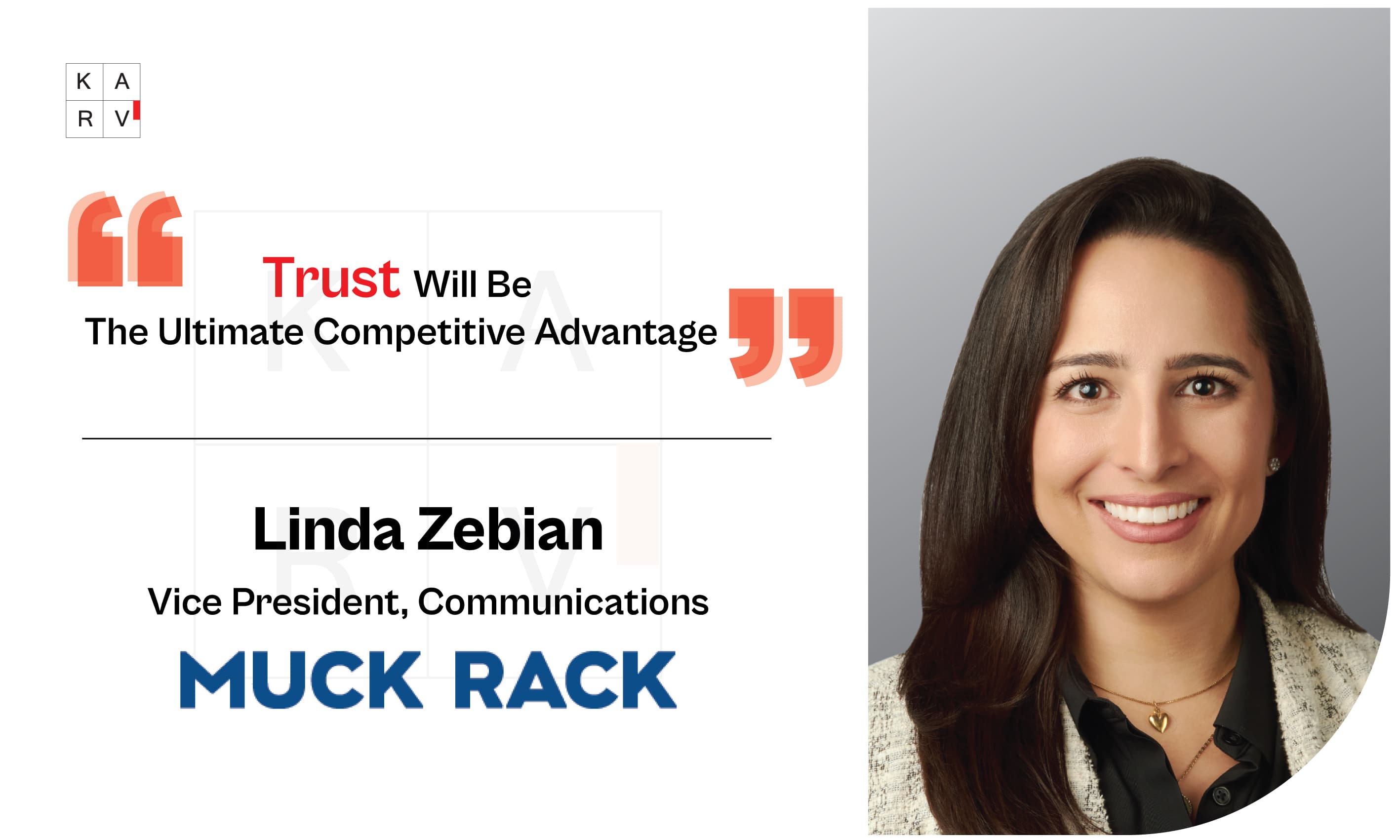
Linda Zebian is Vice President of Communications at Muck Rack, where she leads communications strategy across content marketing, partnerships, events, issues management, media relations, social media, and employee communications. She joined Muck Rack in 2022 as the company's first Director of Communications after spending a decade leading communications initiatives across multiple business divisions at The New York Times.
About Muck Rack
Muck Rack is the AI communications platform where trusted data, human expertise, and embedded intelligence come together to drive clarity, speed and impact. Thousands of companies turn to Muck Rack to make sense of the media conversation around them and understand how their brand shows up in the news and in AI-generated answers.
Muck Rack combines global media monitoring, Generative Engine Optimization (GEO) insights, social listening, trusted media data, AI automation, and analyst advisory to help organizations manage reputation, act quickly, and prove their impact across the PR workflow. Thousands of journalists also use Muck Rack's free tools to showcase their work and analyze the news.
Explore Another Exclusive Leader Interview
If you enjoyed this conversation on AI, trust, corporate communications, Generative Engine Optimization (GEO), and the future of reputation management, you may also like our exclusive Leader Interview with Steven Sidawi, Senior Vice President – Media Delivery, MENA at WPP Media.
Steven shares his perspective on AI-powered media operations, intelligent enterprises, operational excellence, and why organizations that continuously adapt, rather than transform once, will define the next generation of business transformation.
Read the full interview: Steven Sidawi, Senior Vice President – Media Delivery, MENA at WPP Media.