
Leader InterviewsMarketing Automation
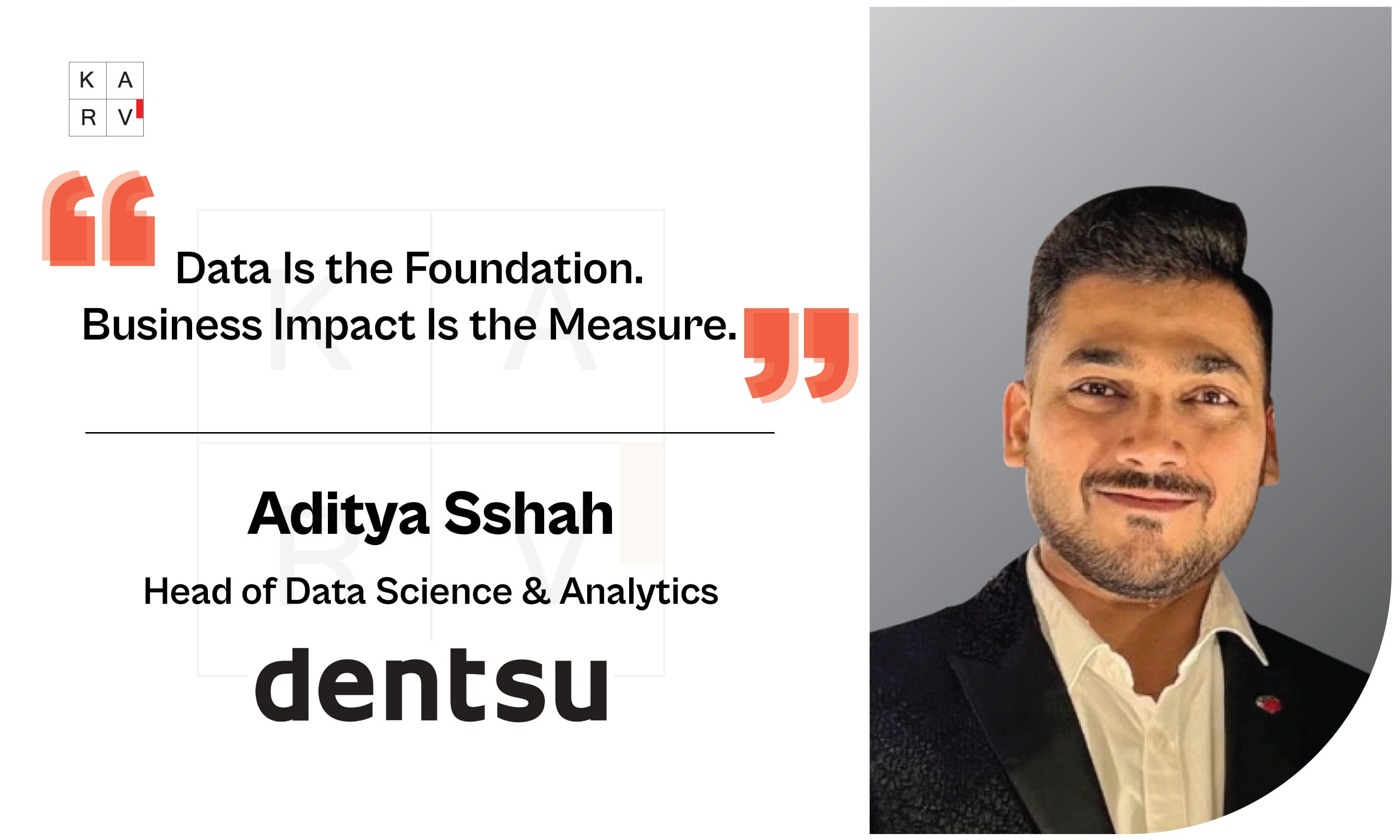
Aditya Sshah on Data Science, AI and the Future of Marketing Analytics
Article content
1. A Career Shaped by Data and Curiosity
Your journey has been centered around data science, analytics, and solving complex business challenges. Looking back, what experiences have had the greatest influence on your leadership philosophy and your approach to using data as a strategic business asset?
A:
The biggest lesson I've learned is simple. The best model in the world is useless if it answers the wrong question.
Early in my career, I was obsessed with the technical side: sharper algorithms, cleaner code, higher accuracy. Over time I noticed that the projects that really moved the needle weren't the most technically complex ones. They were the ones where we understood the client's business deeply before writing a single line of code. That changed how I lead.
Today my philosophy starts with client centricity. Before building anything, I want to know the "why" behind the use case. What problem are we really solving? Who in the organization feels that pain? How can we together act on the output? And how effectively will this solve the problem? Mapping the stakeholders early often decides whether a solution gets adopted or ends up as another slide deck in a shared drive.
The second shift was moving from building for clients to building with them. The old model was "take the brief, disappear into a data cave, come back with an answer." That approach produces technically sound solutions that nobody uses. When clients are in the room shaping the hypotheses, questioning the assumptions and validating the outputs, they end up owning the solution rather than just receiving it.
So my mantra is: understand the business before the data, and co-create rather than hand over. Data becomes a strategic asset only when it's anchored in business context and built through collaboration, not in silos.
2. The Evolution of Data Science
Data science has evolved from supporting business decisions to becoming a key driver of innovation and competitive advantage. From your perspective, what have been the most significant shifts in the discipline over the past decade?
A:
Ten years ago, data science was a "nice to have." Today it's a "must have." That's the biggest shift, and it's a shift in mindset more than in technology.
Every organization now realizes it's sitting on a goldmine of data in every form and shape: transactions, clickstreams, CRM records, call-center logs, social conversations, even unstructured text and images. The question has moved from "should we invest in data?" to "how fast can we turn it into value?"
The second major shift is from reactive to proactive. Businesses used to look at data to explain what happened last quarter. Now they want to predict what's coming and make strategic moves before competitors do. Rear-view-mirror analytics isn't enough anymore; leaders want a windshield.
Nowhere is this more visible than in marketing. Clients have become very disciplined about every dollar they spend. CMOs are under pressure to prove that marketing is a growth engine and not a cost center. The conversation has moved from impressions and clicks to incrementality, ROI and customer lifetime value. Data science is what connects each dollar spent to the business outcome it drives, whether through marketing mix modeling, attribution or propensity scoring.
And here's the uncomfortable truth: legacy organizations that are still treating data as an IT project rather than a business capability are being left behind. The gap between data-mature companies and the rest isn't closing. It's widening, and AI is speeding that up.
3. Beyond Dashboards: Creating Business Impact
Many organizations collect enormous amounts of data but struggle to translate it into meaningful action. What separates organizations that successfully turn data into measurable business outcomes from those that remain trapped in reporting and analysis?
A:
Let's be honest: most organizations aren't short of data. They're drowning in it. Data flows in from websites and apps, CRM platforms, ad servers, social media, e-commerce and retail media networks, point-of-sale systems, loyalty programs, customer service tools, and IoT devices. The problem is that this data usually lives in silos. The media team has one version of the truth, the CRM team has another, and finance has a third.
The organizations that break through have three things in common.
First, they have a data maturity roadmap. They don't try to boil the ocean. They make a clear, staged plan to move from raw data to trusted information, and from information to intelligence. Second, they build a connected ecosystem. When your media, customer, sales and product data talk to each other, you start seeing the hidden nuances: which channels work together, which customers are about to churn, where you're overspending for diminishing returns. Third, they respect every stage of the analytics ladder. Descriptive analytics, meaning reporting, is the mirror. It shows you what your portfolio really looks like and keeps you honest. I'd never dismiss it, because it's the foundation of any honest self-reflection. But a mirror only tells you what you look like today. The real elevation comes when you climb to diagnostic (why did it happen?), predictive (what will happen?), and prescriptive (what should we do about it?).
An illustrative example: Consider a mid-sized consumer brand spending across search, paid social, connected TV and retail media. Each channel had its own dashboard, and each claimed credit for the same sales.
-
Descriptive: We first unified the data into a single view. The honest mirror showed that nearly 40% of spend sat in channels whose returns had flattened.
-
Diagnostic: Digging deeper, we found that upper-funnel video was undervalued because last-click reporting gave it no credit, even though it was driving a large share of branded search.
-
Predictive: We built a marketing mix model and customer propensity models to forecast how sales would respond to different budget scenarios.
-
Prescriptive: Finally, an optimization layer recommended how to reallocate spend week by week.
The brand shifted roughly a fifth of its budget without increasing total spend and saw a meaningful double-digit lift in return on ad spend within two quarters. The data was the same data they had all along. The difference was connecting it and climbing the ladder. Reporting tells you where you are. Prescriptive analytics tells you where to go next. The winners do both.
4. AI's Next Chapter
Generative AI has transformed the way businesses think about automation and intelligence. As organizations move toward agentic AI and autonomous decision-making, where do you see the greatest opportunities and the biggest challenges?
A:
There's a lot of noise about whether AI will help or harm humanity. My view is this: Artificial Intelligence Quotient (AIQ), won't replace Human Intelligence Quotient (HIQ). It will amplify it. AI brings incredible speed. It can analyze millions of data points, draft a campaign brief, or run a thousand scenarios in the time it takes us to finish a coffee. But it still lacks the hidden business context that humans decode naturally: the political dynamics in a boardroom, the cultural nuance of a market, the unwritten history of why a strategy failed five years ago. The organizations that win will be those where AIQ and HIQ work hand in hand. AI does the heavy lifting, and humans supply judgment, empathy and context.
The opportunities:
-
Hyper-personalization at scale: Agentic systems can tailor messaging, offers and experiences to individual customers in real time, something no human team could do manually.
-
Always-on optimization: Instead of monthly campaign reviews, AI agents can monitor performance and rebalance budgets continuously.
-
Democratized insight: Business users can ask questions of data in plain language instead of waiting weeks for an analyst.
-
Freeing up talent: Automating repetitive work lets analysts and marketers focus on strategy and creativity.
The challenges:
-
Context blindness: An agent optimizing a single metric can make decisions that hurt the brand or the long-term customer relationship.
-
Accountability gaps: When an autonomous system makes a bad decision, who owns it? Most organizations haven't answered this yet.
-
Garbage in, garbage out at scale: Agentic AI on top of messy, siloed data doesn't fix the mess. It automates it.
-
Trust and adoption: People won't hand decisions to systems they don't understand. How far AI will go in the near future, nobody really knows, and anyone who claims to is guessing. Time will tell. But I'm confident the best results will come from human-in-the-loop models, not human-out-of-the-loop ones.
5. The Human Side of AI
As AI capabilities continue to advance, discussions around ethics, governance, transparency, and trust have become increasingly important. How can organizations innovate responsibly while ensuring AI remains accountable and human-centric?
A:
To be very honest, the pace at which AI is evolving is alarming. We're deploying capabilities faster than we fully understand their consequences, and only time will tell how this reshapes society and human race in different ways.
But you're right that governance, trust and transparency have moved from being compliance checkboxes to being business-critical. In my conversations with clients, this is often the first question, not the last. Most are understandably cautious about exposing customer data or any personally identifiable information to large language models. They're asking: Where does my data go? Is it used to train someone else's model? Can I explain this decision to a regulator or a customer?
Here's how I believe organizations can innovate responsibly:
Privacy by design, not privacy as an afterthought: Techniques like anonymization, data clean rooms, private or on-premise model deployments, and synthetic data let teams get value from AI without exposing sensitive customer information.
Explainability over black boxes: If you can't explain why a model made a recommendation, you shouldn't be acting on it for high-stakes decisions. Transparency builds trust with internal stakeholders and with customers.
Clear ownership: Every AI system needs a human owner who is accountable for its outcomes. "The algorithm did it" is not an acceptable answer.
Bias checks and continuous monitoring: Models drift and data carries historical biases. Responsible AI means auditing regularly, not just at launch.
A governance framework that enables rather than blocks: Good governance shouldn't kill innovation. It should give teams clear guardrails so they can move fast with confidence.
Ultimately, trust is the currency of the AI era. Companies that earn it will be allowed to innovate further. Those that break it may not get a second chance.
6. Building High-Performing Data Teams
Technology alone doesn't create transformation. What leadership principles have helped you build strong analytics teams, and what qualities do you believe define the next generation of successful data science professionals?
A:
For me, it all starts with trust: trust in yourself, trust in your team, and trust with everyone you work alongside, whether that's clients or internal stakeholders. When people feel trusted, they take ownership, raise their hands when something is off, and aren't afraid to challenge an assumption, including mine. A team that's afraid to say "I think we're wrong" will eventually build something wrong.
A few principles have served me well:
-
Give context, not just tasks: When the team understands the business problem and why it matters, the quality of their thinking changes completely.
-
Celebrate curiosity and smart failure: Some of the best insights come from someone asking a question nobody else thought to ask.
-
Invest in people: That means certifications, learning time, exposure to clients and room to grow. If you don't invest in your team, someone else will, and they'll leave.
On the next generation of talent, the old advice was to be a master of one rather than a jack of all trades. That no longer holds. Today you need to be a jack of all and a master of a few. A great data professional now needs a solid grasp of statistics and machine learning, but also data engineering, cloud platforms, business strategy, storytelling, and increasingly how to work with and govern AI tools. Deep expertise in one or two areas, with working fluency across the rest.
Above all, I look for a curious mindset and a commitment to continuous learning. The tools you master today may be obsolete in three years. The ability to learn, unlearn and relearn never will be.
7. Data-Driven Decision Making at Scale
Organizations openly aspire to become data-driven, yet many struggle to embed analytics into everyday decision-making. What practical advice would you offer business leaders looking to build a genuine data-first culture?
A:
Rome wasn't built in a day, and no organization becomes a data champion overnight. The biggest mistake I see is leaders buying an expensive platform and expecting transformation to follow. Technology is an enabler; culture is the real transformation.
My practical advice:
Start with an honest audit: Data comes from many sources, and not all of it is equally valuable. Map what you have, assess its quality, and decide what's critical now versus what can wait. Prioritization is a superpower.
Build a data maturity roadmap: Move incrementally from foundational data hygiene, to trusted reporting, to advanced analytics, to AI. Each stage should deliver visible value so momentum and executive support keep building.
Chase quick wins tied to business outcomes: Pick one or two use cases with clear ROI and deliver them well. Nothing converts skeptics faster than a result they can see on the P&L.
Partner with the right data partners: Few organizations have every capability in-house. The right partner brings expertise, accelerators and an outside perspective, and should help build internal capability rather than dependency.
Lead from the top: If senior leaders still make decisions on gut feel and then ask for data to justify them, the rest of the organization will notice. Leaders need to model the behavior by asking "what does the data say?" in every meeting.
Invest in data literacy: A data-first culture isn't about everyone becoming a data scientist. It's about everyone being comfortable asking good questions of data.
Patience and persistence win here. Data maturity is a marathon, not a sprint.
8. Looking Ahead
As you look toward the future, what emerging trends in data science, AI, and analytics do you believe will have the greatest impact on businesses over the next five years, and how should leaders prepare for them?
A:
I see five trends that will reshape the landscape:
Agentic analytics: Dashboards as we know them will fade. Instead of logging in to look at charts, leaders will have AI agents that watch the business around the clock, flag anomalies, explain why they happened and recommend what to do next. Analytics will shift from something you visit to something that comes to you.
The privacy-first data economy: With third-party cookies fading and regulations tightening worldwide, first-party data becomes the crown jewel. Clean rooms, consent-based data strategies and synthetic data will move from niche to mainstream.
The return of rigorous measurement: As signal loss makes user-level tracking harder, marketing mix modeling and incrementality testing are having a renaissance, now supercharged by AI and near-real-time data. Proving true business impact will separate leaders from laggards.
Smaller, specialized AI models: Not every problem needs a giant general-purpose model. Domain-specific models trained on proprietary data will offer better accuracy, lower cost and stronger data security, which is a real competitive edge.
AI governance as a board-level priority: Responsible AI will move from the legal team's desk to the boardroom agenda, as regulation and customer expectations both mature.
How should leaders prepare? Get your data foundations right first, because every one of these trends depends on clean, connected, trusted data. Invest in your people as much as your platforms, and upskill teams to work alongside AI rather than fear it. Build governance early so it becomes an accelerator rather than a brake. And stay experimental: run small pilots, learn fast and scale what works.
The next five years won't reward the organizations with the most data or the most AI tools. They'll reward those that combine AIQ with HIQ, and technology with trust. The future will belong to the curious.
About Aditya Shah
Aditya Shah is Head of Data Science & Measurement at dentsu in Singapore. He brings nearly 13 years of experience across data science, marketing analytics and product strategy, with a sharp focus on measurement and business impact in complex, multi-channel environments.
Before dentsu, Aditya worked with WPP and Fiserv, where he built deep expertise in media measurement and attribution at scale. He has led marketing analytics work across automotive, FMCG, CPG, ecommerce and financial services. That work has included building scalable analytics capabilities, strengthening in-house data teams, and helping brands see exactly what their marketing spend is delivering.
Today, his focus is on solving measurement in fragmented data ecosystems, using modern analytics, automation and smarter data models so decisions are consistent and tied to business goals. He starts with the client's business, not the technology, and builds alongside their teams so the work gets used. Aditya sits on the IAB SEA+India AI Council and recipient of Merkle's APAC Excellence in Analytics award.
About dentsu
dentsu is a global integrated marketing and communications group headquartered in Tokyo, Japan, with operations across approximately 120 countries. It helps brands drive growth through media, creative, customer experience management, data, and technology-led transformation.
Explore Another Exclusive Leader Interview
If this conversation resonated with you, you may also want to explore our exclusive Leader Interview with Raushida Vasaiwala, Vice President, Publisher Alliances & Success at Affinity Global.
Raushida Vasaiwala on AdTech, Publisher Monetization and the Future of Digital Advertising
Read the full interview: Raushida Vasaiwala on AdTech, Publisher Monetization and the Future of Digital Advertising