
Leader InterviewsMarketing Automation
Helene Draoulec on AI, Customer Trust, and Why Simplicity Will Define the Future of Marketing
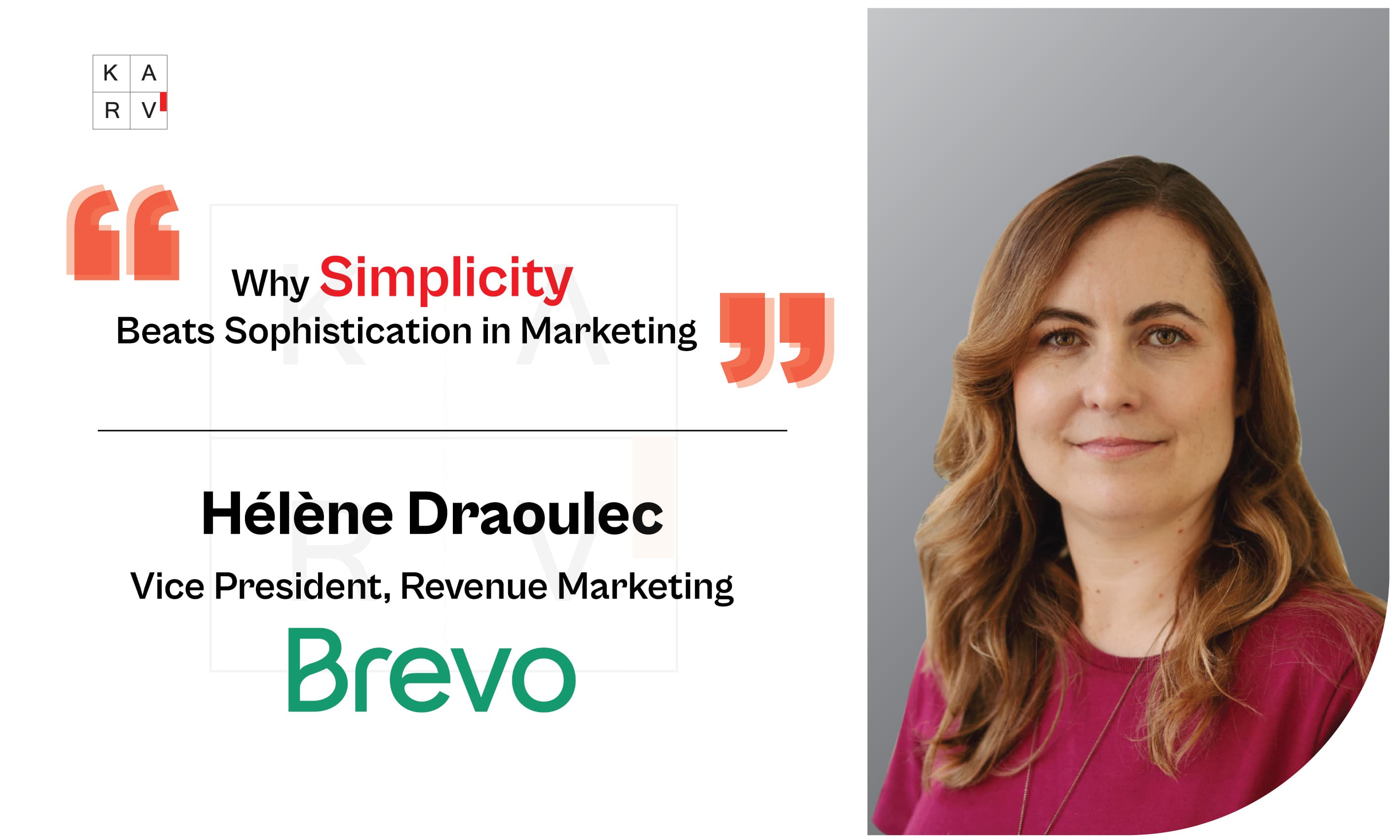
Article content
1. Finding the Right Mission
Your recent announcement mentioned that it took 15 years to find your ideal company profile. Looking back on your career, what experiences shaped your leadership philosophy, and what ultimately convinced you that Brevo was the right place for your next chapter?
A:
It took me 15 years to define my leadership philosophy and what actually matters to me: a mission to untangle customer experiences, a product loved by customers, a founder who thinks fast, managers who know how to decide and set direction, a culture built on collaboration and entrepreneurial spirit, social values you actually live by (not just post about), and, of course, hypergrowth and profitability are the cherry on the top.
My experiences at other companies have helped me realize that I need this foundation to thrive, and that if even one of these criteria is missing, I can quickly become unhappy. Now that I'm in my forties, I won't compromise on these criteria anymore.
Brevo ticks every box. We're profitable at $200M+ ARR with 600,000 customers and B Corp certified since May 2025.
2. The Changing Role of Marketing Leaders
Marketing has evolved from a brand-building function into a strategic driver of business growth. How do you see the role of today's marketing leaders changing, and what capabilities are becoming essential in an AI-driven business environment?
A:
Right now, most martech spend doesn't have a clear return story. Complexity is masking ROI. What's changing is that CMOs are far less tolerant of this than they used to be. They're done with 18-month implementations and exponential cost growth promised as "sophistication." They want platforms that work immediately, cost fairly, and let them stay in control.
AI is a game changer here in that it makes marketing dramatically more accessible. But it’s not a solution on its own. AI amplifies what already works (and what doesn’t). If your data is fragmented, AI amplifies fragmentation. If your strategy is muddled, AI amplifies that at scale.
What needs to happen for AI to democratize martech is having a solid foundation - the centralized data and unified stacks that create consistent intelligence under agents. That’s the differentiating capability.
3. Customer Relationships in the AI Era
Customer expectations continue to evolve as AI becomes more deeply integrated into every stage of the customer journey. How can organizations use AI to deliver more meaningful and personalized customer experiences while maintaining authenticity and trust?
A:
AI can either make your marketing more authentic or more obviously fake. The outcome depends on what's actually feeding it. Content created without knowing who your customer is will be generic, whether AI wrote it or not. Being informed is the beginning. It makes you relevant, not necessarily trusted.
Trust depends on how you act on this information and whether you respect the relationship once you understand it.
Signals like churn risk or engagement drop-off shouldn't just trigger another push to buy; they should trigger a genuine "are you still interested?" moment, sent because you noticed someone pulling away, not because you needed an ROI lift from that cohort.
That's the real test of authenticity in an AI-driven world. A brand that uses its customer intelligence to check in when it should, and to check in genuinely rather than just convert harder, is the one that reads as authentic because it knows and respects the person on the other end.
4. Balancing Growth with Customer Experience
Many organizations focus heavily on acquisition, yet long-term success depends on customer retention and engagement. In your view, what separates companies that build lasting customer relationships from those that simply generate transactions?
A:
The difference is when and how they remove friction. One is a banker, the other is a butler.
Transactional companies focus on the point of sale, notably with discounts to close the deal.
Relationship companies remove friction from the experience. Making it effortless to reach a real person fast, over WhatsApp or chat, without a three-day wait. Treating consent as something to earn and keep earning and reducing the unsubscribes down the road. In B2B, for example, it’s providing dedicated support to equip and inform before friction can even happen. In B2C, it’s rewarding loyal behavior and engagement before invisible friction (disinterest) drives them away.
It doesn’t necessarily require innovation. Just a simple shift of using data when it counts for the business, and the customer.
5. The Future of Marketing Technology
The MarTech landscape continues to evolve at an extraordinary pace. Which emerging technologies or trends do you believe will have the greatest impact on marketing over the next three to five years, and how should organizations prepare?
A:
The greatest impact will be how people and technology work together, specifically, simplification through fully connected tools and strategies.
First: AI that goes both deeper and wider. AI is the obvious answer, but the real breakthrough will come from platforms acting as both specialists and bridges.
To go deeper, you need specialized, native AI. As I mentioned earlier, if you just use a general LLM to write content without knowing your customer, your marketing becomes completely generic. You need native agents built into the platform, trained specifically on marketing strategy and your actual customer data.
To go wider, you need bridges. That’s where open standards like MCP come in. It connects the external intelligence of your daily workspace to the deep, native expertise of your platform. Your general LLM can consult your specialized marketing AI, meaning you get the broad reach of your entire business alongside the deep truth of your customer data.
Second: data unification. Not new, but finally urgent. Fragmented data makes AI unreliable and more tedious to work with. The companies winning over the next three years are the ones with cleaner, more consolidated customer data.
Third: simplicity of execution. Marketing teams are tired of complexity. They're moving toward platforms where they can analyze data and execute campaigns immediately and that don't require consultants or 18-month implementations. That's the real shift, not a technology, but a refusal to accept the overhead legacy vendors have normalized.
The emerging technology isn't innovation; it's pragmatism.
6. Building High-Performing Marketing Teams
Great marketing is built by great teams. What leadership principles have helped you build collaborative, high-performing organizations, and what qualities do you look for when developing future marketing leaders?
A:
High-performing teams thrive on psychological safety to disagree. "Disagree and commit" only works if people know you genuinely want their honest perspective. I look for: strategic ambition (revenue/impact, not activity), intellectual honesty (they'll tell me when I'm wrong), and the ability to communicate with cross-functional teams.
I inherited a team of 22. My leverage is narrative clarity as connective tissue. If everyone speaks the same story, execution becomes decentralized and faster.
7. Driving Sustainable Growth
Brevo continues to expand globally while maintaining a strong customer-first approach. How do you balance rapid growth with delivering consistent customer value, and what role does marketing play in that equation?
A:
Most marketing teams choose growth at the expense of customer value. They complexify and add process layers, and growth becomes expensive.
At Brevo, we believe the opposite: simple platforms that scale without overhead.
Rapid growth doesn't require complexity. It requires clarity, knowing what customers actually need, and delivering it. That's what sustainable growth looks like.
8. Looking Ahead
As you begin this new chapter at Brevo, what opportunities excite you most, and how do you see customer engagement, AI, and marketing evolving over the next few years?
A:
The opportunity that excites me most is composability.
Just having an AI integration won't be the differentiator; anyone can connect a general LLM to their software. The real advantage is being the open backbone where specialized marketing intelligence, data, and customer engagement naturally integrate without the lock-in and complexity.
Over the next few years, marketing teams will move away from expecting one behemoth to do everything and lock them in with "sophistication" fees, and toward picking the right piece for each real job. We build a CRM and a data platform ourselves, but you're not locked into using them. Bring your own if you'd rather, and just take the piece that's actually hardest to get right: a customer engagement platform that already covers the full lifecycle (email, SMS, WhatsApp, push, loyalty) as one coherent system, not five more vendors to stitch together within that category alone.
That's the piece where pricing should follow the same logic as the architecture: you pay for the part of the lifecycle you're actually using, not a bundle of extras you're quietly subsidizing.
What excites me is more of the stack getting built this way; composable between categories, but never fragmented within one, and never so monolithic you're locked into paying for parts you don't need.
About Hélène Draoulec
Hélène Draoulec is VP Revenue Marketing for Brevo's Enterprise Business Unit, leading marketing strategy across the company's key markets, France, Germany, the UK and the US, to drive growth in the enterprise segment.
Hélène brings over 15 years of experience in customer experience, B2B marketing and organizational transformation, having held leadership roles at Zendesk, Yext, and more recently Phenix. A recognized figure in the French digital ecosystem, she was named IT Woman of the Year in 2021 and is the founder of the Prix de la Femme Digitale. She holds a degree from Sciences Po Paris.
About Brevo
Brevo offers the most intuitive Customer Engagement Platform for the sustainable growth of all businesses and organizations, including nonprofits. With Brevo, companies benefit from a unified view of the customer journey through an all-in-one marketing and sales platform featuring email, SMS, WhatsApp, chat campaigns, and much more.
Today, more than 600,000 companies, including eBay, H&M, Louis Vuitton, Carrefour, and Michelin, trust Brevo's reliability to deepen their customer relationships. A B Corp-certified company, Brevo employs 950 people worldwide, with its headquarters located in Paris.
For more information, visit www.brevo.com.
Explore Another Exclusive Leader Interview
If you enjoyed this conversation on AI, customer engagement, marketing leadership, customer trust, and the future of marketing technology, you may also like our exclusive Leader Interview with Linda Zebian, Vice President, Communications at Muck Rack.
Linda shares her perspective on AI, trust, Generative Engine Optimization (GEO), strategic communications, and why reputation has become one of the most valuable assets organizations can build in an AI-driven world.
Read the full interview: Linda Zebian, Vice President, Communications at Muck Rack