
Leader InterviewsMarTech Platforms & Strategy
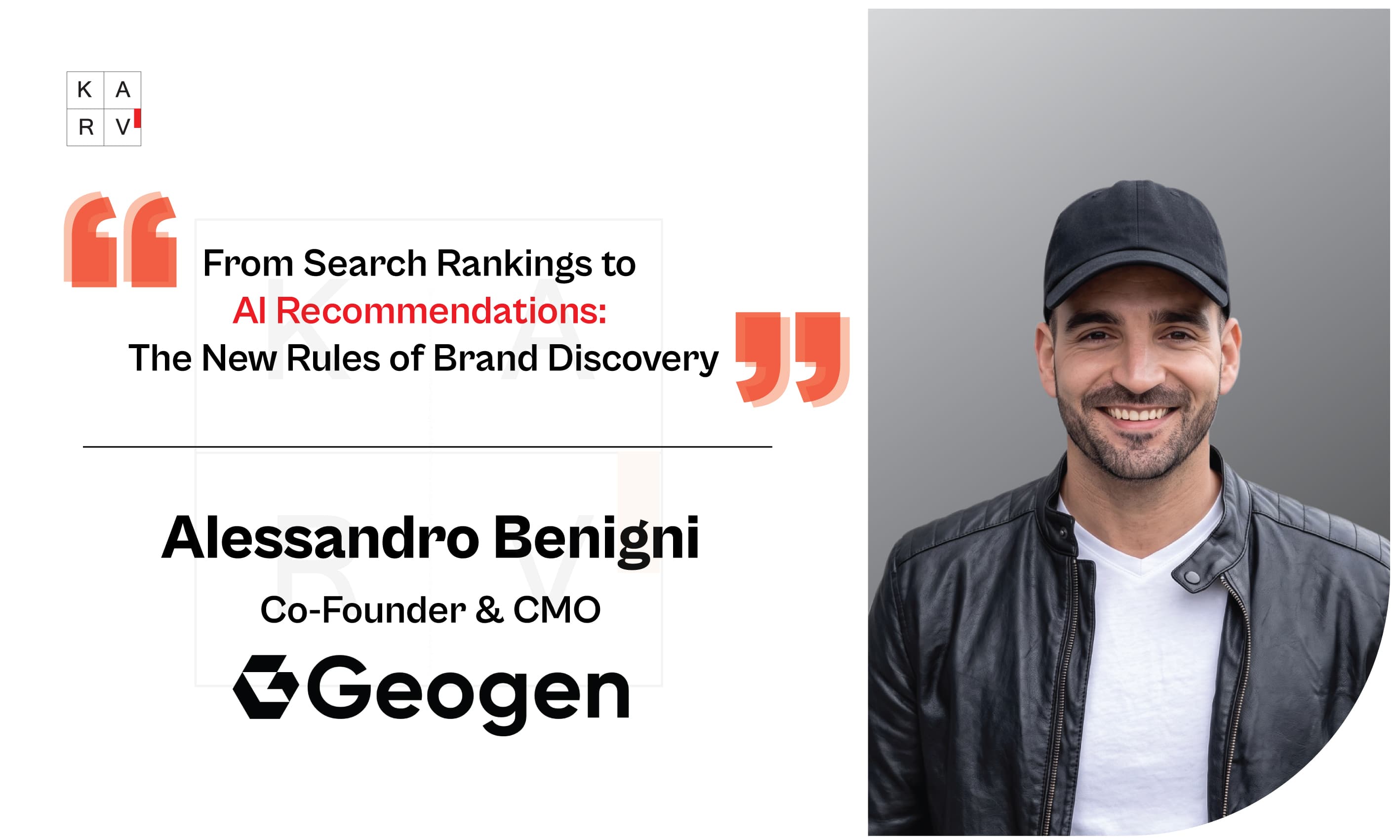
Alessandro Benigni on AI Search, GEO and the Future of Brand Discovery
Article content
1. Building for the Next Generation of Search
Your career has been centered around marketing, growth, and helping businesses adapt to changing digital landscapes. Looking back, what experiences have most shaped your perspective on innovation, leadership, and preparing organizations for the future of search?
A:
Over the past two decades in SEO, I’ve had a front-row seat to the evolution of search. I’ve seen firsthand how compounding organic visibility drives sustainable business growth far more effectively than the ephemeral spikes of paid acquisition. When we observed the exponential rise of AI-driven recommendation engines as a primary channel for inbound lead generation, it was a watershed moment. We recognized that optimizing for Generative AI isn't just a tactical advantage, it’s an existential imperative. Every brand must adapt to this new paradigm to remain relevant in the short term, and to ensure their very survival in the long term.
2. Why GeoGen, Why Now?
GeoGen was built around the idea that Al-powered search is fundamentally changing how people discover brands and information. What convinced you this shift was significant enough to build an entire platform around Generative Engine Optimization, and what problem are you solving that traditional SEO can no longer address?
A:
At its core, consumer behaviour is driven by the pursuit of frictionless experiences and absolute efficiency; users demand immediate, synthesized answers, not a list of links they have to manually parse. Those two behavioural drivers alone guarantee the dominance of AI search. We aren't questioning if the traditional organic search model will be replaced; we are simply modelling when complete market saturation will occur, rendering the classic Google organic experience entirely obsolete.
3. The Rise of Generative Engine Optimization
As Al assistants like ChatGPT, Gemini. Perplexity, and others increasingly become discovery engines, how do you see GEO reshaping digital marketing over the next few years? What should marketing leaders begin doing today to prepare for this new reality?
A:
Within the next few years, traditional organic search will transition from the primary acquisition channel to an optional secondary one, while LLM-driven discovery becomes the absolute priority. For marketing leaders today, my recommendation is to pivot immediately toward measuring Generative Engine Optimization (GEO) metrics. Begin by establishing a baseline for your AI search visibility. Then, reverse-engineer the semantic footprint of the competitors most frequently recommended by these models in your niche. Start with targeted, high-leverage experiments, and scale your resource allocation dynamically as the data dictates.
4. From Rankings to Recommendations
For years, marketers measured success through rankings, clicks, and traffic. Al-generated answers are introducing entirely new success metrics. How should organizations rethink visibility, authority, and brand influence in an Al-first search ecosystem?
A:
The zero-click ecosystem requires a complete overhaul of our KPIs. First, organizations must track "Share of Voice" within AI responses, measuring aggregate presence across the exact conversational prompts your Ideal Customer Profile (ICP) is using. Second, ranking position within those AI outputs still matters deeply; users retain a cognitive bias toward the top of any generated list, a remnant of the Google era. Currently, marketers can influence these metrics by aligning owned media (website, social) with a strong, self-referential semantic narrative, while amplifying that signal through high-authority third-party citations and digital PR. Once foundational visibility is secured, the strategy must shift to capturing highly specific, long-tail conversational prompts, the high-intent queries where your exact offering intersects perfectly with the user's hyper-specific need.
5. Building Brands That Al Trusts
Many organizations are experimenting with Al-generated content, but far fewer understand what makes a brand trustworthy enough to be cited by Al models. From your perspective, what separates brands that become trusted Al references from those that remain invisible?
A:
In the AI-first era, your product is your marketing. Traditional algorithmic manipulation has a rapidly diminishing ROI. LLMs ingest the entirety of the web's sentiment; if your digital footprint is riddled with unsatisfied customers, no amount of optimization will save you. Conversely, a legitimately exceptional product creates a self-sustaining flywheel of semantic authority. Brands must transition to product-led visibility: implement frictionless, automated systems to capture positive reviews from satisfied users, cultivate hyper-engaged communities across social channels, and allow the undeniable quality of your offering to serve as the ultimate trust signal for AI models.
6. Leading Through Constant Change
Technology is evolving faster than ever, requiring marketing leaders to continuously rethink their strategies. What leadership principles have helped you navigate rapid change, and what qualities do you believe will define the next generation of marketing leaders?
A:
The most dangerous trap I observe in the traditional SEO industry is cognitive dissonance. Many practitioners are violently resistant to change because AI disrupts the predictable, deterministic workflows they’ve relied on for years. We are seeing professionals actively boycott the shift toward AI visibility rather than adapting to it. That rigid mindset is toxic, both to their agencies' balance sheets and their clients' market share. The defining qualities of the next generation of marketing leaders will be intellectual humility and radical agility. They must be willing to burn their legacy blueprints the moment the data proves a new paradigm has arrived.
7. Looking Ahead
If you could leave today's marketing and business leaders with one piece of advice as Al reshapes search, content, and digital discovery, what would it be?
A:
Rely on first principles and common sense. As AI models become exponentially more accurate and conversational, ask yourself a simple question: Will users truly want to spend hours scrolling through pages of blue links, filtering through SEO spam, just to be fed results dictated by whichever corporation had the largest budget for backlinks? Of course not. The future of discovery belongs to synthesized, immediate value. Stop optimizing for an outdated algorithm, and start optimizing for the frictionless experience your users are already demanding.
About Alessandro Benigni
I’m Alessandro Benigni. With over 20 years of SEO experience, I’ve successfully driven organic growth for everything from large global enterprises to countless local businesses. Now, I’m Co-founder & CMO of geogen.io, a Generative Engine Optimization (GEO) SaaS platform built to help brands track citations and optimize their visibility across AI-first search engines like ChatGPT, Gemini, and Perplexity.
About GeoGen.io
GeoGen.io equips marketing teams and businesses with the data foundation needed to measure, influence, and optimize how their brands are represented in generative AI systems. Moving beyond traditional SEO, GeoGen.io focuses on Generative Engine Optimization (GEO) to align brand content with how AI models interpret relevance, authority, and trust.
Explore Another Exclusive Leader Interview
If this conversation on AI-powered search, Generative Engine Optimization, brand visibility, digital discovery, and the changing rules of SEO resonated with you, you may also want to explore our exclusive Leader Interview with Karisa Schroeder, Director of Product Marketing at MediaRadar.
Karisa shares her perspective on AI-powered marketing intelligence, proprietary data, creative intelligence, advertising strategy, and why the future of marketing will belong to organizations with intelligence others cannot replicate.
Read the full interview: Karisa Schroeder, Director of Product Marketing at MediaRadar