
Leader InterviewsAdvertising & Performance Marketing
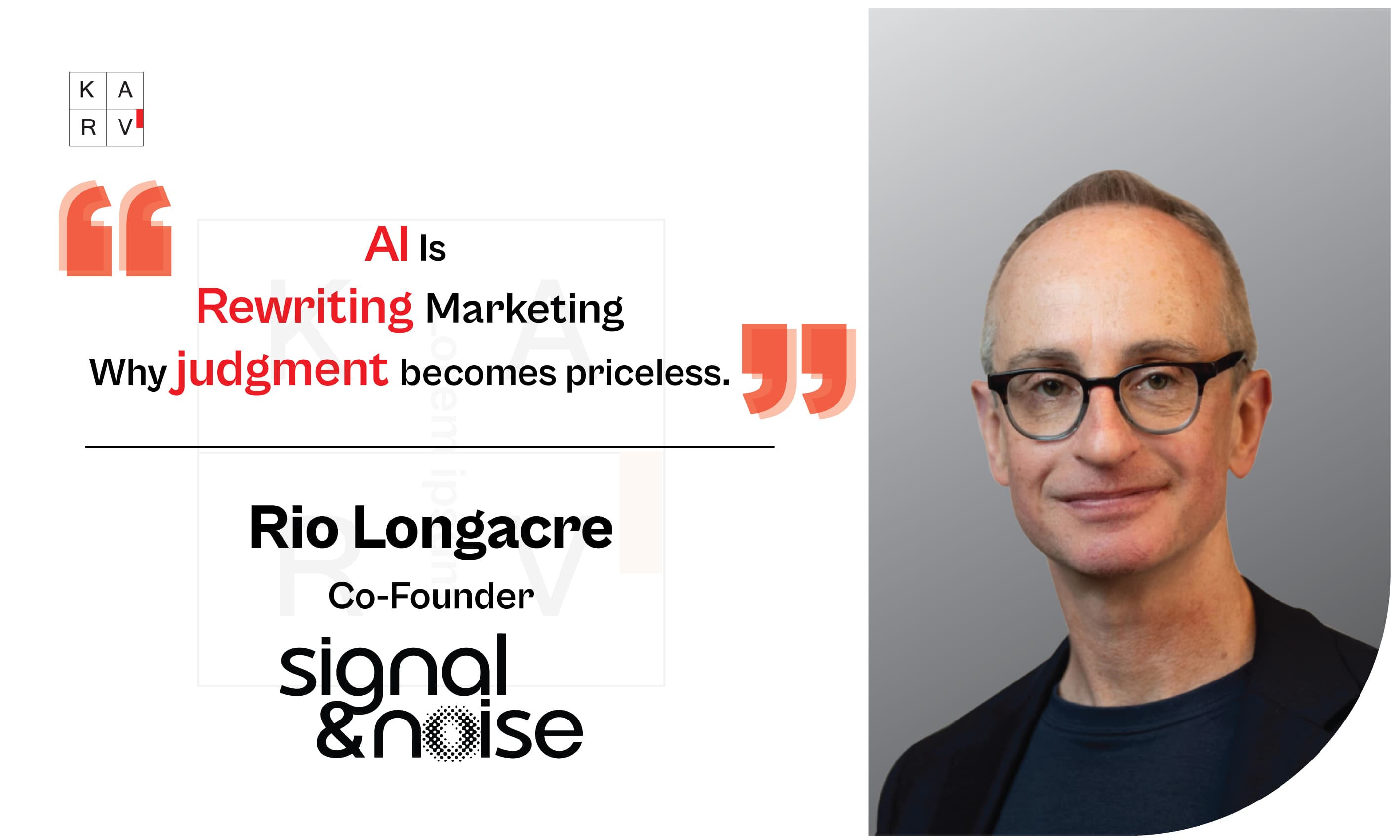
Rio Longacre on AI, Advertising, AdTech and the Changing Future of Marketing and Media
Article content
1. Building Signal & Noise
Signal & Noise has quickly become a respected voice exploring the intersection of AI, advertising, media, and marketing. What inspired you to build the platform, and what gap did you believe existed in how the industry was discussing AI and its impact on marketing?
A:
There is no shortage of podcasts in advertising, media, and AdTech. But Brett House and I felt there was a clear gap: too much of the content felt like advertorial or vendor cheerleading. We wanted to create a place for conversations that were real, deep, and insightful—where the point was not to promote a company or service, but to interrogate an issue that matters.
That is why Signal & Noise is deliberately long-form. Most of our episodes run at least 60 minutes, and some go much longer. Complex topics deserve more than a quick sound bite or a “hot take.” We identify smart people, choose a theme, and then sit down with a leader who can help us unpack it honestly. The conversations are informal and often non-linear… We ask difficult questions, we do not shy away from controversy when it is part of the story, and we are comfortable being a little irreverent when the moment calls for it.
We have welcomed founders, operators, technologists, public-sector leaders, academics, and people from across the media ecosystem. The goal is to keep widening that aperture as the platform grows—because the issues shaping AI, advertising, media, and marketing are too consequential to be understood from only one vantage point.
2. Separating Signal From Noise
AI has created an overwhelming amount of information, predictions, and opinions. As someone who spends every day analyzing where the industry is headed, how do you distinguish meaningful long-term shifts from short-lived trends?
A:
My test is not whether something is new, loud, or generating attention. It is whether there is a genuinely important issue beneath the headline, and whether we can find someone with an informed, distinctive point of view to help interrogate it. We do respond to timely developments. For example, we recently spoke with a University of Colorado Boulder professor about the growing backlash to technology and data centers. But news alone is never enough to make something worth covering.
The more durable filter is depth. We look for smart people who are willing to have a serious conversation about the forces shaping the industry, not simply sell a product or promote their company. Many of our guests are founders, CEOs, or senior executives, and their businesses are naturally part of the context. But every episode is thematic. The real question is whether a guest can help us get closer to the truth of an issue, and whether the conversation will still be useful after the immediate news cycle has moved on.
3. The Future of Marketing Leadership
Marketing leaders today face more change than ever before, from generative AI and automation to changing consumer behavior and evolving media ecosystems. What qualities do you believe will define the next generation of successful marketing leaders?
A:
The first quality is adaptability. The pace of change is faster than anything most of us have experienced in our working lives, and nobody can be expected to understand every development perfectly. Keeping an open mind matters more than ever. The leaders who assume that yesterday's patterns will continue to work tomorrow are increasingly likely to be wrong.
The best leaders will also have real range. They will be deep in a few areas, but broad enough to move comfortably among technical, functional, creative, and commercial teams. AI gives leaders remarkable access to expertise when they need it, but it also raises the premium on people who can bridge disciplines and make sense of the whole system. Much of AI's organizational impact will be about operating models and org design, so comfort with ambiguity and change is becoming a core leadership capability.
Finally, I think taste is becoming priceless. The cost of producing content may approach zero, but judgment—knowing what is worth making, what is worth saying, and what will actually resonate—becomes even more valuable. Great leaders will form strong, informed views about where the world is going, prepare their organizations for several plausible futures, and get more of those calls right than not.
4. AI Is Changing More Than Marketing
Much of the conversation around AI focuses on productivity gains, but its impact extends far beyond efficiency. Which changes do you believe business leaders still underestimate, and how will AI reshape the way organizations create value over the next five years?
A:
The productivity story is real, but it is only the beginning. AI is changing how we use technology and, increasingly, how we work with one another. People are spending more time in AI interfaces rather than navigating a dozen platforms or browser tabs. More importantly, the distance between an idea and a finished output is shrinking dramatically.
I see that in my own consulting work. AI has made it possible for me to spend more time in the trenches creating client deliverables, presentations, and actual work product—not less. I still lead teams and set direction, but many of the laborious tasks that once created distance between a senior leader and the work can now be completed in seconds. That has been liberating.
The larger implication is organizational. Teams are becoming flatter and leaner. The traditional pyramid may increasingly look more like a tower, with fewer layers between strategy and execution. That will redefine what leadership means, how teams are staffed, and how organizations manage change. As AI becomes better at specific tasks, I expect this effect to become even more pronounced.
5. The Next Chapter for Advertising & Media
Advertising has evolved from traditional campaigns to highly personalized, AI-driven customer experiences. Looking ahead, what major shifts do you expect will redefine advertising, media, and customer engagement during the next decade?
A:
Advertising works, and I expect the market to remain robust. As AI changes how people interact with technology, attention will become even more valuable, and new surfaces for advertising will continue to emerge. We have already watched retail media and CTV become consequential channels. Over the next decade, I expect more channels and formats to develop as consumer behavior evolves.
The larger change will be in how media is planned, bought, and sold. Agentic media trading is still nascent, but I believe it will become a meaningful part of the ecosystem. I do not expect a wholesale replacement of programmatic auctions or the current supply path, and there will still be plenty of auction-based trading. But a growing share of inventory will likely be transacted through AI agents, with more direct and reservable deals, particularly as connected TV becomes more prominent.
That shift will create a major reordering in AdTech. Companies that provide tangible value—premium inventory, differentiated data, trusted workflows, or meaningful decisioning capabilities—will have a strong role to play. Intermediaries whose primary function is to take a toll within a transaction may find their models under pressure. New leaders will emerge, and some incumbents, including DSPs and SSPs without clear differentiation, may have to fundamentally rethink their businesses.
6. Learning From the Industry's Best
Through Signal & Noise and Exec Voices, you've spoken with leaders building the future of advertising and marketing. Across those conversations, what common themes or leadership lessons have stood out to you the most?
A:
One of the most reassuring lessons from these conversations is that nobody has the entire future mapped out. There is a great deal of ambiguity right now, and even organizations that appear far ahead are often closer to everyone else in maturity than outsiders assume. Leaders should not mistake uncertainty for failure. The important thing is to stay curious, informed, and willing to adapt as the picture changes.
A second theme is that technology will only become more central to how we work and create value. AI is beginning to make technology more accessible through natural language and voice. A great deal of what we used to think of as coding is becoming a conversation. We are not fully there yet many advanced agentic tools still require meaningful technical fluency—but the direction is unmistakable.
Signal & Noise’s Exec Voices, a channel we introduced with executive contributors leading the next generation of media, technology & AI transformation—has also reinforced the value of giving smart people a place to publish quickly and in their own voice. Traditional trade publications still have an important role, but they can be slow, heavily edited, and constrained by format. Many leaders want a more direct way to respond to a changing market with an unfiltered point of view. Signal & Noise was built to meet that need.
7. Looking Ahead
If you could leave today's marketing, media, and business leaders with one piece of advice as AI continues to reshape the industry, what would it be?
A:
My advice is simple: the AI we have today is the worst AI we are ever going to have. Plan accordingly.
The tools, information, and capabilities available to leaders will be materially better in the years ahead than they are today. That can feel intimidating, but it should also be exciting. When I think about how much these tools have improved in only the past two or three years, I am convinced that the organizations willing to learn, experiment, and redesign how they work will have a meaningful advantage. Buckle up.
About Rio Longacre
Rio Longacre is a marketing, media, and technology executive with more than 20 years of experience at the intersection of AI, data, advertising, and customer experience. He is a Partner and Head of AdTech at Credera, Omnicom’s global transformation consulting firm, where he advises organizations on modernizing their marketing, data, and media capabilities for an AI-driven world. Rio is also the co-founder and co-host of Signal & Noise, a media platform and podcast focused on the ideas, technologies, and leaders reshaping marketing, advertising, data, and AI.
About Signal & Noise
Signal & Noise is a media platform for leaders navigating the transformation of marketing, advertising, data, and artificial intelligence. Through its podcast, original articles, executive interviews, and industry conversations, Signal & Noise cuts through hype to explore the practical shifts shaping how companies build brands, use data, engage customers, and create growth. Founded by Rio Longacre and Brett House, it brings together candid operator perspectives from across media, technology, agencies, and enterprise leadership.
Explore Another Exclusive Leader Interview
If this conversation on AI, data, advertising, AdTech, agentic media trading, marketing leadership, and the future of work resonated with you, you may also want to explore our exclusive Leader Interview with Stephen Bates, Founder of Cabot Insights.
Stephen shares his perspective on AI, data intelligence, buying signals, proprietary data, experimentation, and building the next generation of go-to-market systems.
Read the full interview: Stephen Bates on AI, Data Intelligence and Building the Next Generation of Go-to-Market Strategy