
Leader InterviewsMarTech Platforms & Strategy
Redefining Revenue Growth in the AI Era: Karthick Raajha on AI Search, Pipeline Generation, and the Future of GTM
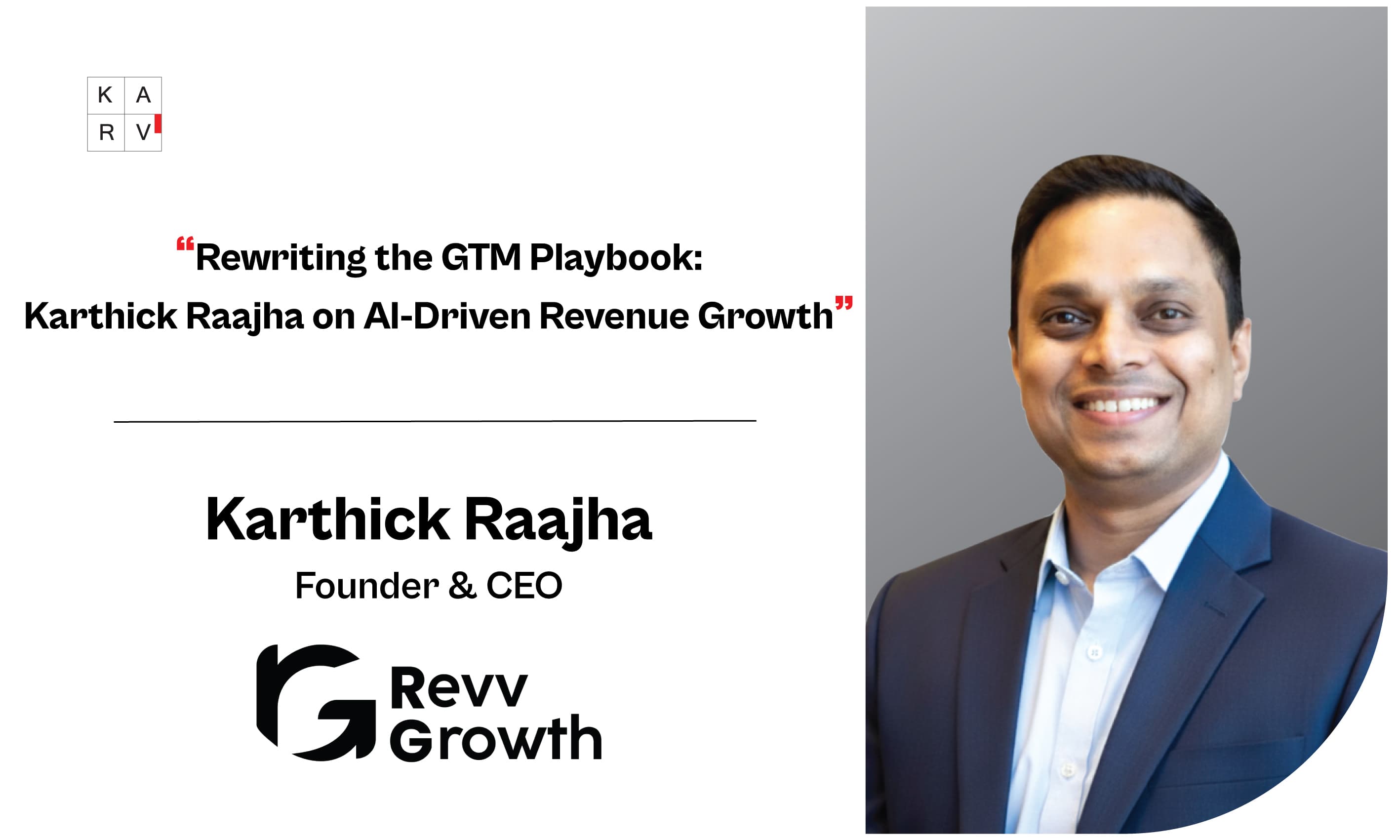
Article content
1. Redefining Growth in an AI-First GTM Era
Q: The definition of “growth” is evolving rapidly as AI reshapes how buyers discover, evaluate, and engage with solutions. How do you personally define modern revenue growth today, and what has fundamentally changed in how companies must think about scaling demand and revenue?
A:
Growth used to mean more traffic, more leads, more pipeline. That thinking still exists and it is not wrong. But it is incomplete now.
The fundamental shift is that the buyer's research journey no longer starts with a Google search. It starts with a conversation. They open ChatGPT or Perplexity, describe their problem, and ask for recommendations. By the time they visit your website, they may already have a shortlist that does not include you.
Modern revenue growth means being present at that earlier moment. Visibility is now non-negotiable. What has changed is the point of influence. It used to be the search result. Now it is the AI answer.
Companies that understand this early are building a compounding advantage. Companies that are still optimising purely for Google rankings are fighting for a shrinking share of a shifting audience.
Growth today is about being discoverable, credible, and associated with your category across every surface where buyers do research. Not just search engines. AI tools, LinkedIn, Reddit, review platforms. All of it.
2. Building RevvGrowth: The Problem Worth Solving
Q: What inspired you to build Revv Growth, and what specific gap in the go-to-market ecosystem convinced you that most organizations were not approaching revenue growth in a structured or scalable way?
A:
I did not start RevvGrowth with a grand vision. I started it because I needed to earn 1 lakh a month and nobody was going to give me a job to do it. I had been consulting for a while when I realized I wanted more, and that is how Revv Growth was born.
But the problem I kept running into with every client was the same. Funded B2B SaaS companies spending real money on content and SEO and having no idea whether it was generating pipeline.
Great dashboards. Growing traffic. Zero connection to revenue.
The agencies they had worked with before were optimising for rankings. Not for leads. Not for demos. Not for the metric that actually keeps a business alive. That gap is what RevvGrowth was built to close.
We are not a content factory and we are not a rankings agency. We are a pipeline agency that uses SEO, content, PPC, AEO/GEO, and paid to drive qualified demand. Every decision we make connects back to one question: is this going to move a potential buyer closer to a conversation with our client's sales team?
Most of the market was not asking that question. They were asking: did we publish enough this month?
Fun fact: The name “Revv Growth” wasn’t our first choice.
3. Where GTM Teams Are Getting AI Wrong Today
Q: AI is now widely adopted across revenue teams, but outcomes remain inconsistent. In your view, what are the most common mistakes or misconceptions companies make when applying AI to go-to-market execution, and why do these gaps persist?
A:
The most common mistake is using AI to produce more of the same thing faster.
Companies are using AI to write more blog posts, more email sequences, more LinkedIn content. But if the strategy was wrong before, AI just helps you be wrong at scale.
The second mistake is treating AI adoption as a content production problem rather than a buyer intelligence problem. The most valuable use of AI in GTM right now is not content generation. It is understanding what your buyers are asking, where they are asking it, and what signals indicate they are close to a buying decision.
Third: ignoring how AI has changed the buyer's research process. Your buyers are using AI tools to shortlist vendors before they ever visit your website. If your GTM strategy does not account for that, you are investing in the wrong stage of the funnel.
The gap persists because most teams are measured on outputs. Content published. Emails sent. Leads generated. Not on whether the right buyers are finding them at the right moment. That measurement problem drives the behaviour.
4. The Real Impact of AI on Revenue Engines
Q: Where are you seeing AI create the most measurable impact in GTM today, particularly across demand generation, sales intelligence, and buyer engagement, and where is its value still being overestimated?
A:
Where I am seeing real, measurable impact is in three areas.
Content operations. We run a blend of 50 to 60 percent AI-assisted production and 40 percent human-driven work. This lets us produce the volume a competitive content strategy requires without the quality falling apart. The key is that humans are doing the strategic work. AI is handling structure and drafts.
Buyer research intelligence. AI tools are helping us map what a client's buyers are actually asking, what competitors are being cited for, and where the gaps are. This used to take weeks of manual work. Now it takes days.
GEO tracking and reporting. We have built automated systems that track how often a client's brand appears in AI search responses, which prompts trigger citations, and how that is trending over time. That visibility did not exist 18 months ago.
Where the value is being overestimated: AI-generated outbound. Mass personalised emails at scale are producing diminishing returns fast. Buyers have become very good at filtering AI-generated messages. The outbound game is not won by volume. It is won by relevance and timing.
5. Predictable Pipeline in an Unpredictable Market
Q: In today’s volatile buying environment, predictable pipeline generation remains one of the hardest challenges for revenue leaders. What operating principles or frameworks do you rely on to create consistency and reliability in growth performance?
A:
I am going to be honest. Predictability is hard in a services business and anyone claiming they have fully solved it is probably overselling.
But there are a few things that have helped us get closer to it.
Focus on fewer, better-fit clients: We have less than 20 clients. All of them are B2B SaaS or tech companies at a stage where our work can actually move numbers. We are not trying to serve everyone. That focus means retention is high and referrals are consistent.
Measure what connects to the pipeline, not what looks good on a report. Traffic is a lagging indicator. Demo requests, MQL quality, and LLM-sourced sessions are leading indicators. We track the second set obsessively.
Build content that serves buyers at multiple stages. The companies we work with that have the most consistent pipeline are the ones with content for bottom-funnel buyers, not just informational content for people who are still researching. Most B2B content strategies are top-heavy. Rebalancing that is often the fastest pipeline lever available.
Retention is the foundation. If a client leaves every 6 months, you spend all your energy on acquisition. Long retentions create the margin to do the work properly and build on momentum.
6. ABM, Intent, and the Shift to Precision Revenue Marketing
Q: With increasing access to intent data, behavioral signals, and AI-driven insights, how should B2B organizations rethink account-based marketing and precision targeting to improve conversion efficiency and deal velocity?
A:
ABM is often sold as a technology solution. Install the tool, get the signals, run the campaign. The reality is more complicated.
Intent data tells you who is in-market. It does not tell you why, what they actually need, or how your product fits their specific situation. The teams that are getting real results from ABM are using intent signals as a trigger for a human-led conversation, not as an automation input.
The most underused precision targeting approach right now is GEO-led ABM. Map the specific prompts your target accounts are typing into AI tools. Build content that answers those exact questions. Make sure your brand is associated with those answers. When those accounts search for solutions, you are already part of their consideration set before anyone has sent a single outreach message.
That is a different way to think about account-based marketing. Instead of interrupting accounts that might be in-market, you are being present when they are actively looking. The conversion efficiency is significantly higher because you are not creating demand. You are capturing it.
7. The Future Operating Model of Revenue Teams
Q: As AI continues to automate and augment core revenue functions, how do you see the roles of marketing, sales, and RevOps evolving? What does a high-performing, AI-enabled revenue organization look like over the next 3–5 years?
A:
The roles are not disappearing. They are getting smaller and more specialised.
A marketing team in 3 to 5 years will have fewer generalists and more people who are deeply expert in specific areas: AI search optimization, buyer intelligence, content strategy, conversion. The execution layer will be heavily AI-assisted. The strategic layer will require more human judgment than it does today, not less.
For sales, the change is already happening. Buyers arrive better informed than they used to. The sales conversation is starting later in the journey and needs to be higher quality. Reps who can add genuine insight above what a buyer can find themselves will be valuable. Reps who are just moving a buyer through a standard process will be replaced by better workflows.
RevOps becomes the connective tissue for all of it. The team that ensures the data, tools, and processes are actually talking to each other. That role gets more important as the number of signals and systems increases.
The common thread is this: AI handles volume and pattern recognition. Humans handle judgment, trust, and relationships. Revenue teams that understand that division clearly will build the right operating model.
8. The Future of GTM: What Will Break First
Q: Looking ahead, do you believe traditional demand generation and funnel-based GTM models will still hold relevance, or are we moving toward a fundamentally new AI-native operating model? What parts of today’s GTM motion do you think will break first?
A:
The top-of-funnel content model will break first. The idea that you publish a high volume of informational content, drive traffic, nurture with email sequences, and eventually convert through a linear funnel is already showing cracks.
AI Overviews are answering informational questions directly. Buyers are not clicking through to read the blog post. They are getting the answer and moving on. Companies that built their entire demand generation model on informational traffic are already seeing this in their analytics. They just have not changed the strategy yet.
What replaces it is not fully clear. But the direction is: brand authority over traffic volume, AI search visibility over page-one rankings, and content that earns trust rather than content that just captures a keyword.
The companies that will still be growing in 5 years are the ones that are building deep category authority, showing up in AI recommendations, and creating genuine reasons for buyers to trust them specifically. Not the ones publishing 50 blog posts a month hoping the algorithm rewards them.
The funnel is not dead. But the top of it looks very different now. The sooner revenue teams accept that, the sooner they can build something that actually works.
About Karthick Raajha
Karthick Raajha is the Founder & CEO of RevvGrowth, a B2B SaaS marketing agency based in Chennai. He started the agency with no savings, no funding, and no safety net. Before that: debt, job loss, a resume with no stint longer than eight months, and a period he does not shy away from talking about. Today he runs a bootstrapped, remote team of 45 people serving funded tech and SaaS companies across India and the US. He has been working in B2B marketing for over a decade, with clients including Atlan, EverStage, and Hasura. He writes about SEO, GEO, AI search, and what building a services business from nothing actually looks like.
About RevvGrowth
RevvGrowth is a B2B SaaS marketing agency that helps funded tech and SaaS companies generate qualified pipeline through SEO, content, GEO, and PPC. Based in Chennai with a fully remote team, the agency works with funded companies across India and the US that are frustrated their content and search investment is not translating into demos and revenue. RevvGrowth specialises in connecting marketing work directly to pipeline outcomes, not just traffic dashboards. As AI search changes how B2B buyers discover and evaluate vendors, RevvGrowth helps clients stay visible and credible wherever that research is happening.