
Leader InterviewsMarTech Platforms & Strategy
Dana Averbouch on AI Search, Digital Intelligence, Revenue Marketing, and the Future of Go-to-Market Strategy
Article content
1. A Career Shaped by Product, Marketing, and Growth
Your career has spanned product marketing, go-to-market strategy, demand generation, and revenue growth. Looking back, what experiences have most influenced your perspective on building successful products, connecting with customers, and driving sustainable business growth?
A:
My path has been defined by a constant desire to bridge the gap between product innovation and real-world market impact. Early in my career, I realized that building a great product is only half the battle; the other half is ensuring the right audience understands the value that this product delivers.
My experiences in go-to-market strategy and demand generation taught me that true, sustainable growth doesn't come from a "move fast and break things" approach. It comes from deep, data-driven empathy for the customer's problem. Whether it was my time as a CMO at a smaller, agile organization or my current role at Similarweb, I’ve learned that the most successful solutions are those that solve a specific pain point, and the most successful marketing engines are those that tell that story with precision and integrity.
2. Why Similarweb, Why Now?
Similarweb has become a trusted source of digital intelligence for organizations seeking to better understand markets, customers, and competitive dynamics. What attracted you to the company, and what aspects of its mission and vision resonate most strongly with you today?
A:
We are living through a period of profound digital uncertainty. Organizations are flooded with data, yet many feel less confident than ever about their decision-making. Similarweb resonated with me because we aren't just providing "more data"; we are providing the meaning behind that data. Our mission—to empower organizations to understand the digital landscape—is more critical than ever.
In addition to our traditional business of providing dashboards and analytic tools to marketing teams, we’re increasingly providing data feeds into enterprises and other technology platforms, including the major AI firms. We’re developing AI interfaces to our data that bypass the traditional dashboards, as well as a Model Context Protocol Server that allows AI models to talk directly to our data model.
For us, there are two sides of the AI story. At least two. The part I just mentioned is about AI as part of the enterprise architecture of Similarweb and our large Enterprise customers. Then there is also a huge story about how AI search is reshaping the web and altering consumer behavior. AI is also reshaping our whole technology stack. One of the things we’re putting a lot of work into right now is unifying all the datasets we have available to address digital business questions, rather than letting that data be siloed by product line – stay tuned for details!
Whether it’s helping a company navigate the volatility of AI-driven search or helping an investor understand competitive dynamics in real-time, Similarweb is the source of truth that turns noise into strategic signals and series of actions. That clarity of mission is what gets me excited to come to work every day.
3. The Convergence of Product Marketing and Revenue Marketing
You lead both Product Marketing and Revenue Marketing, two functions that have traditionally operated independently in many organizations. How has the relationship between these disciplines evolved, and why is tighter alignment becoming increasingly important for driving business outcomes?
A:
I wouldn’t argue that combining these functions under one leader is something every organization should do, but it made sense for Similarweb right now. We decided that the best way to maximize our current opportunities was to align frontline marketing and storytelling for our most strategic solutions with go-to-market strategies and feedback from the field about what is working.
We see emerging business opportunities everywhere, which is great, but pursuing them is changing how we need to organize our marketing. We need to be putting targeted messages to different audiences without letting our overall marketing message get muddled.
How we draw the org chart isn’t really the point. The point is achieving that alignment and consistency across channels. The stories we tell with our website, our social media, our webinars, our events, our thought leadership – the whole package – has to align with the strengths of our solutions.
Ultimately, as revenue marketing leader, it’s my job to make sure we deliver results, not just slide decks. I spend a lot of my time gathering feedback on what is and isn’t working and refining our marketing-to-GTM processes.
Fortunately, I had the experience of being a CMO at another, somewhat smaller company, so I know how to delegate parts of the job and make them add up to the results we need.
None of this works without the right people around you. I'm incredibly lucky to have a team I genuinely learn from every day — they bring creativity, rigor, and a bias for impact that pushes me to be better. And I have a manager who truly believes in what we're building and gives us the space and support to do it well. That combination of trust from above and talent around you is what makes ambitious goals feel achievable.
4. Turning Market Intelligence into Strategic Action
Organizations have access to an unprecedented amount of market and customer data, yet many struggle to translate insights into meaningful action. What separates companies that successfully leverage market intelligence to fuel growth from those that simply collect data without realizing its full value?
A:
The gap between "collecting data" and "driving growth" usually comes down to one thing: context. Many companies drown in dashboards that offer retrospective views of what happened, rather than prospective views of what to do next. Successful companies use intelligence as an input for actionable strategy. At Similarweb, we don't just show you that your traffic dropped; we help you understand the "why" by benchmarking your performance against competitors and industry benchmarks in real-time and also provide recommendations on how to fix it with AI agents designed to integrate within the organizations' workflow . It’s about moving from a reporting mindset to an operational one—where your market intelligence platform is as critical to your daily workflow as your CRM or project management tools.
5. How AI Is Reshaping the Modern Buyer Journey
Artificial intelligence is changing how buyers research solutions, discover brands, and make purchasing decisions. From your perspective, how is AI reshaping the B2B buyer journey, and what should marketers do differently to remain visible, relevant, and trusted?
A:
AI has fundamentally shifted the B2B buyer journey from a linear funnel to a much more complex, discovery-driven loop. Buyers are now using AI agents and chatbots not just for research, but to qualify brands before they ever reach out to a human. For marketers, this means "brand visibility" is no longer just about Google Search rankings; it’s about appearing in the conversational output of LLMs like ChatGPT and Gemini. To remain trusted, marketers need to double down on "AI-Proof" strategies—creating deep, unique, and highly valuable content that provides answers AI can’t easily replicate, while simultaneously optimizing their brand’s presence within the AI-generated results that define modern search.
In retrospect, it’s going to feel like digital marketers were spoiled in the era when traditional search was at the center of so much web activity. For years, it was possible to directly track the consumer journey from the search to the click to a conversion activity like buying something or signing up for a webinar. That direct attribution of search to transactions is much more elusive with AI search.
On the other hand, we just concluded a report on the Downstream Impact of AI Visibility where we followed a study group of users who received brand recommendations from ChatGPT across finance, travel and beauty. We found people were 2.5x more likely to visit a brand that ChatGPT recommended, even when they weren't given a direct link and hadn't previously visited the website.
The traffic and the customer conversion may not be as immediate or directly attributable, but they do happen for the brands that get mentioned favorably in AI answers. And not for the brands who don’t get mentioned. So it’s important that we help brands optimize their content so they get those favorable mentions.
6. Building a Unified Go-to-Market Engine
Achieving alignment across product, marketing, sales, and customer-facing teams remains a challenge for many organizations. What best practices have you found most effective for creating a unified go-to-market strategy that delivers measurable growth and customer value?
A:
The greatest friction in B2B growth is often the organizational silo—where Product Marketing, Demand Gen, and Sales are speaking different languages. My experience has been that success lies in aligning these functions around a single, integrated "story" that spans the entire customer journey.
We’ve found success by organizing around industry-specific pods that house product marketing, campaign management, and content within the same unit. This removes the "hand-off" delays that kill momentum. When you connect product messaging to market feedback in real-time, you stop creating separate, disjointed departments and start building a unified machine where every piece of collateral, every webinar, and every sales asset is pulling in the same direction.
7. What Digital Behavior Is Telling Us About the Future of Growth
Given Similarweb's unique visibility into digital behavior across industries and markets, what emerging trends are you seeing in how organizations compete for attention, customers, and market share, and which of these trends do you believe leaders should be paying closer attention to?
A:
We are seeing a massive shift in how organizations compete for attention. We’ve moved beyond the era of simple "traffic acquisition." Today’s battle is about "intent capture" within new platforms. We are seeing a divergence where desktop usage is increasingly the domain of professional, work-related tasks and complex research, while mobile and app usage dominate consumer life and transaction-heavy behaviors. Leaders need to pay attention to where their audience is thinking versus where they are acting. If you aren’t mapping your digital presence to the specific intent—whether it’s navigational, transactional, or research-based—you are likely leaving significant market share on the table.
8. Looking Ahead: The Next Chapter of Marketing and Revenue Growth
As AI, digital intelligence, and customer expectations continue to evolve, what do you believe will define the next generation of marketing and revenue growth, and how should organizations prepare for the opportunities and challenges ahead?
A:
The next generation of growth will be defined by "Agentic AI." We are moving beyond the era of AI as a passive research assistant into an era where AI agents act on behalf of the CMO to execute, optimize, and refine marketing plans in real-time. Organizations that thrive will be those that embrace this shift toward a more holistic, integrated approach. At Similarweb, we call this "Similarweb Complete." It’s our vision for a future where CMOs don't just look for "AI visibility," but instead get the full picture of their digital performance—from top-of-funnel brand awareness to bottom-line conversions—all within a single, unified intelligence layer that allows for continuous, automated optimization.
About Dana Averbouch
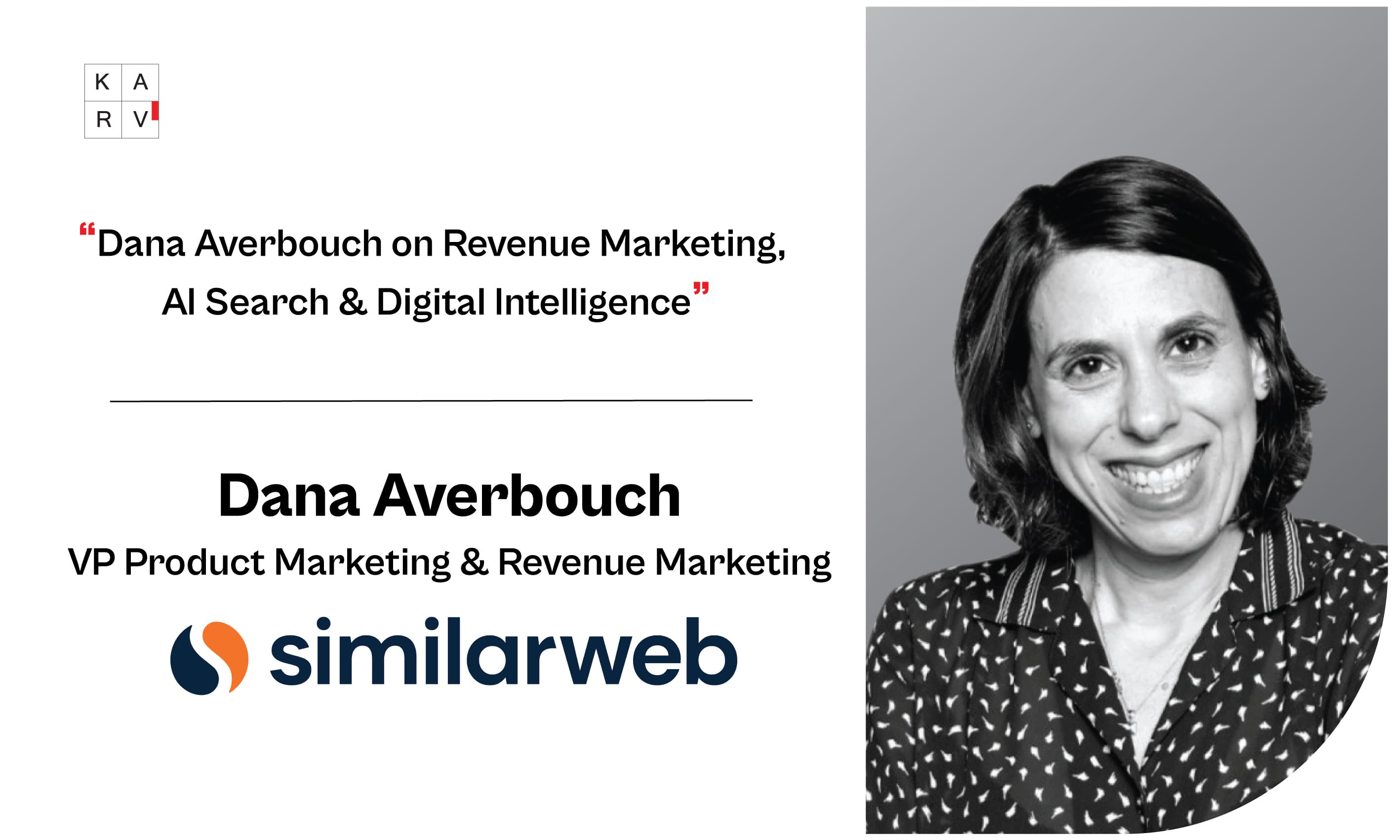
Dana Averbouch is a senior marketing executive with over two decades of experience leading growth strategy for global B2B technology companies. As VP of Revenue and Product Marketing at Similarweb, she drives go-to-market strategy at the intersection of data intelligence and commercial impact. Prior to Similarweb, Dana served as CMO at Panaya and VP Marketing EMEA at NICE Ltd., where she built and scaled high-performing marketing organizations across global markets. She holds an MBA from Tel Aviv University and is a mentor at Gvahim, supporting immigrants building careers in Israel.
About Similarweb
Similarweb is a leading digital intelligence platform that provides comprehensive data on website traffic, mobile app performance, and user behavior. By acting as an "outside-in" lens for the internet, it allows companies to track their competitors, analyze market trends, and optimize their digital marketing strategies. Publicly traded on the NYSE, it is a go-to tool for thousands of global enterprises looking to benchmark their performance against the rest of the web.