
Leader InterviewsMarTech Platforms & Strategy
Dr. Kartik Nagendraa on Marketing Courage, AI-Native Organizations, Thought Leadership, and the Future of Trust
Article content
1. The Evolving Role of the CMO
Having led marketing across startups, scale-ups, and global enterprises, how do you define the role of the modern CMO today, and what has changed most significantly over the last decade?
A.
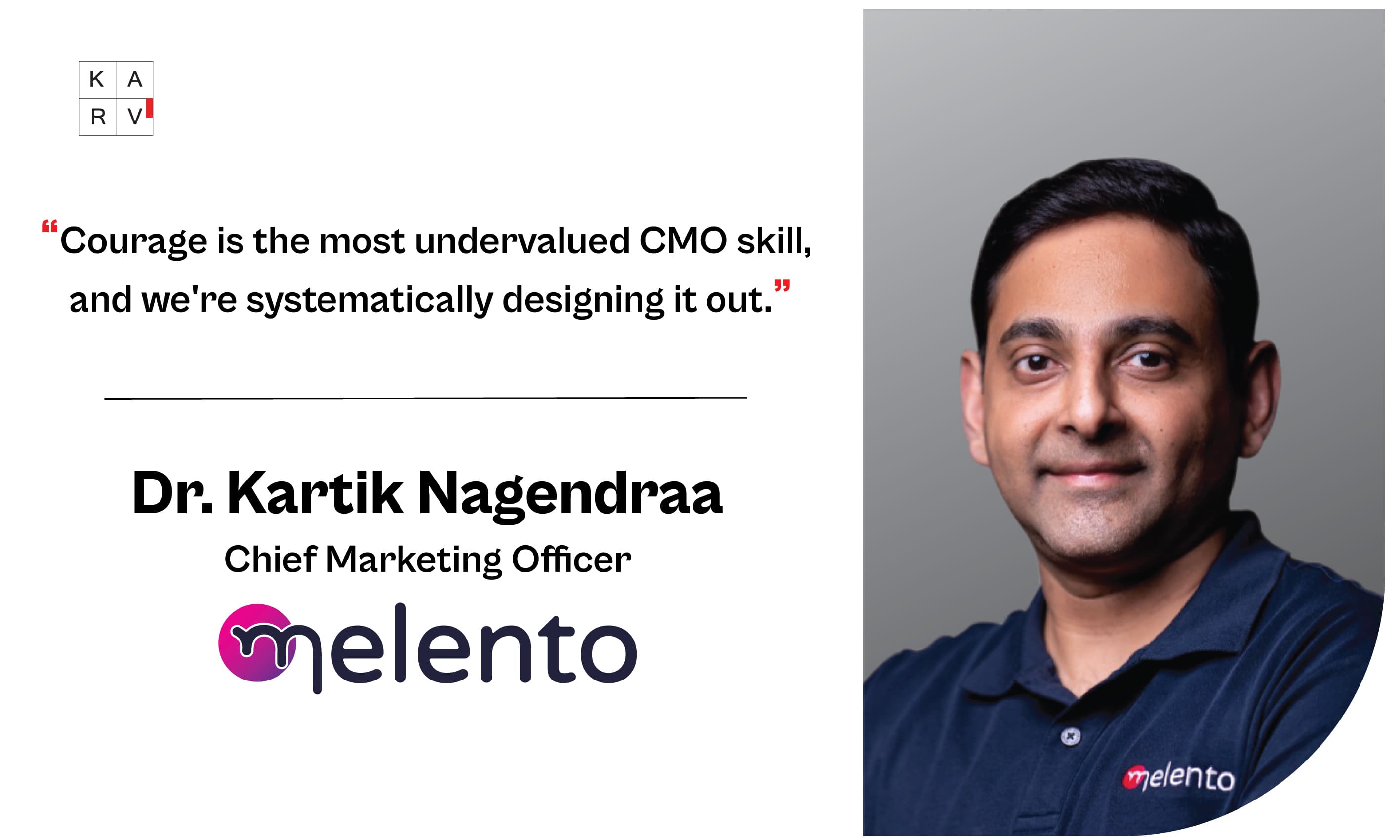
Everyone says the CMO has become more strategic, more data-driven, more accountable. I'd argue the opposite has happened. We've buried the CMO under dashboards and attribution models until the role lost its original superpower conviction & creativity. The most dangerous trend in modern marketing leadership isn't lack of data; it's the paralysis of too much of it. The CMOs who moved markets over the last decade weren't the ones with the best analytics stack. They were the ones willing to make a bet before the data confirmed it. Courage is the most undervalued CMO skill, and we're systematically designing it out.
2. Building Marketing for an AI-Native Future
As CMO of Melento, an AI-native collaborative intelligence platform, what market shifts convinced you that organizations need a fundamentally new approach to intelligence, collaboration, and decision-making?
A.
The prevailing narrative is that AI is transforming how organizations make decisions. My view is that most organizations haven't fixed how humans make decisions yet, and AI is amplifying that dysfunction rather than solving it. What convinced me we need a fundamentally new approach wasn't a technology shift, it was watching brilliant people consistently reach wrong conclusions not from lack of data, but from lack of shared context. AI tools layered onto misaligned teams don't produce intelligence; they produce faster, more confident mistakes. The real market shift isn't about adopting AI. It's about building organizations whose thinking infrastructure is actually worthy of it.
3. From Expertise to Influence
Thought leadership has been a recurring theme throughout your career. Why do so many organizations struggle to establish authority in their markets, and what separates true thought leadership from content noise?
A.
Here's what most marketing leaders won't say publicly: the thought leadership industry has become a credentialing performance. Organizations struggle to establish authority because they're too afraid to hold a position anyone would disagree with. Real authority is earned through friction, not frequency. The brands and leaders who built genuine market authority did so by saying something that made their peers uncomfortable. The moment you optimize thought leadership for likes, you've already lost the plot. Stop measuring reach. Start measuring how many people changed their minds because of what you published. But for that to happen, you as a brand and the leader must carry the courage to take the contrarian stand.
4. Marketing in the Age of AI
As AI becomes embedded in every aspect of business, how do you see the balance between human creativity, strategic thinking, and machine intelligence evolving within marketing teams?
A.
The mainstream conversation positions AI as a creative accelerator for marketing teams. I think that framing will age poorly. AI won't augment human creativity in marketing — it will expose how little of what we called creativity was actually creative. Most marketing content was formulaic before AI; AI just makes the formula faster and cheaper. The genuinely irreplaceable human contribution is judgment about what matters and why. The marketers who thrive won't be the ones who learn to prompt AI better. They'll be the ones who develop strong enough convictions that they know when to override the machine entirely.
5. Rethinking B2B Growth and Customer Engagement
Today's buyers are more informed and independent than ever before. How should B2B organizations rethink growth, account-based marketing, and customer engagement in this new environment?
A.
Everyone is racing to meet buyers where they are - more content, more channels, more self-serve journeys. I'd push back sharply. The informed, independent buyer isn't a problem to accommodate; they're a signal that most of what sales and marketing traditionally did added no value. The ABM playbook as currently practiced is largely retrofitted spray-and-pray with better targeting. Paradoxically, as digital noise reaches saturation, the highest-converting surface in B2B will be the room - the roundtable, the executive briefing, the working workshop where real problems get named without a pitch deck in sight. True account-based growth means fewer accounts, deeper relationships, and the discipline to walk away from opportunities you aren't built to win. The growth unlock isn't more touchpoints. It's the courage to pursue fewer conversations with far greater intentionality - and the wisdom to have those conversations in person.
6. Building the Next Generation of Marketers
As a professor and industry practitioner, what skills and mindsets do you believe future marketing leaders must develop to succeed in an AI-first world?
A.
Every conversation about future marketers emphasizes AI literacy, data skills, and tech fluency. I'll argue those are table stakes, not differentiators. The skill that will separate the next generation is epistemic. Can you form an original hypothesis? Can you defend a position under pressure without retreating to consensus? Can you tell the difference between a trend and a distraction? We are training marketers to be excellent operators of existing frameworks. We are not training them to build new ones. The next marketing leaders will be defined by intellectual independence, not tool proficiency. Teach people to think, not just execute.
7. Leadership in a Time of Constant Change
Drawing from your experience as both a business leader and certified coach, what leadership qualities have become most critical for navigating uncertainty and disruption?
A.
The dominant leadership conversation focuses on resilience, adaptability, and emotional intelligence. Those matter. But I believe the most undervalued leadership quality in disruption is the willingness to name reality before others are ready to hear it. Most leadership failures I've observed weren't failures of courage in the dramatic sense they were failures of honesty in the mundane sense. Leaders who couldn't say "this strategy isn't working" soon enough. Coaching taught me that people don't resist change; they resist ambiguity. The leader's job in uncertainty isn't to project confidence. It's to provide clarity, even when that clarity is uncomfortable.
8. Looking Ahead
As you look at the convergence of AI, marketing, and business intelligence, what major shift do you believe will define the next five years, and how are companies like Melento preparing for that future?
A.
The consensus prediction is that AI will transform marketing, decision-making, and competitive advantage. My view: the biggest shift won't be technological, it will be reputational. In a world where any company can generate content at scale, publish thought leadership on demand, and automate personalization, the scarce resource becomes trust. Growth-stage companies that win the next five years will be the ones that built genuine category authority early, invested in relationships before they needed them, and had the discipline to stand for something specific rather than everything possible. The danger for ambitious AI-native companies isn't moving too slowly. It's growing fast while remaining invisible to the buyers who actually matter and waking up to find that a competitor with a clearer narrative owns the conversation you were qualified to lead.
About Dr. Kartik Nagendraa
Dr. Kartik Nagendraa is Chief Marketing Officer at Melento and an award-winning marketing leader with more than 20 years of experience driving growth and building impactful marketing programs across technology, education, retail, consulting, and other global industries.
A recognized thought leader, his insights have been featured in Forbes, Business Standard, Impact, and People Matters. He is the author of The Thought Leader Way, which has been recognized by leadership expert Marshall Goldsmith as a definitive guide to thought leadership marketing.
Dr. Nagendraa has been recognized among Thinkers360's Top 100 Global Marketing Thought Leaders, LinkedIn Top Voices, and CMS Asia's Top 10 Content Marketing Leaders in APAC & Japan. He also serves on the Harvard Business Review Advisory Council and LeanIn India's HeForShe initiative, while actively mentoring leaders and organizations as a certified executive coach.
About Melento
Melento (formerly Signdesk) is the world's first AI-powered collaborative intelligence platform that helps enterprises streamline contracting workflows, strengthen governance, reduce operational complexity, and unlock strategic insights through automation and AI. The company serves more than 3,000 brands globally and processes over 75 million transactions annually.