
Leader InterviewsMarketing Automation
From Revenue Marketing to AI Decisioning: Rony Vexelman on the Future of Enterprise Growth
Article content
1. Revenue Marketing & Business Outcomes
Q: You've helped scale marketing-generated ACV significantly at Optimove. What separates today's high-performing revenue marketing teams from traditional B2B marketing organizations?
A:
The shift is that revenue marketing teams have stopped pretending the funnel exists in isolation. We don't optimize for MQLs anymore - we optimize for pipeline that closes and renews. The high-performing teams I see today share three traits: they own a number alongside sales (not just "marketing-sourced," but actual ACV influence), they treat segmentation as a creative discipline rather than a database problem, and they use AI to compress the gap between insight and action.
Traditional B2B marketing was built around campaigns. Revenue marketing is built around accounts and outcomes. At Optimove we restructured our marketing org around the same principle we sell to our customers - that the best growth comes from orchestrating across journeys, not pushing through channels. Once you internalize that, the work changes. You stop measuring impressions and start measuring whether a buyer actually moved. The teams getting this right also stopped chasing volume in favor of velocity: fewer plays, deeper plays, and a tight feedback loop with sales on what's converting and why.
2. AI, Personalization & Customer Lifecycle Engagement
Q: AI is rapidly reshaping CRM marketing, personalization, and customer lifecycle engagement. How do you see AI transforming customer marketing over the next few years, particularly for enterprise brands competing on customer experience and retention?
A:
Here's what I think most CMOs are getting wrong: they're treating AI as a productivity layer when the real opportunity is to treat it as a customer experience layer. For years, CRM marketers had to pick - relevance or reach. Both required tradeoffs. AI finally collapses that choice. You can now run orchestrated journeys where every customer gets the next-best message, on the right channel, with the right offer, based on real-time behavior.
Over the next few years I think enterprise brands will split into two camps. The ones using AI to personalize at the message level will outperform on short-term engagement. The ones using AI to orchestrate decisions across the entire lifecycle will win retention and LTV, which is where the real margin lives.
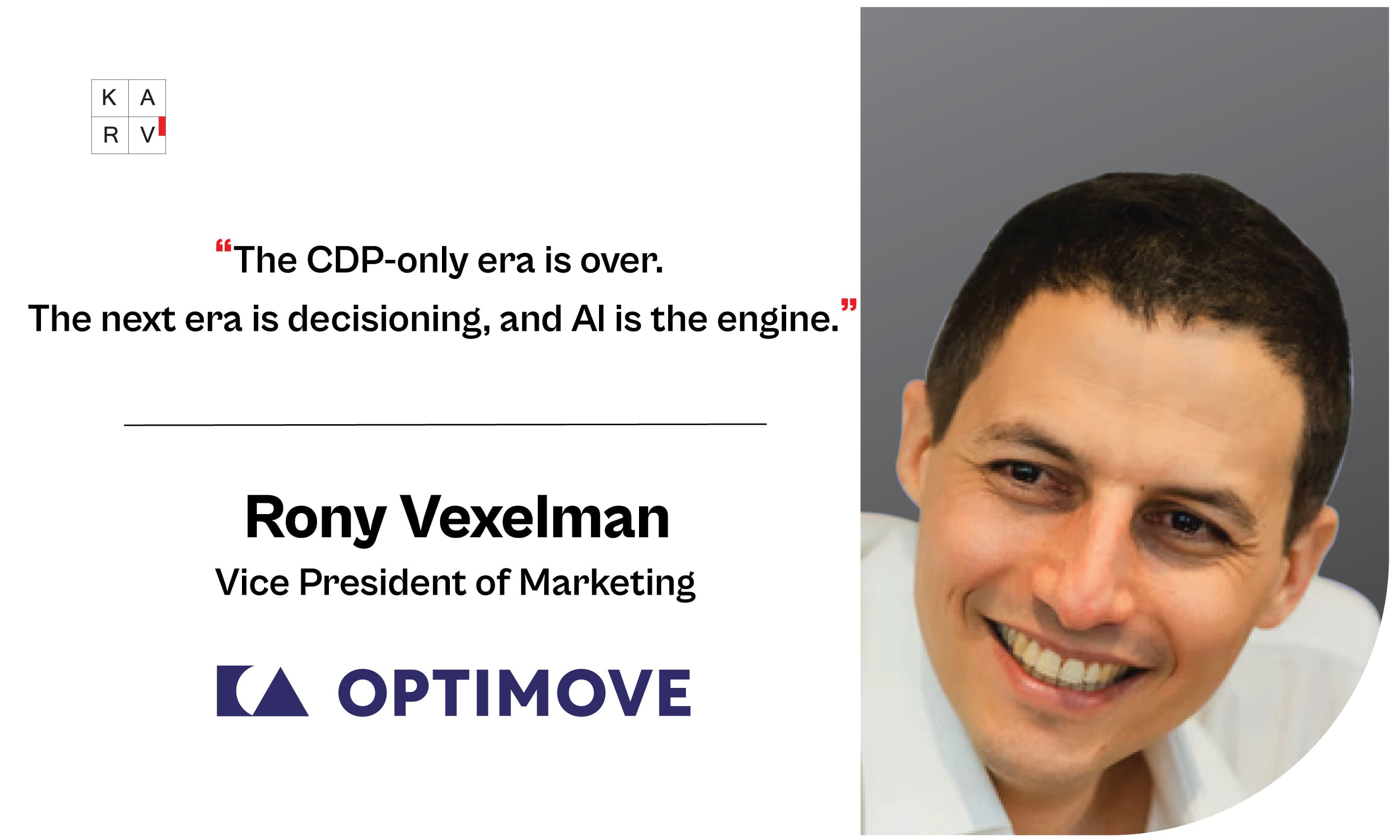
The CDP-only era is over. The next era is decisioning, and AI is the engine.
Brands that build their stack around that shift, and rewire their teams to work alongside the models, will pull away. Everyone else will keep producing more content for fewer results.
3. Category Leadership & Market Positioning
Q: Optimove has strengthened its industry positioning through analyst recognition, customer advocacy, and strategic brand initiatives. In highly competitive Martech categories, how important is category positioning and market perception in driving long-term growth?
A:
Category positioning is the single highest-leverage thing a martech company can invest in, and it's also the easiest to fake. The companies that get it right don't just claim a category, they define a problem the market hadn't articulated yet and become the obvious answer to it.
Analyst recognition matters because analysts validate the language. Customer advocacy matters because it makes the language credible. Awards and visibility matter because they reinforce the narrative. But the underlying work is intellectual - what do you actually believe about how this market is changing, and can you defend that thesis when the room pushes back?
For us, Positionless Marketing was that bet. It started as a point of view and turned into a category because customers and analysts agreed the old model a handful of technical specialists holding the keys for everyone else - was broken.
If you don't have a thesis, you're just doing demand gen with better design.
Category leadership compounds. Brand equity is the longest-duration asset on a CMO's balance sheet.
4. Product Marketing, GTM Alignment & Commercial Growth
Q: Having led product marketing, competitive intelligence, and go-to-market strategy, how do you ensure alignment between product innovation, customer needs, and commercial growth in a fast-moving SaaS environment?
A:
Most "misalignment" between product, marketing, and sales is really a vocabulary problem. Each function speaks its own dialect for the same thing — feature, benefit, value prop, use case, outcome — and the misalignment is really translation failure. The PMM job is to be the bilingual layer.
The mechanism I've found that works is simple: every major release gets a single messaging artifact that product, marketing, and sales all sign off on before launch. Not a brief — a real source-of-truth document with positioning, proof, and the customer story. Once that exists, everything downstream pulls from it: sales decks, web pages, emails, enablement, analyst talking points.
The faster the SaaS environment moves, the more important it is to slow down once, in the right place, and get the narrative right.
We rebuilt our PMM motion around that principle and it's done more for GTM alignment than any org-chart change. Innovation only translates to revenue if the field can explain it the same way the product was built.
5. Acquisition Integration & Unified Brand Vision
Q: You've worked on multiple acquisitions and their integration into Optimove's broader GTM and marketing strategy. From a leadership perspective, what are the biggest challenges in integrating acquired products, teams, and narratives into one unified brand vision?
A:
The technical integration is the easy part. The hard part is narrative integration — convincing the acquired team their identity isn't being erased, and convincing the market that one plus one actually equals three. Every acquisition comes with a customer base who bought a specific story, a team who built that story, and a brand that meant something to both. Collapse it too fast and you lose trust on both sides. Don't collapse it fast enough and you live with brand confusion forever.
The thing I've learned is to lead with the customer outcome, not the org chart. What can a customer do after the acquisition that they couldn't do before? If you can answer that crisply, the integration writes itself. If you can't, you have a positioning problem dressed up as an M&A problem.
On the team side, it's mostly about clarity. People will follow a story they believe in, even one that's harder than the one they signed up for. They won't follow ambiguity.
6. Customer Advocacy, Trust & Community Building
Q: From Voice of the Customer initiatives to customer marketing programs and industry awards, Optimove has invested heavily in customer advocacy. How should modern B2B brands approach building stronger customer trust and long-term community engagement?
A:
B2B brands love to talk about community, and most of them don't have one. They have a logo wall.
Real advocacy starts from a different place you actually have to be useful to your customer beyond the transaction. The programs that work are the ones where customers learn something or get something they can't get anywhere else: peer benchmarks, early access, a stage to share their work, a network that advances their career.
Voice of the Customer is table stakes. The real question is what you do with what you hear. We invest heavily in customer advocacy because our buyers trust each other's words far more than they trust ours. A great peer story closes deals we couldn't close on our own.
My advice to B2B brands is to stop optimizing for testimonial volume and start optimizing for the depth of the relationship with your top 50 advocates. Awards and gifts don't build community. Being indispensable to their career does. Get that right and your customers do your marketing for you.
7. Leadership Advice for the AI Era
Q: As someone who has scaled teams, entered new markets, and led strategic transformation initiatives, what advice would you give to future marketing leaders navigating the intersection of AI, growth, and enterprise marketing transformation?
A:
The marketing leaders who will matter in the next five years are the ones who can hold two contradictions at once.
You have to be technical enough to know what AI can actually do, and human enough to know which problems it shouldn't solve. You have to chase growth and protect brand. You have to move fast and have a clear point of view. Most leaders default to one side and let the other atrophy.
My advice and this is what I tell my own team is to stop chasing the next tool and start sharpening your thesis. Tools change every six months. A clear belief about how your market is evolving compounds for years. AI is going to flatten the cost of execution, which means the premium on judgment, taste, and conviction is about to spike. The marketers who win the next cycle will be the ones with the strongest ideas, not the biggest stacks. Get curious about the technology, but don't outsource your point of view to it.
About Rony
Rony Vexelman is Optimove's VP of Marketing. Rony leads Optimove's marketing strategy across regions and industries.
Previously, Rony was Optimove's Director of Product Marketing leading product releases, customer marketing efforts and analyst relations. Rony holds a BA in Business Administration and Sociology from Tel Aviv University and an MBA from UCLA Anderson School of Management.
About Optimove
Optimove, the creator of Positionless Marketing, frees marketing teams from the limitations of fixed roles, giving every marketer the power to execute any marketing task instantly and independently. Positionless Marketing has been proven to improve campaign efficiency by 88%, allowing marketing teams to create more personalized engagement with existing customers.
For two years running, Optimove has been positioned as a Visionary in Gartner's Magic Quadrant for Multichannel Marketing Hubs, recognized for its AI-driven decisioning, prescriptive insights, and proven ability to orchestrate thousands of personalized campaigns in real time across channels.
Its Positionless Marketing Platform includes Optimove Engage and Orchestrate for cross-channel campaign decisioning and orchestration; Optimove Personalize, a digital personalization engine; and Optimove Gamify, a loyalty and gamification platform.
All are powered by Optimove AI, the marketing AI suite that brings AI everywhere marketers work. Inside the platform through Native AI agents for decisioning, analysis, and creation, outside it to external AI tools like Claude and ChatGPT through the Optimove MCP, and into custom-built applications on top of the platform through Optimove Custom Apps.
Optimove has embedded AI in its platform since 2012, paving the way for Positionless Marketing. Today, its comprehensive AI-powered suite is at the leading edge of empowering marketers to streamline workflows from Insight to Creation and through Optimization. Optimove provides industry-specific and use-case solutions for leading consumer brands globally.