
Leader InterviewsMarTech Platforms & Strategy
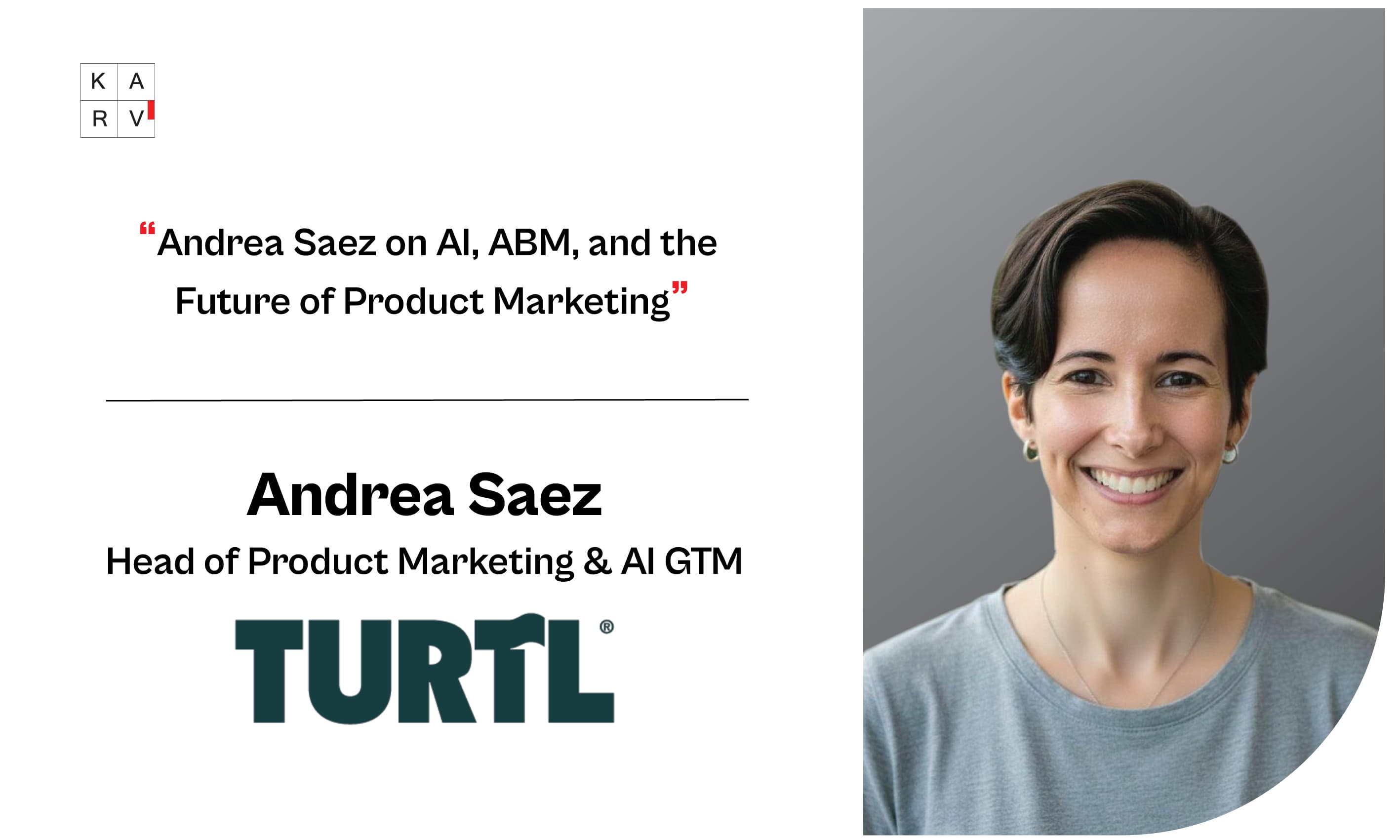
Andrea Saez on Product Marketing, Revenue Content, AI Operations, and the Future of GTM Strategy
Article content
1. Building a Product Marketing Function from the Ground Up
You built the product marketing function at Turtl from the ground up and helped shape its go-to-market strategy. Looking back, what experiences most influenced your approach to product marketing, and what lessons have been most valuable in building a PMM function from scratch?
A.
The honest answer is that building PMM from scratch is less about having a perfect framework and more about deciding what to do first. When you walk into a company with no PMM infrastructure, everything is urgent: positioning, messaging, ICP, launch process, competitive intel, sales enablement. You can't do all of it at once, so the first real skill you develop is sequencing.
My approach was to start with the things that would earn trust with the teams I needed to work with. PMM is fundamentally a cross-functional discipline. You have authority over very little and influence over almost everything. If product doesn't trust your take on the market, your input doesn't shape the roadmap. If sales doesn't trust your messaging, they write their own. So the early investments I made were in customer proximity and competitive clarity, because those are the two things that are hardest for other teams to do well and that PMM is uniquely positioned to own.
Getting in front of customers early, before you have all the answers, is the single most valuable thing you can do when standing up a PMM function. It calibrates everything else. The language customers use, the problems they name, the outcomes they care about: those become the foundation of positioning, messaging, and the ICP work that follows.
The other thing I'd say shaped my approach is the recognition that PMM is a translation function. You're sitting between product, market, and the commercial teams, and your job is to make the signal from each of those legible to the others. The PMM functions I've seen struggle are ones that operate as an output machine, being seen as deck builders or those that put out fires at the last minute. The ones that have real impact operate as a connective layer.
2. Repositioning Turtl for Revenue Impact
One of the most notable milestones in your journey has been repositioning Turtl from an interactive content tool to a Revenue Content Platform. What prompted this strategic shift, and what did it take to align the business around a completely new market narrative?
A.
Our repositioning was based on a series of decisions, each one sharpening the narrative as the market moved around us.
When I joined Turtl, the product was genuinely differentiated but the story didn't match the accountability B2B marketing leaders were starting to feel. Marketing leaders are increasingly on the hook for pipeline and revenue. That shift changed what they needed from their tools, and it changed what they needed to be able to prove. An interactive content platform was a compelling product story, but it wasn't a story that answered the question their board was asking.
The move to Revenue Content Platform is about claiming the outcome, not the output. Marketers don't buy content tools because they love content. They buy them because they need to justify budget, prove commercial impact, and defend their seat at the revenue table. Repositioning Turtl around that accountability unlocked a completely different conversation.
The internal alignment work was harder than the market-facing work. Repositioning a company around a new narrative means every commercial team has to update their mental model simultaneously, eg how sales pitches, how CS frames value, how product prioritizes, how marketing campaigns are built. This can only happen through repeated exposure, consistent language, and making the new narrative easy for each team to use in their own context.
Most recently, the repositioning has continued as AI has reshaped what's possible. Turtl is now the agent-first Revenue Content Platform for ABM. The core insight, that marketing leaders need to close the gap between content investment and revenue outcomes remains, but the mechanism has fundamentally changed thanks to AI.
3. The Growing Strategic Role of Product Marketing
Product marketing is increasingly becoming a strategic growth function rather than a supporting role. How do you see the role of product marketing evolving, and where do you believe many organizations still underestimate its impact?
A.
Most companies still think of PMM as a launch function; someone to write the press release, build the one-pager, run the enablement session, build a deck, etc. That's a fraction of what a high-functioning PMM actually does, and it's the reason so many PMM teams are perpetually under-resourced and underestimated.
What's changing is accountability. As B2B companies face more pressure to connect investment to revenue, the question of what the company actually is in the market, not what it does, but what role it plays in its customers' commercial success, becomes a strategic value point, and inherently a PMM question.
The area where I see the most consistent underestimation is competitive positioning and category strategy through the lens of customer value. Most companies treat competitive intelligence as a tactical exercise: feature comparison tables, objection handling docs, battlecards. The strategic version of that work is defining the category you want to own, the problem you want to be synonymous with, and the narrative that makes your differentiation durable as the market evolves. That work has compounding returns when you thoroughly understand the buyer’s perception of what is valuable to them. Companies that get it right win more deals, they attract better customers, build stronger partner ecosystems, and hire easily because people understand what the company stands for.
The other underestimated area is PMM's role in internal alignment. A company's narrative isn't just external. It's the story every employee uses to explain why the work matters. PMM is often the team that makes that story coherent across product, sales, marketing, and CS. When it works well, it looks invisible. When it breaks down, you see it everywhere: inconsistent messaging, misaligned priorities, and commercial teams working with different definitions of what the product is for.
4. AI's Influence on Modern Go-to-Market Teams
AI is rapidly changing how marketing, sales, and customer teams operate. How are you seeing AI reshape go-to-market execution today, and what opportunities are emerging for organizations willing to embrace it early?
A.
The most significant shift AI is driving in GTM right now is the collapse of time between signal and action. Marketing and sales teams have always had more data than they could act on. The bottleneck has never been data, but the bandwidth to translate insight into the right action for the right account at the right moment.
AI removes that bottleneck in a way that fundamentally changes how you build a GTM motion. The teams I see pulling ahead aren't the ones using AI to write faster or generate more content. They're the ones redesigning their workflows around the premise that the gap between a buying signal and a relevant response can be seconds rather than days.
In practice, that means a few things. Intent signals that used to sit in dashboards waiting for someone to notice them now trigger real-time content personalization, CRM updates, and sales alerts. Account coverage that used to require headcount decisions (which accounts get the full-treatment experience, which get generic outreach) now scales across the entire target list. The personalization work that used to be a specialist task can now happen automatically across hundreds of accounts simultaneously.
The opportunity for organizations willing to move early is a meaningful lead in ABM execution. Full-coverage, personalized, revenue-attributed ABM has been the aspiration for years. The infrastructure to actually run it at scale without a proportional increase in team size is now real. The companies that build systems around that capability rather than bolt AI tools onto existing processes will compound that advantage over time.
The risk I see equally clearly is treating AI as a productivity tool on top of a broken process. If your positioning is unclear, AI will produce more unclear content, just faster. If your account selection criteria are weak, AI will personalize the wrong message for the wrong account more efficiently. The work that unlocks the value of AI in GTM is the foundational strategic work that PMM owns.
5. Building AI Operations Inside Marketing
You have led Marketing AI Operations initiatives at Turtl, creating connected AI workflows across commercial teams. What have been the biggest lessons from implementing AI internally, and where have you seen the greatest gains in efficiency and effectiveness?
A.
The most important thing I learned building AI Operations at Turtl is that context is everything. The quality of AI output is almost entirely determined by the quality of the context you give it. Generic input produces generic output, regardless of how capable the underlying model is. The teams that get transformational results from AI are the ones that have invested in the context layer: the shared understanding of what the company is, who the customer is, what good looks like, and what decisions the AI is authorized to make.
At Turtl, building connected AI workflows across commercial teams meant solving the context problem first. Each team had its own language, its own workflows, its own definition of the customer and the problem. Before AI could do useful work across those teams, we needed a shared context layer that every workflow could draw from.
Where I've seen the greatest efficiency gains is in workflows that previously required human judgment at every micro-step. Research and synthesis work that used to take days: competitive analysis, market research, win/loss synthesis, customer briefing prep, etc. That work doesn't disappear, but the time compression is real, and more importantly, the quality gets more consistent because the AI draws from the same context every time rather than relying on whoever happens to be running the process.
The AI Operations work also surfaced something important about organizational knowledge: a lot of what makes commercial teams effective lives in people's heads, like how to position against a particular competitor, which proof points land with which buyers, or what good messaging for this audience looks like. Building AI workflows forces you to make that knowledge explicit. That process of making tacit knowledge legible turns out to be valuable independent of the AI. It builds organizational resilience and makes onboarding faster, which compounds over time.
6. Product-Market Fit, Customer Insights, and GTM Alignment
Successful growth often depends on deeply understanding customers and market dynamics. How should organizations approach product-market fit validation, customer research, and positioning in an increasingly competitive and fast-moving market?
A.
Product-market fit is a direction, not a destination. It’s never a binary state of being. The companies that treat it as a box to check tend to check it once, declare victory, and then wonder why their growth stalls. The ones that treat it as a continuous question build better products and better go-to-market motions because they keep adjusting to what the market is actually telling them.
The most common failure mode in customer research is conflating what customers say with what customers do. Customers will tell you your product is great, that pricing is fine, that the missing feature is important. Their behavior tells a different story. The research that matters is the kind that closes the gap between stated preference and revealed preference: conversion rates, retention patterns, deal loss reasons, expansion signals. Those tell you where PMF is strong and where it's fragile.
In a competitive market, positioning has to be grounded in the customer's language, not the company's. One of the most useful exercises I've done consistently is mapping the words customers use to describe their problem against the words we use to describe our solution. When those vocabularies diverge, messaging fails, even when the product genuinely solves the problem. Closing that gap is partly a research exercise and partly an editorial discipline.
GTM alignment is where the research work pays off commercially. The most common misalignment I see is between marketing's definition of a qualified account and sales's experience of the accounts that actually close. When those definitions diverge, the pipeline looks healthy on paper while the conversion rate quietly erodes. Fixing it requires a shared language around what good looks like at every stage of the funnel, and that shared language has to be built from actual customer evidence, not from whoever made the biggest case in the last planning cycle.
7. Revenue-Led Marketing and the Rise of ABM
As organizations place greater emphasis on revenue outcomes, account-based marketing and personalization continue to gain momentum. How do you see revenue-led marketing evolving, and what separates successful ABM programs from those that struggle to deliver results?
A.
ABM fails most consistently when it's treated as a marketing channel rather than a GTM strategy. The difference matters. A marketing channel can be owned by marketing. A strategy requires multiple commercial teams to operate with shared account selection criteria, shared definitions of engagement, and shared accountability for the outcome. When you see ABM programs that struggle to demonstrate results, the root cause is almost always that one team is running the program while the others are only nominally participating.
The programs that work have a few things in common. Account selection is rigorous and agreed upon before the program starts, not negotiated retroactively based on whoever has capacity. Engagement is defined at the buying group level, not the contact level, because enterprise B2B deals aren't won by persuading one person. Attribution is built in from day one, not bolted on when leadership asks for the ROI number.
Personalization is where ABM programs most visibly succeed or fail. Generic content delivered to named accounts is still generic content. The accounts on your target list know when they're being treated as accounts versus when they're being treated as individuals with a specific problem at a specific moment in a buying journey. The companies pulling ahead in ABM right now are the ones that can deliver that individualized experience at scale, which is exactly where AI agents are changing the math.
The convergence of ABM and product-led growth is a development worth watching. The conventional wisdom treated them as alternatives: you either build a self-serve product motion or you build a high-touch ABM motion. What's emerging is a model where PLG generates the behavioral signals that ABM acts on. A contact who's been using the product, engaging with content, and showing up in intent data is a completely different prospect than one you're approaching cold. ABM sharpens every downstream investment when it's informed by product engagement data.
8. The Future of Product Marketing
Looking ahead, how do you see product marketing, AI, and go-to-market strategy evolving over the next five years, and what capabilities will define the next generation of high-performing commercial teams?
A.
The PMM role is undergoing the same shift that every knowledge-work function is experiencing: the research and synthesis work is getting dramatically faster, which moves the value up the stack toward judgment, strategy, and the ability to make sense of signals.
Concretely, that means the PMM of the next five years will spend less time on the mechanics of research, positioning documentation, and content production, and more time on the questions that require genuine human judgment: what narrative will resonate in this market at this moment, what are the second-order competitive implications of a product decision, where is the category going and how should we be positioned for it. Those questions can be informed by AI, but they can't be answered by it.
The organizational implications are significant. PMM teams will get smaller but their scope will expand. A single well-equipped PMM can do the research synthesis, competitive monitoring, and messaging production work that used to require a team. The headcount savings create room to invest in the strategic work that most PMM functions currently don't have time for.
For the commercial teams PMM serves, the change will feel like compression. The time between a product insight and a positioned commercial narrative, between a market signal and an updated sales play, between a customer research finding and a revised ICP, will collapse. The teams that build the infrastructure for that compression now will have a structural advantage over the ones that are still treating each of those as slow, manual processes.
What won't change is the premium on customer empathy and the ability to build trust across the business. AI doesn't replace the judgment that comes from spending time with customers, or the credibility that comes from being the person who got the market call right. The craft of PMM, understanding people well enough to say something that changes their behavior, stays irreducibly human. The tools around that craft are just getting dramatically better.
About Andrea Saez
Andrea Saez is a product marketer, author, and builder with more than 15 years of experience helping companies bridge the gap between products that work and products that grow. She is the co-author of The Product Momentum Gap, which explores how organizations can align strategy with genuine customer value. Andrea also built Forma, a platform designed to help teams bring greater rigor to go-to-market strategy, and has been actively developing AI operations frameworks that transform GTM workflows into scalable commercial systems. She regularly writes, speaks, and hosts events on product strategy, growth, and go-to-market excellence.
About Turtl
Turtl is the Revenue Content™ Platform built for account-based marketing and B2B revenue teams. The platform enables enterprise marketing organizations to deliver personalization at scale, capture real-time intent and behavioral insights, and leverage agent-driven ABM workflows that transform buying signals into actionable next steps. Turtl is trusted by organizations including Cisco, AWS, Kantar, and 8x8 to help connect content investments directly to revenue outcomes.