
Leader InterviewsLeadership & Strategy
From Data to Decisions: How Navdeep Singh Gill is Building the Trust Layer for Enterprise AI
Article content
1. Journey & Foundation
Q: You’ve spent over a decade building XenonStack and now leading product at ElixirClaw. What have been the defining moments or shifts that shaped your journey into enterprise AI and platform thinking?
A:
When I started XenonStack 14 years ago, the conversation in enterprise technology was still about big data, dashboards, and digital transformation. The defining shift for me wasn't a single moment, it was a slow realization that enterprises kept hitting the same wall: they had data, models, and pipelines, but they couldn't reliably act on any of it.
The first inflection point was around 2017–2018, when we moved from building data platforms to designing AI-first enterprise architectures across BFSI, Healthcare, Government, and Telecom. We saw how regulated industries struggled not with intelligence, but with trust and traceability.
The second shift came with Generative AI which I wrote about in Hyperautomation with Generative AI. That's when I realized models alone would never be the bottleneck. Context, governance, and execution would be.
ElixirClaw is the natural continuation of that journey. After a decade of watching enterprises fail at the "last mile" of AI, I'm now building the infrastructure that makes autonomy trustworthy, the Context OS as the control plane between intelligence and action.
2. From Data to Decisions
Q: A recurring theme in your work is making complex systems more intelligible and actionable. What core problem are you most focused on solving today when it comes to enterprise AI?
A:
The core problem I'm focused on today is what I call the Trust Tax, the hidden 30–40% operational cost enterprises pay because nobody can prove their AI is right.
It manifests as compliance teams manually reviewing agent decisions, senior engineers re-running every recommendation, and meetings that exist only because nobody trusts the dashboard. The AI isn't necessarily wrong, it just isn't provable.
My focus is making decisions, not just data, the first-class citizen of enterprise AI. That means decision traces instead of logs, machine-readable governance instead of PDF policies, and context provenance that shows where data came from and when it was last valid. When organizations build these into the infrastructure rather than as afterthoughts, they ship AI into production roughly 3x faster.
The shift is from "what did the model predict?" to "why did the system decide that, with what evidence, and who is accountable?"
3. Building Context OS
Q: At ElixirClaw, you’re building a Context OS for agentic AI. How do you see “context” evolving as the foundational layer for autonomous systems in enterprises?
A:
Context is becoming what the operating system was for the PC era and what the cloud became for SaaS, the foundational layer that everything else assumes.
Today, most enterprises treat context as ephemeral. An agent answers a query, the session ends, and the context dies with it. Nothing compounds. That's why most agents that companies believe are at L3 or L4 maturity are actually stuck at L2 in our Agent Maturity Model.
Context OS evolves through three layers. First, context assembly, moving from fragments of retrieved data to decision-grade context with identity resolution, freshness scoring, and policy attached. Second, context governance, every decision evaluated against policy before execution, not audited after. Third, context memory, agents that remember what they decided, why, and what alternatives they rejected, so the system compounds intelligence over time.
In the next phase, context won't just feed agents, it will govern them. It becomes the connective tissue between the System of Intelligence and the System of Action, and the substrate on which multi-agent ecosystems can safely coordinate.
4. Agentic AI in Production
Q: There’s a lot of conversation around AI agents, but real-world deployment is still evolving. What does it take to move from experimentation to production-grade, governed AI systems?
A:
The gap between a demo and production isn't the model, it's everything around it. We've seen agents pass every test set with 97% accuracy, then quietly drift in production for six weeks because they were optimizing on three-month-old pricing data. That's the Confidence Trap, and it's the most dangerous phase of enterprise deployment, when the agent is good enough that nobody watches it anymore.
Moving to production-grade autonomy requires what I call AgentOps as an operating discipline, structured in three layers: observe (decision traces, not just latency), evaluate (decision accuracy, not just uptime), and optimize (where each cycle compounds).
Practically, this means temporal awareness on every context artifact, active invalidation when upstream data changes, confidence degradation as context ages, and decision-level observability that tracks logic drift, not just latency drift. Static RAG won't survive production. You need context that knows when it's getting old, and governance that's continuous rather than monthly.
5. Governance, Trust & Scale
Q: As AI systems become more autonomous, how should enterprises think about governance, compliance, and decision traceability without slowing down innovation?
A:
Governance is too often framed as the brake pedal of innovation. In reality, well-designed governance is the accelerator, because it eliminates the trust tax that slows everything down.
The shift enterprises need to make is from governance-as-document to governance-as-runtime. Before any agent acts, four questions must be answered automatically: What policy applies? Who has authority? What is the evidence? Where is the trace? If your governance lives in a PDF, you can't answer those at machine speed.
I also tell CXOs to stop treating each agent as a separate governance project. Right now, most enterprises have multiple teams independently rebuilding identity resolution, audit trails, and policy logic, six teams, six governance models, six audit formats. When the auditor asks about your AI governance posture, the honest answer is "we have six." That's why an Agentic OS matters: one governed runtime where every new agent inherits identity, governance, memory, and coordination by default. That's how you scale without slowing down, you stop rebuilding the foundation every quarter.
6. Industry Impact
Q: You’ve worked across sectors like BFSI, healthcare, and telecom. Which industries do you believe will see the most immediate and meaningful impact from agentic AI, and why?
A:
I expect the most immediate, meaningful impact in three sectors, in roughly this order.
BFSI will lead because the economics are unambiguous and the infrastructure for governance already exists. Loan underwriting, fraud detection, compliance reporting, and risk operations are decision-heavy domains where decision traceability isn't a nice-to-have, it's a regulatory requirement. We've already seen a fintech agent shift approval rates 11 points in 72 hours and move $14M in decisions silently. Once AgentOps becomes standard, that visibility unlocks enormous value.
Telecom and IT Operations are next, because they are observability-native. SRE, SecOps, and incident management are where agentic systems can deliver Observability 3.0, moving from alerting humans to autonomously remediating with auditable reasoning.
Healthcare and Government will follow, but more cautiously and more profoundly, because the regulatory bar is higher and the stakes are human. Once Context OS-style infrastructure becomes mature, agentic AI will reshape clinical workflows, claims processing, and citizen services.
Manufacturing, shipping, and hospitality follow as Physical AI matures and the digital agents start to extend into the physical world.
7. The Road Ahead
Q: Looking ahead, how do you see the enterprise AI landscape evolving over the next 3–5 years, especially with the convergence of physical AI, multi-agent systems, and real-world execution?
A:
Over the next 3–5 years, I see three convergences reshaping enterprise AI.
First, the Agentic OS layer will consolidate. Today, every team builds its own governance, memory, and coordination. By 2027–2028, that will look as absurd as building three apps on three different operating systems. Enterprises will standardize on agentic runtimes the way they standardized on Kubernetes.
Second, multi-agent systems will move from orchestration to negotiation. Agents will negotiate constraints with other agents, learn from outcomes rather than just inputs, and operate as governed networks with shared context and individual accountability. That's the leap from L3 to L5 in our maturity model.
Third, and this is what excites me most, Physical AI will converge with software agents. The same Context OS that governs a digital workflow will govern a robot, a shipping system, or an embodied agent in a hospital. That's why we're building toward NEXOM X1 in 2026, converging Physical AI, hardware-software integration, and AGI-native automation.
A note of caution: humanoids capture imagination, but they're as much an aesthetic choice as an engineering one. The future of robotics won't be decided by what looks like us, it will be decided by what works better than us. The winners will be task-specific systems and process redesign around robotic strengths, not generalist humanoids.
8. Personal Insight
Q: For young professionals and builders entering the AI space today, what’s one book, idea, or mindset you would recommend they explore to better understand this shift?
A:
For young builders entering AI, the single most important mindset shift is this: stop chasing intelligence, start designing for trust. The constraint in this era is not model capability, it's infrastructure, context, and governance. The boring stuff has become the strategic advantage.
In terms of reading, I'd recommend a combination rather than a single book. Pair Thinking in Systems by Donella Meadows with The Worlds I See by Fei-Fei Li. The first teaches you to think about feedback loops, leverage points, and emergence, which is exactly how multi-agent systems behave. The second grounds you in the human and scientific arc of AI, so you don't lose perspective in the hype.
And one practical idea I'd ask every young builder to internalize: capture decision traces, not logs. What was decided, why, with what evidence, what alternatives were rejected, and what happened next. If you can build systems that do that natively, you're already operating ahead of 90% of the industry.
About XenonStack:
XenonStack is a Data and AI Foundry for Agentic AI Systems, helping enterprises move from data to decisions with real-time intelligence, AI agents, and decision intelligence at scale. Headquartered in Newark, New Jersey, with global delivery hubs, XenonStack designs and operates AI Factories that combine an AI-Ready Data Fabric, Reasoning Engine, Trust & Governance Layer, and Autonomous Applications. With 14 years of experience across BFSI, Healthcare, Government, Telecom, and Manufacturing, XenonStack enables enterprises to build governed, production-grade autonomous systems.
About ElixirClaw:
ElixirClaw is the Agentic Operating Platform for the enterprise a Context OS that transforms AI from experimentation into governed, production-grade execution. It embeds enterprise context, data, workflow state, and policy into AI decision-making, enabling continuous, secure, and scalable autonomous operations.
About Navdeep Singh Gill:
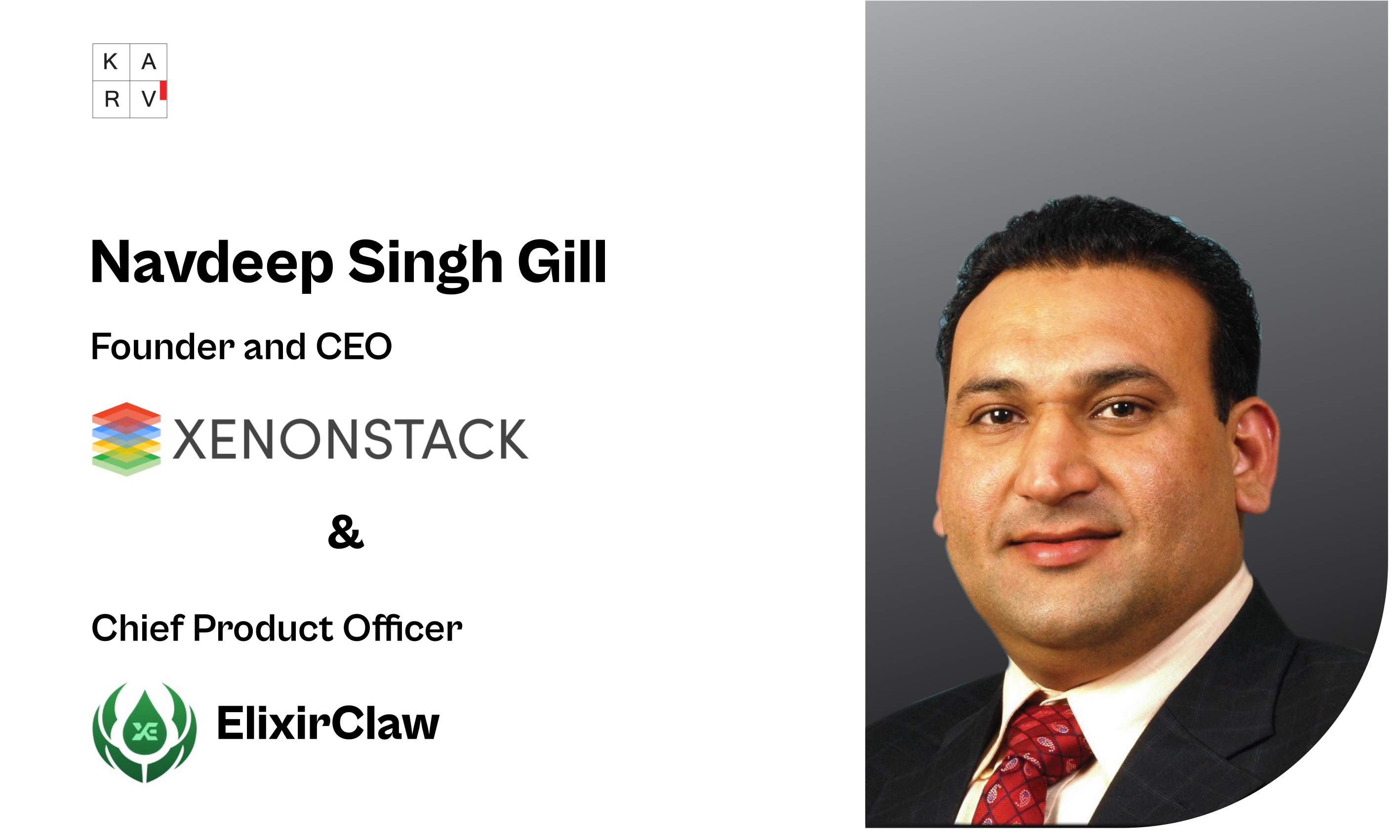
Navdeep Singh Gill is the Chief Product Officer at ElixirClaw and Founder of XenonStack, with over 14 years of experience in enterprise AI, AgentOps, and multi-agent systems. He is the architect behind Context OS and a recognized voice in AI-driven transformation.