
Leader InterviewsAI Business & Ecosystem
Richard Fitzgerald on AI, Modern Media, Advertising and the Future of Digital Publishing
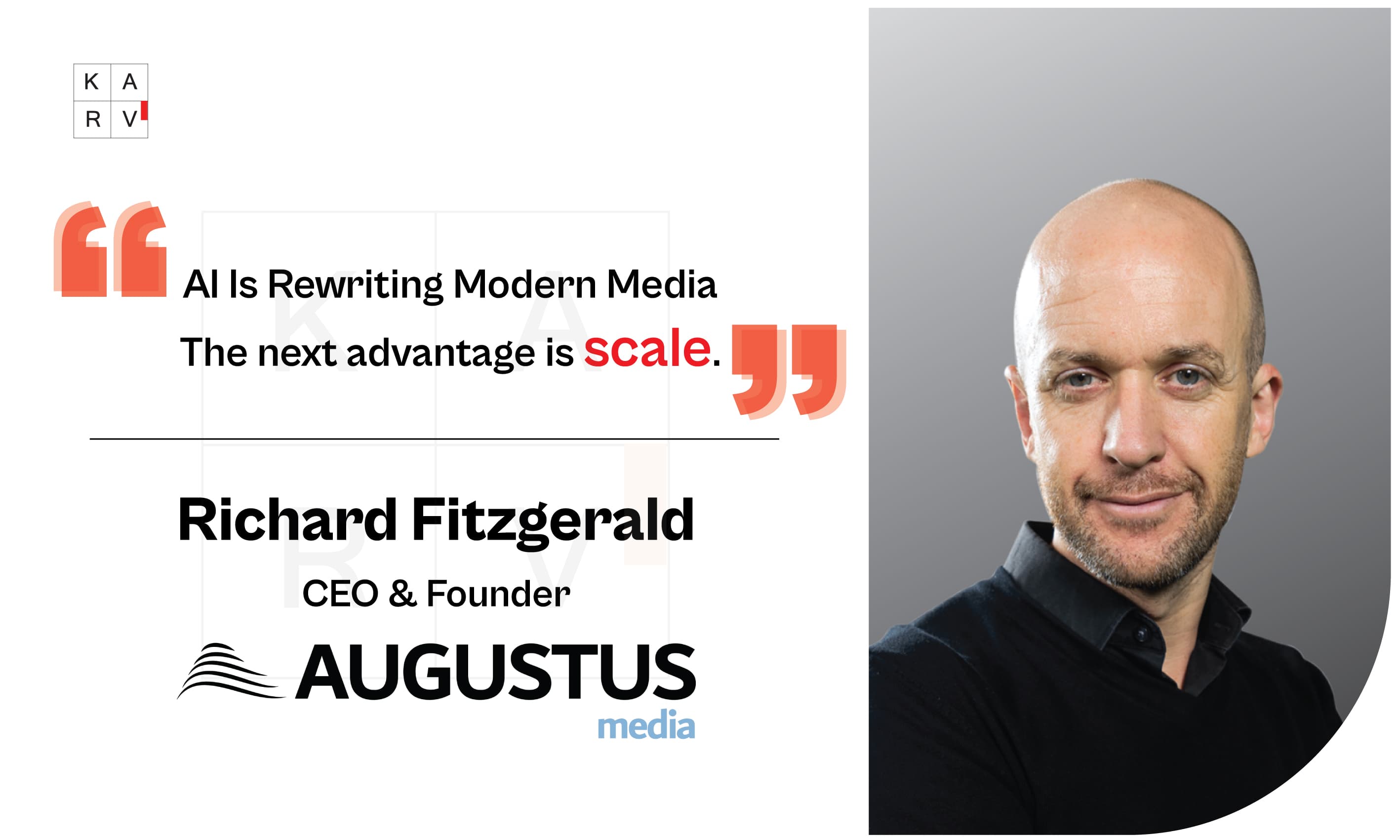
Article content
1. Building a New Media Company
You've spent nearly two decades across advertising, media, and entrepreneurship before founding Augustus Media. Looking back, what experiences shaped your decision to build a modern media company, and what gap did you believe traditional media was failing to address?
A:
“My agency career happened to coincide with the start of social media, and seeing digital media evolve in real time really shaped my thinking. It pushed us toward a real-time agency model always-on, focused on community management, and publishing in the moment. That’s what ultimately led to my vision for a modern media company built around real-time publishing.
Now, news organizations and 24-hour news channels had always operated in real time, but other forms of digital media simply weren't doing that, especially when it came to content creation and being readily available to deliver content for audiences.
The gap we saw was two-fold: first, taking a true digital-first approach rather than treating digital as a secondary thought. Second, it was about the cadence, the publishing frequency, and the formats. Consumer media, particularly in the spaces we entered first, had huge gaps in how it was serving audiences.”
2. Reinventing Digital Publishing
Augustus Media has built brands such as Lovin Dubai, Lovin Saudi, and Smashi by engaging audiences in ways that differ from traditional publishers. How has your philosophy around content, storytelling, and audience engagement evolved as digital consumption habits continue to change?
A:
"To be honest, our core philosophy hasn't actually changed all that much. Our approach has really been about doubling down on what we started with Lovin Dubai ten years ago and replicating that model across multiple cities, as well as expanding it through our Smashi verticals covering business, sports, and branching further into property, style, crypto, gaming, with plenty more to come.
The formats themselves remain very consistent: it's real-time, it captures the zeitgeist of what’s happening in the moment, and it’s heavily focused on curation. Today, there are countless content creators out there, but nobody is really making sense of everything being published. We focus on cutting through all that noise while keeping a native social style.
Now, consumption habits, algorithms, and platforms are constantly evolving, but that’s primarily on the distribution side. As a guiding principle, our commitment to digital-native publishing has stayed completely true.”
3. Winning Attention in the Creator Economy
Consumers today divide their attention across social platforms, creators, publishers, streaming services, and AI-powered experiences. How should media companies rethink audience loyalty, and what separates brands that build communities from those that simply generate views?
A:
"To address what separates community-builders from view-chasers, depth and consistency are essential. It's always tempting to post clickbait or rely on low-hanging viral content like constantly posting about Ronaldo just because the algorithm will serve it to his 600-plus million Instagram followers but then you just end up becoming another generic page.
While publishing what's trending and engaging is definitely required, you have to balance it with consistent depth. At Augustus, we call it having a clear 'media lens.' You need to stand for something and continuously bring content back to that core perspective whether that lens is anchored in a local city, a specific passion point, or a defined vertical to keep it genuinely relevant. That principle holds true across the board, from broad mainstream consumer media all the way to hyper-niche B2B."
4. AI and the Future of Media
Artificial intelligence is reshaping journalism, content creation, audience discovery, and advertising. Where do you see the greatest opportunities for AI within modern media, and how can publishers embrace innovation while preserving authenticity, creativity, and trust?
A:
"When looking at SaaS and operational workflows, there are endless backend processes that can be streamlined with AI. But in terms of how AI-generated content is actually consumed, we still have a way to go before formats feel completely seamless and accepted by audiences.
Since April of this year, we’ve published close to 2,000 AI-assisted articles across an 11-website setup. Those pieces stem from our original curated social posts we essentially work backward from social into other media distribution channels. But it always starts with the journalist or creator; we use AI strictly to assist, amplify, and facilitate extra publishing volume.
On the audio side, we’re known as an industrial user of ElevenLabs given the sheer scale of our output. Across the region, we produce over 70 daily podcasts in both English and Arabic, which simply wasn't possible at this scale previously. Our goal is to scale that to 350 episodes a week instead of relying on a single weekly drop. That audio content then fuels clips, fast-format app feeds, RSS streams, and YouTube.
The same applies to our sports streaming capabilities out of roughly 2,000 games we streamed last season, around 1,000 were produced using AI cameras. Ultimately, AI allows us to execute and distribute far more without compromising the core human element."
5. The Evolution of Advertising and Brand Partnerships
Having worked across both agency and publisher environments, you've seen the relationship between brands and media transform significantly. How do you see advertising evolving over the next few years, and what will brands increasingly expect from media partners beyond reach and impressions?
A:
"Look, the media agency business model isn't going away. Holding companies might be facing structural challenges, but with global digital ad spend well over $200 billion, there will always be a need for media buying and execution services. We're seeing massive growth in retail media, CTV, digital out-of-home, and social performance.
Brands will handle this in different ways some will bring content in-house, some will use AI directly, and others will rely on partners using AI for them. But regardless of the tools, you still need storytellers and smart marketers who understand brand positioning. AI helps, but I've never believed this is a zero-sum game. It’s not a complete AI takeover; it’s a hybrid approach.
As for what brands expect: lower-funnel metrics like ROAS are great, and platforms have done a thorough job educating clients on conversion. But good marketers know that classic media fundamentals reach and frequency still matter. In an influencer-driven ecosystem, people often forget that. They put all their energy into creating a piece of content and hope it works on a single view. Real brand building still relies on repetition, consistency, and sustained presence."
6. Building High-Growth Media Businesses
Growing media brands across multiple markets requires balancing creativity with commercial discipline. What leadership principles have helped you scale Augustus Media, and what qualities do you look for when building high-performing teams?
A:
"Like any organization, it starts with our mission and values, and living up to them as best we can every day. We focus heavily on clear, consistent communication and navigating challenges as they come.
It’s important to remember what kind of business we are: we’re building a media company for the digital era. We’re not a tech company, we’re not a pure sales organization we are a content company that does a lot of social-first publishing around news. Communicating that identity clearly to our teams is critical.
When it comes to the specific qualities in people, we look for the right attitude, a strong work ethic, and real ambition whether that's a desire to grow their career or continuously learn within this sector. We need people who understand our core values, but also understand the values of the region, because regional impact is fundamentally baked into our mission.
Our three core values are tenacity, velocity, and ingenuity. And everything we do ties back to our overarching mission: to become the modern media company of choice in the Middle East and North Africa."
7. Entrepreneurship, Innovation, and Staying Ahead
Media is one of the fastest-changing industries in the world. As a founder, how do you decide which opportunities to pursue, which trends to ignore, and how do you foster a culture that encourages innovation while remaining commercially sustainable?
A:
"When it comes to deciding which opportunities to pursue and spotting where the market is moving, we maintain a very strict focus at Augustus Media: we focus on digital, we focus on the Middle East and North Africa, and we focus on building our own IPs.
When we say digital, we mean text, audio, and video across every native channel apps, blogs, podcasts, newsletters, websites, streaming, and social publishing. For instance, our tech team automates our articles directly into growing WhatsApp communities, and whenever a new platform like Upscroll emerges, we test it. But naturally, the bulk of regional audience attention remains on TikTok, Snapchat, Instagram, and X.
That strict focus on owned IPs across MENA is what keeps us commercially sustainable we stay disciplined around core audience monetization rather than getting distracted.
To handle broader innovation without derailing that commercial focus, I run Fitzy Fund separately. It’s my personal investment vehicle for regional media tech. It allows me to spot macro trends and test emerging concepts early, but it acts as a strategic buffer for Augustus. By channeling speculative bets into a separate vehicle where I have zero operational capacity or involvement, it prevents us from constantly pivoting our core business. It gives me the discipline to stay on top of industry trends while keeping Augustus fully focused on its primary, profitable mission."
8. Looking Ahead
As you look toward the next five years, what major shifts do you believe will redefine media, marketing, and audience engagement across the Middle East, and what advice would you offer entrepreneurs and business leaders preparing for this next chapter of digital transformation?
A:
"Look, the internet really matured this century after being introduced late last century we had the dot-com era, and then social networks took off around 2004 or 2005. Moving forward, concepts around Web 3.0, the token economy, and the tokenization of value whether crypto-driven or not have real legs and room to grow, alongside ongoing developments in AI and virtual reality.
At a foundational level across the Middle East, the region is still maturing. In parts of the region outside the Gulf, 5G adoption is still underway, and Connected TV penetration remains in single digits. Over the next five years, I don't see a radical departure from what we’re doing today it’s going to be an evolution and a bolt-on. When I first came to the region, digital was 10% to 15% of ad spend; today it's 50% to 60% on average, with some clients spending 100% on digital. We’re moving toward complete digital adoption.
For entrepreneurs and business leaders navigating this next phase, my advice comes down to a few key principles:
First, go deeper. Once you're on digital, simply being there isn't enough. You have to understand the underlying mechanics social shopping, data, and platform dynamics.
Second, you can simplify your service model. You can accomplish an enormous amount with a very lean setup: a strong creative social shop that produces great video human or AI-assisted paired with a sharp performance agency to amplify that content and hit your specific business goals.
Third, be careful with unit economics and commitment. Lots of brands want to do their own publishing launching podcasts, newsletters, or running their own social channels. But the internet is a hungry beast, and the unit economics can catch you off guard. If you stop feeding it content, your audience dissipates and your channels go dormant, which is a bad look for any brand. Before you start the next podcast or initiative, know that it requires time, effort, and an always-on, long-term commitment.
Those who embrace digital and AI with that kind of operational discipline will definitely be heading in the right direction."
About Richard Fitzgerald
Richard Fitzgerald is the Founder and CEO of Augustus Media, a modern media company focused on the Middle East and North Africa. He has built his career around social and modern media, with Augustus Media operating brands including Lovin, Smashi and ODEUM. His professional profile also highlights his work as an investor in emerging media technologies through Fitzy Fund.
About Augustus Media
Augustus Media is a Middle Eastern digital media company behind brands including Lovin, Smashi and ODEUM. Lovin focuses on local news, entertainment and community stories, while Smashi operates across content verticals including business, crypto, gaming and sports. ODEUM is the company's social-first content studio. Augustus Media has expanded its presence across the region, including recent growth in Saudi Arabia.
Explore Another Exclusive Leader Interview
If this conversation on AI, modern media, digital publishing, advertising, audience engagement and the future of media resonated with you, you may also want to explore our exclusive Leader Interview with Kim Tremblay, Director, Global Partner Programs, Channels & Alliances at Demandbase.
Kim explores AI, partner strategy, ecosystem growth, partner enablement, and the future of B2B go-to-market, sharing how AI and increasingly connected partner ecosystems are changing the way B2B organizations build pipeline and create customer value.
Read the full interview: Kim Tremblay on AI, Partner Strategy, Ecosystem Growth and the Future of B2B GTM.