
Expert ArticlesMarketing Automation
AI Slop Is Not the Problem. When Marketers Stop Thinking, It Is.
Article content
AI has made content creation dramatically easier.
For marketers, that is both an opportunity and a warning.
Ideas can be turned into drafts in seconds. Research can be summarized almost instantly. Headlines, social posts, email campaigns and creative variations can be generated at scale.
But as AI-generated content becomes more common, another problem is becoming harder to ignore: content that is technically polished but has nothing original to say.
LinkedIn's introduction of a “Seems like AI slop” reporting option has put a label on a frustration many marketers and audiences already recognize.
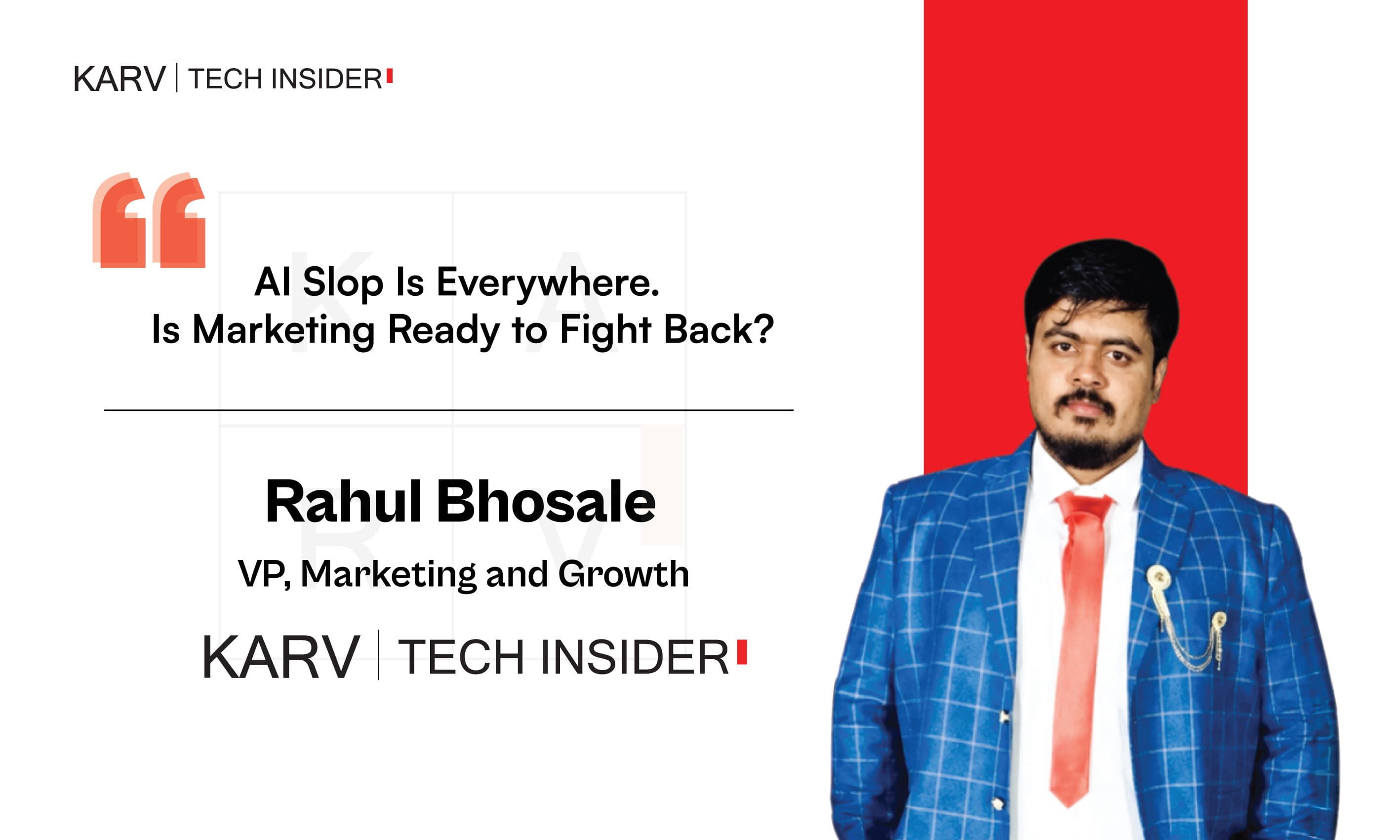
For Rahul Bhosale, VP Marketing and Growth at KARV Tech Insider, the issue is not AI itself. It is what happens when marketers allow the technology to replace the thinking behind the content.
“AI is not the problem. How we use it is.”
That distinction matters.
The Rise of Formulaic Marketing Content
Scroll through any professional social feed and the patterns are increasingly familiar.
“Here are 5 lessons I learned…”
“AI is not replacing you, but…”
“Let that sink in.”
The problem is not that any one of these formats is inherently bad. The problem emerges when thousands of posts begin following the same structure, using the same vocabulary and arriving at the same predictable conclusion.
For marketers, this creates a growing paradox.
AI has made content production scalable, but it has also made sameness scalable.
The more easily brands can produce content, the harder it becomes to distinguish one voice from another.
That is particularly important in MarTech, where audiences are already navigating an overwhelming volume of content about AI, automation, personalization, customer experience and digital transformation.
Producing more content is no longer necessarily the advantage.
Producing something worth remembering is.
AI Should Accelerate Thinking, Not Replace It
There is a meaningful difference between using AI as a marketing tool and using AI as a substitute for marketing judgment.
Rahul uses AI as part of his own workflow, particularly for organizing ideas, researching topics, improving language and sharpening messaging.
That is fundamentally different from asking a model to form the opinion, write the argument and publish the finished piece without meaningful human input.
As Rahul puts it:
“If AI helps me organize my thoughts, research an idea, improve my grammar, or sharpen my message, I am all for it.”
This is where the conversation around AI-generated content needs more nuance.
The question should not simply be:
“Was AI used to create this?”
The more useful question is:
“What did the human contribute?”
Did the marketer bring experience?
Did they challenge the obvious conclusion?
Did they add a customer insight?
Did they bring proprietary data?
Did they explain something from a perspective others have not considered?
Did they have an opinion worth disagreeing with?
Those are the elements that turn generated content into meaningful marketing.
The MarTech Problem Is Bigger Than LinkedIn
LinkedIn may be where the conversation is most visible, but AI slop is not exclusively a social media problem.
The same dynamic can appear across the entire modern marketing stack.
AI can now generate:
- Blog articles
- Social media posts
- Email campaigns
- Ad variations
- Landing-page copy
- SEO content
- Product descriptions
- Sales enablement material
- Webinar scripts
- Customer communications
For marketing teams under pressure to deliver more content across more channels, the temptation is obvious.
If AI can produce 100 pieces of content, why not produce 100?
Because the economics of production have changed faster than the economics of attention.
Creating content is becoming cheaper.
Getting someone to care about it is not.
That changes the role of the modern marketer.
The competitive advantage increasingly shifts away from simply being able to produce content and toward being able to identify what deserves to be said in the first place.
From Content Production to Content Judgment
For years, marketers have been told to become more data-driven.
Now they also need to become more judgment-driven.
AI can help identify trends, analyze audiences, summarize research and generate possibilities. But deciding what a brand should believe, what it should stand for and what it should say still requires human context.
That is especially relevant to thought leadership.
A thought leader does not simply explain what everyone already knows in a more polished format.
They introduce a perspective.
They challenge an assumption.
They connect seemingly unrelated developments.
They draw from experience.
And sometimes, they say something that makes the audience stop scrolling.
That is precisely what AI-generated content struggles with when the human contribution ends at the prompt.
The New Marketing Differentiator: Originality
The arrival of AI has created an unusual situation for marketers.
For decades, brands competed on their ability to produce content consistently and at scale.
Now almost everyone has access to tools that can help them do exactly that.
The differentiator is therefore moving upstream.
What is the idea?
Why does it matter?
Why should anyone believe you?
What do you know that others do not?
What experience gives you the right to make this argument?
AI can help marketers get from an idea to execution faster.
But it cannot make a generic idea distinctive simply by generating more words around it.
As Rahul puts it:
“The goal should not be to punish people for using AI. The goal should be to reward people who have something original to say.”
That may be the more important conversation for MarTech.
Don't Build an AI Detector. Build Better Marketing.
There is understandable excitement around tools and platforms that can identify AI-generated content.
But detection alone does not solve the underlying problem.
A piece of content can be entirely human-written and still be derivative, repetitive and forgettable.
Conversely, a marketer can use AI extensively and still produce something insightful, original and genuinely useful.
The distinction is not necessarily human versus machine.
It is thinking versus outsourcing thought.
That is why Rahul welcomes LinkedIn's new reporting mechanism, but with a caveat.
“I hope it does not become an ‘AI detector.’”
For marketers, that is an important distinction.
The future of content should not be about proving that a human typed every sentence.
It should be about proving that a human had something worth saying.
The Marketer Still Needs to Be in the Driver's Seat
AI will continue to become more capable.
Marketing teams will use it to automate workflows, personalize experiences, analyze audiences and accelerate creative production.
That is not something marketers should resist.
They should embrace it.
But the best use of AI in marketing may ultimately be the one that makes the marketer more human, not less.
Use AI to research faster.
Use it to challenge your thinking.
Use it to find patterns.
Use it to make your writing clearer.
Use it to explore ideas you may not have considered.
But bring the experience, judgment, curiosity and point of view yourself.
Because when everyone has access to the same models, the model itself is no longer the differentiator.
The differentiator is what you bring to it.
And perhaps that is the real lesson behind the “Seems like AI slop” button.
The future of marketing will not belong to the brands that produce the most content.
It will belong to the brands that still have something original to say.
About Rahul Bhosale
Rahul Bhosale is VP Marketing and Growth at KARV Tech Insider, where he works across marketing strategy, growth, technology and the evolving intersection of AI and modern marketing. His perspective focuses on how marketers can use emerging technologies to improve efficiency without losing the human judgment and originality that make marketing effective.