
Leader InterviewsAI Business & Ecosystem
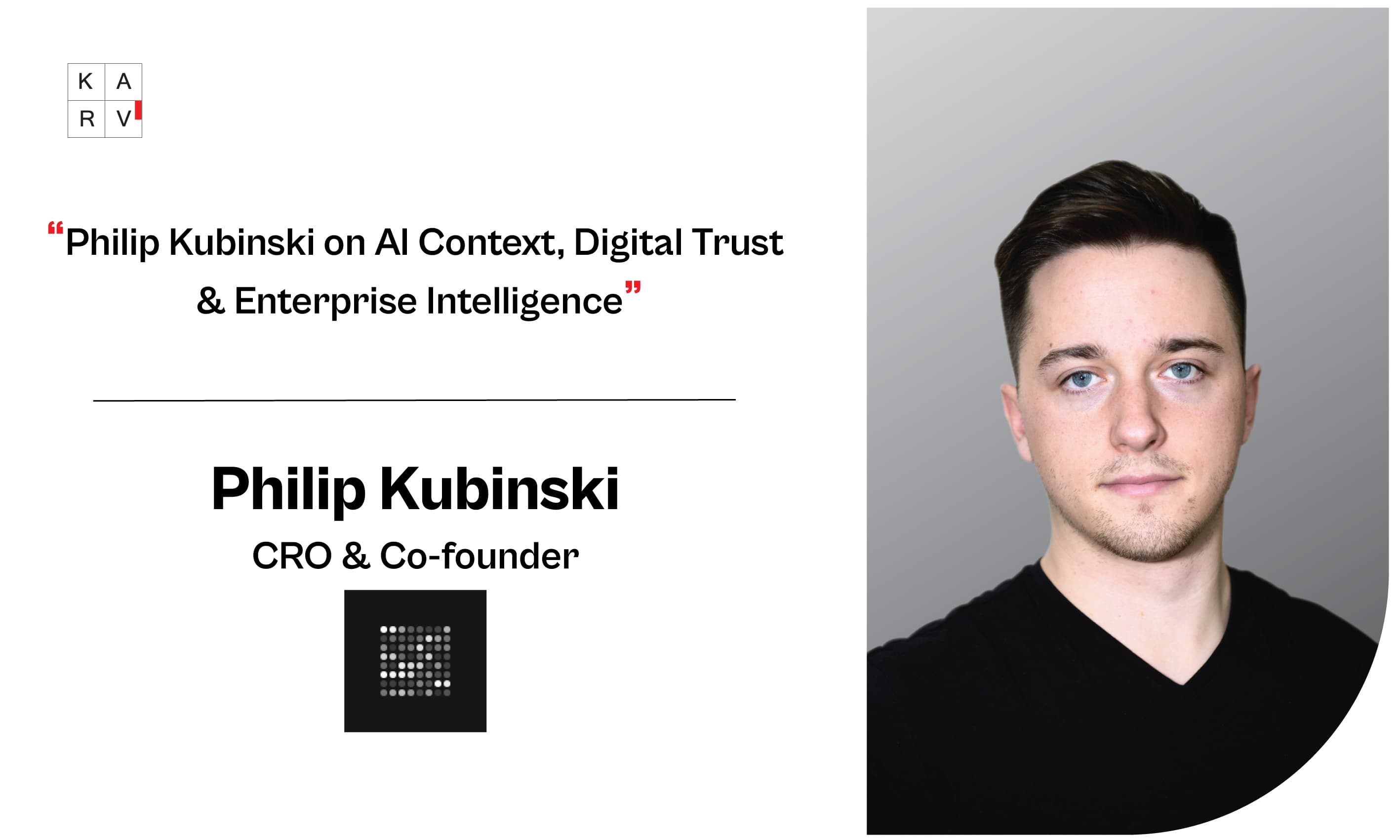
The Rise of AI Context: Philip Kubinski on Building Trusted Enterprise Intelligence
Article content
1. A Founder's Journey
Every entrepreneurial journey begins with identifying a problem worth solving. Looking back, what experiences shaped your perspective on cybersecurity and enterprise technology, and ultimately led you to co-found Unabyss?
A:
Long before Unabyss, I ran an NGO - Studia na Horyzoncie - helping around 50,000 students navigate university choices. It's about as far from "enterprise AI" as you can get, but it taught me the lesson that ended up defining Unabyss: information that lives in the wrong place is worthless, no matter how good it is. Advisors kept re-explaining the same context to every student because none of it was portable.
I saw the same pattern from a completely different angle at Growbots, where I ran sales development and partnerships. Reps re-explained the same account context to every tool in the stack, every single day. Then at Leadpack and RevPack, running GTM for 80+ B2B clients, I watched it at scale: every client onboarding was, in part, a context-transfer problem.
The direct trigger was smaller and weirder. Before Unabyss, Marcin, Dominik, Staś and I (we've worked together since the NGO days, over 15 years) built an AI ghostwriter. It hit $12.5K MRR at $500+ ARPU in seven months, and users kept telling us the same thing: "this thing actually knows me." Then they'd ask why nothing else did. That question became Unabyss.
2. Why Unabyss, Why Now?
Cyber threats continue to evolve at an unprecedented pace, while AI is reshaping how organizations operate. What market opportunity did you see when building Unabyss, and why do you believe the timing is right for your vision?
A:
The honest framing isn't cyber threats; it's fragmentation. AI makes software cheap to build, so instead of consolidating into a few giant platforms, every niche is spawning dozens of small, sharp AI tools. Great for users, terrible for context: your identity, your projects, your preferences get scattered across a dozen apps that don't talk to each other.
The timing is right because MCP, the protocol that lets AI tools share context, went from niche to universal standard almost overnight, donated to the Linux Foundation with serious backing behind it. That's the first time this industry has had a real, open way to serve context to any AI app instead of building another walled garden.
We built Unabyss to be the neutral layer underneath all of it.
3. The Business of Cyber Resilience
For many organizations, cybersecurity is no longer just an IT concern but a boardroom priority. How has the conversation shifted over the past few years, and what should business leaders be thinking about beyond traditional security measures?
A:
I'd reframe the boardroom question slightly: it's less "are we secure" and more "who has access to what we know, and can we take it back." When you connect Slack, Gmail, Notion, and meeting notes into one context graph, you're creating something genuinely valuable and genuinely sensitive.
We treat permissioning as a core product feature, not a settings-page afterthought: approvals are granular and per-app, closer to iOS-style permission prompts than a cookie banner, every access is logged, and revocation is one click.
Underneath that: AES-256 at rest, TLS 1.3 in transit, OAuth, EU hosting for EU customers, GDPR by default, and we started the SOC 2 Type II process early rather than treating it as a later checkbox. That last point matters more than people think: without SOC 2, larger companies won't even open the door, no matter how good the product is.
Beyond security, the question boards should really be asking is about portability. If you stopped using a vendor tomorrow, could you take your organization's knowledge with you, or is it locked inside someone else's memory feature?
4. AI: Opportunity, Risk, and Responsibility
Artificial intelligence is transforming both cyber defense and cyber threats. How do you see AI changing the security landscape, and what principles should organizations follow to embrace innovation without compromising trust?
A:
AI is only as good as the context you feed it, which means the same connection that makes it dramatically more useful also raises the stakes of what's exposed. Give a model your calendar, inbox, and internal docs and it stops giving generic answers, but now you've handed it real, sensitive knowledge about your life or your company.
The principle we build around is neutrality plus control. Don't lock context inside one vendor's walled garden. A lot of the big platforms have real incentives against building a context layer that serves every AI equally, since their business model depends on you staying inside their app.
Give people item-level control over what leaves their context graph, separate personal from company context by default, and require explicit opt-in for anything genuinely sensitive.
Trust isn't a feature you bolt on later. For something holding this much of a person's identity, it's existential from day one.
5. Building a Category-Defining Company
As both Co-founder and Chief Revenue Officer, you're responsible for translating vision into market adoption. What have been the biggest lessons in building a company, earning customer trust, and scaling revenue in a highly competitive market?
A:
Three lessons, and none of them are comfortable.
First: things break in public. We launched, a lot of it didn't work the way we expected, and we spent the next stretch in a genuine debug session. As CRO, that meant selling a product I was simultaneously helping fix.
Second: compliance is a go-to-market decision, not a legal one. We started SOC 2 early because we knew the sequencing: personal users first, then small teams of 5 to 15, then upmarket. It only works if the trust infrastructure is ready before we knock on bigger doors. Without it, you're not "less competitive," you're simply not in the room.
Third: positioning is the unlock, not the feature. We had the product for a while before "never re-explain yourself to AI again" clicked as the way to say it. Once it did, our Product Hunt launch hit #1 Product of the Day with 659 upvotes. Same product, sharper story.
6. The Future of Go-to-Market Leadership
The role of the CRO has evolved significantly, particularly in technology companies. How do you see modern revenue leadership changing, and what capabilities will define the next generation of high-growth commercial organizations?
A:
The CRO job used to be about relationships and quota math. Now it's also a data and automation job. I run our outbound through Clay, Apollo, and Instantly, and I think of AI as an assistant that handles volume, not a replacement for judgment.
What'll define the next generation of revenue leaders is speed of iteration: probing an idea cheaply before scaling it, rather than committing budget on a hunch, and the discipline to treat distribution as a real workstream, not something that happens automatically once the product's good enough.
The tools get more powerful every quarter. The skill that doesn't get automated is knowing which signal is real buying intent and which is noise.
7. Culture as a Competitive Advantage
The strongest technology companies are often defined as much by their culture as their products. How have you approached building a company that encourages innovation, accountability, and long-term customer success?
A:
Our culture is mostly a function of history, not a values deck. Marcin, Dominik, Staś and I have worked together for 15 years, starting with an NGO, through a GTM consultancy, and now Unabyss. There's no politics because there's nothing to prove to each other. If something's broken, someone just says so.
Early on that meant literal intensity: four or five days a week in Kraków, sleeping in the office to get things moving. I don't think that's sustainable or something to romanticize forever, but it bought us the speed to launch, break things, and fix them fast without the internal friction that slows down teams who haven't built that trust yet.
If there's a principle in it: be honest about what isn't working, in public, quickly, with each other and with users.
8. Looking Ahead
As you look toward the next five years, what trends do you believe will have the greatest impact on cybersecurity, AI, and enterprise technology, and how is Unabyss preparing for that future?
A:
The fragmentation I mentioned earlier isn't slowing down. AI is making it cheaper to build software, so we'll see more tools, not fewer, in every category. That means the layer that ties them together becomes more valuable than any single tool, because agents and AI apps are only as good as the context underneath them.
For Unabyss, that means staying the neutral layer: protocol-agnostic, user-owned, and working with any MCP-compatible tool rather than betting on one AI vendor winning. Our roadmap follows the trust sequencing I mentioned: personal use, then small teams, then enterprise, with SOC 2 and portability guarantees built in ahead of each step rather than bolted on after a customer asks.
If the last five years were about which model is smartest, I think the next five are about which one actually knows you and who controls that knowledge.
About Philip Kubinski
Filip Kubiński is Co-founder and Chief Revenue Officer of Unabyss, the universal context layer for AI tools. He started building young: at 19 he founded the Polish NGO Studia na Horyzoncie, which ran for four years with 200+ volunteers across 7 cities, helped roughly 50,000 students choose their university path, and built a YouTube channel with over 1 million views. He went on to lead sales development and partnerships at Growbots, then co-founded the GTM and RevOps consultancies Leadpack and RevPack, working with companies including Packhelp, Quesma, GitProtect, Xopero, and Zowie. In 2026 he co-founded Unabyss alongside longtime collaborators Marcin Uchacz and Dominik Bartosik. Unabyss launched to #1 Product of the Day on Product Hunt.
About Unabyss
Unabyss is the universal context layer for AI tools. It connects sources like Slack, Gmail, Notion, GitHub, and meeting notes into a single structured context graph, then serves that context to any AI tool—Claude, ChatGPT, Cursor, and others via the Model Context Protocol (MCP), so people and teams never have to re-explain who they are and what they're working on in every new AI conversation. Access is controlled by granular, user-set permissions, with personal and company context kept in separate layers. Founded by Filip Kubiński, Marcin Uchacz, and Dominik Bartosik, Unabyss launched in 2026 to #1 Product of the Day on Product Hunt (#2 Product of the Week, #5 of the Month), ahead of entries from OpenAI and Anthropic. The company is based in Warsaw and Kraków, Poland.