
Leader InterviewsAI Leadership & Strategy
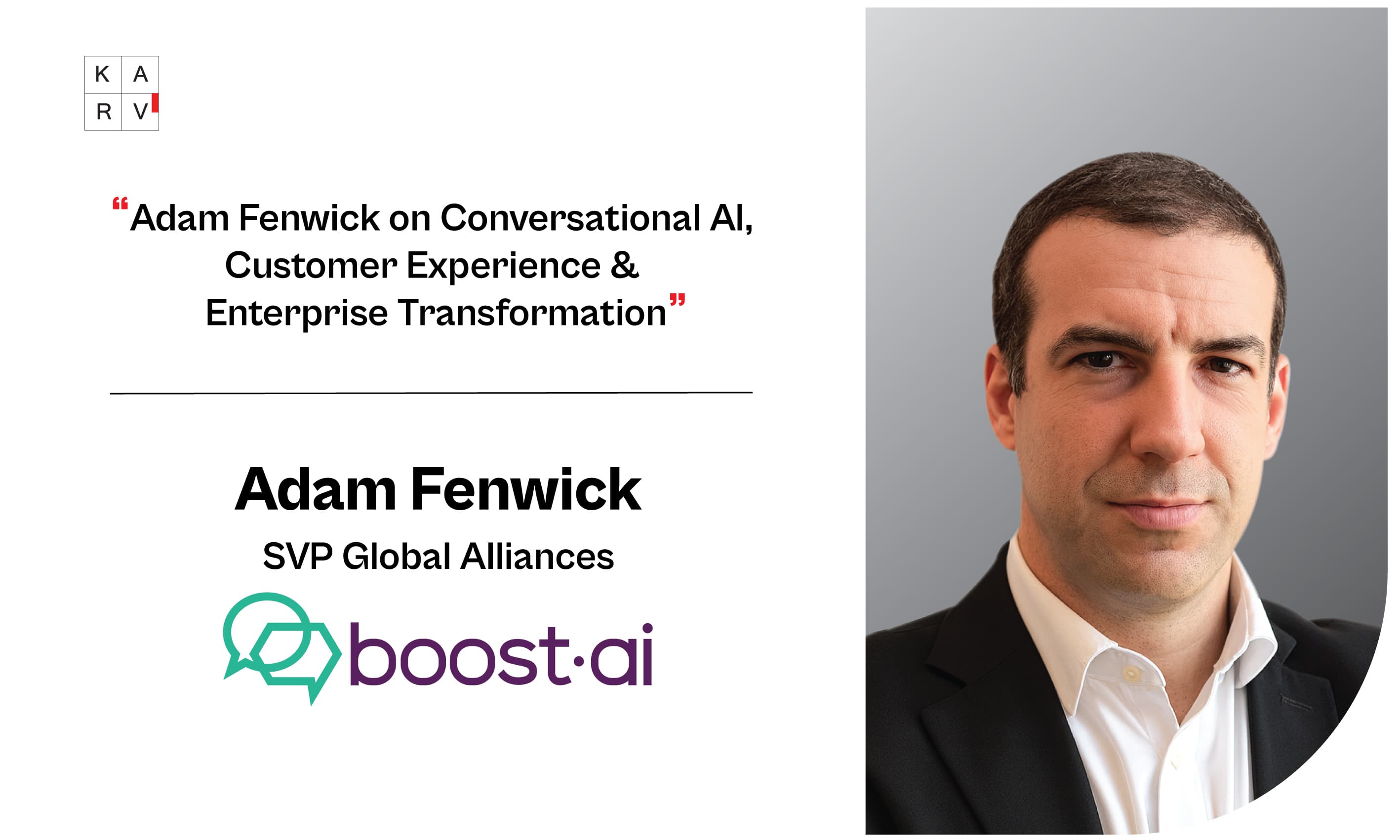
Adam Fenwick on Conversational AI, Customer Experience and the Future of Enterprise Transformation
Article content
1. A Career at the Forefront of Enterprise Transformation
Your career has spanned leadership roles across automation, process intelligence, digital transformation, and now conversational AI. Looking back, what experiences have most shaped your perspective on helping organizations navigate change and unlock business value through technology?
A:
My instinctive answer to this question is to note that, when speaking to customers, so much of what I learn remains surprisingly consistent. Whether vision, challenges, requirements or innovation are being discussed, many customers are still in the same business they’ve been in for a long time. However, they constantly have to address new challenges and dynamics in their respective industries; new competitors emerging, and new technologies that can sometimes provide a non-linear impact to their way of operating.
I’ve always tried to center my thinking around the customer first and try to gain sight early on of the results we’d like to be standing in, Stephen Covey-esque you might say. Nothing original but there is often a tremendous pull with new technology to go ‘looking’ for nails with your new proverbial hammer rather than to hold true to what has always been the case - the customer is the important object in the equation. Really understanding a customer takes effort and time but that investment up front pays huge dividends when you come to solutioning what you believe your firm’s contribution can be to their problems and goals. Past experiences of similar initiatives can also greatly inform and provide perspective on future direction. Take automation for instance. Neither a new concept nor a new technological front per se. AI and conversational AI simply represent the latest iteration of technologies designed to drive automation into various parts of a business.
Regarding the question around ‘change’ and ‘business value’, I’ve observed that the people and culture change aspect of new technology is frequently one of the most under-appreciated aspects of successfully navigating a big project. For business value, being able to connect the immediate measures and metrics of those attached to a major project with the downstream business metrics that affect the entire company is an extremely fruitful area to focus on. A short term metric win in a departmental silo will satisfy a few but needs to connect to larger downstream company-wide outcomes to really deliver the business value that most talk about.
2. Why boost.ai, Why Now?
Having worked with some of the world's leading technology companies, what attracted you to boost.ai, and why do you believe conversational AI is becoming such a critical priority for organizations today?
A:
The decision to join boost was an easy one for me and the people were the decisive element. I already knew one of their leaders, Nick Mitchell - CRO, from our time at Celonis together and his presence was instrumental in giving me confidence. What quickly became clear was that the entire senior team had forged similar bonds of trust through past connections, and since at boost, that resulted in extremely high trust and togetherness. The chance to join such a strong group in that moment in the market was not to be missed! I then had the good fortune to discover a product that was legitimately market-leading in what it could deliver to customers at a time where the percentage of noise to actual AI results was disproportionately negative. I’ve always believed in choosing the team you are going to work with first and foremost. It’s then wonderful to be able to address a market need with a robust product that can deliver on its potential to help customers trying to navigate the best course of action when it comes to AI.
Conversational AI as a priority for organisations is becoming more and more obvious as time passes I’m finding. In perhaps the majority of scenarios, whether an organisation is B2B, B2C etc., there are disruptive market changes that affect the way a business interacts with its customers, partners and affiliates. The ongoing evolution of digital that began with websites and ecommerce is now rapidly evolving into fully digital ‘front doors’ that brands need to curate in order to meet their customers where they now reside. Websites, mobile apps, messaging platforms, chat and voice agents etc. are more important than ever and require an organisation to address this consistently in an omni-channel fashion. It also raises questions around multi-modality; how can customers engage via one channel and switch seamlessly to another whilst still receiving a quality experience? How can these digital channels also be evoked and interacted with from remaining physical locations (stores, warehouses, infrastructure sites). The interplay between channels to finally deliver on the promise to ‘meet customers where they are’ is where conversational AI takes us, fast.
3. From Automation to AI: The Next Phase of Enterprise Transformation
Over the past decade, we've seen organizations embrace automation, data-driven decision-making, and digital transformation at scale. How do you see conversational AI fitting into this broader transformation journey, and what opportunities does it create for businesses?
A:
It is correct to describe the progress made in areas like automation and digital transformation over the years. Only from my personal experience, a disproportionate amount of this success occurred in the middle-back office rather than in the front office and customer operations. More than 50% of all customer interactions still take place over the phone and a significant number of organisations still operate a traditional IVR with ‘press 1 for x’ style menus. Whereas Finance, HR and even IT departments have succeeded with automation at scale, the customer-facing channels look perhaps less evolved in recent years. Many websites still look the same with similar navigation etc. Many out of date chat bots still persist in major public company’s homepages, seemingly deprioritised. Most importantly, customer expectations have changed enormously so this becomes a decisive factor when assessing where we are.
Conversational AI offers a new way for a brand to engage with its customers. A new front door; one that is open 24/7, speaks many languages, can be reached via many communications channels and, crucially, one that is capable of personalising your customer journey to a far greater degree than anything before. The promise of ‘hyper-personalisation’ for each individual customer journey is something that conversational AI is made to address. Extant business processes and playbooks were designed, entirely reasonably, with an understanding that people would need to provide manual inputs alongside logical step by step flows. Conversational AI changes that. An organisation has the chance to re-imagine what a customer journey can and should look like without that constraint. Processes and journeys will of course continue to contain human steps depending on the context and the need, but the opportunity to design a customer journey for AI, not ask AI to drive a journey made for human operators is a major shift in design thinking. A better customer experience comes from being able to design a flow or journey that leverages AI for what it is good at and the same with people; not using AI to brute force an older design because it can do it cheaper.
4. What Customers Are Really Looking for from AI Investments
Through your experience working with enterprise customers across industries, what are the key business challenges organizations are trying to solve with AI today, and what separates successful AI initiatives from those that fail to deliver meaningful outcomes?
A:
There are hugely varied reasons why Enterprises are looking to adopt AI. Whilst it is tempting to say automation is always at the heart, driving more efficiency, productivity and thus more savings, I’m not sure that is an accurate reflection anymore. The potential to reduce cost via AI is ever present and increasingly expected - nothing wrong with that. However, attention also now turns to how to harness AI to make money, not just save it. AI operating in support of upsell, cross-sell, retention motions is a growing area of focus for example as both the technology itself rapidly improves alongside the ability for vendors to design and deliver more ambitious roles for AI that remain compliant and safe.
In reference to earlier comments around customer channels and where brands now need to focus their efforts, one of the key business challenges is Customer Experience (CX). Customers are more well informed before engaging with a brand, often they have used AI themselves as part of their research, and now bring a considerably higher expectation with them in terms of how they wish to be engaged in whatever channel they prefer. Getting this right is existential to a business today. A poor customer experience offered in one place invites a customer to switch to a different provider, a process itself made more easy than ever before thanks to AI. CX is a high stakes contest, particularly in hyper-competitive categories like mobile phone contracts or fast fashion.
Regarding what separates successful outcomes from those that fail to deliver; a lot of best practices associated with success is not unique to conversational AI. Clear sponsorship from the Executive level for example is a must, particularly as many organisations begin with a scaled down pilot in a specific business unit that needs to clearly connect to the larger AI agenda in the business. Great design is perhaps the strongest determinant of success that I’ve seen overall. Really clearly expressing what is trying to be achieved via the AI and how that fits into the wider context is essential. This includes not being encumbered by thinking rooted too much in what has gone before. Looking at a process that was designed for a fundamentally different type of user, a person, is informative but also can restrict what a ‘to be’ version of that process needs to look like with an AI agent involved.
Finally, selecting the right measures remains a very difficult area for many. Business casing varies hugely, with many high profile examples of elements like token usage denuding what was thought to be an obvious business case otherwise. Good design (see above) and a highly flexible AI platform that ensures that tokens are used judicially on the right actions and not as a blanket approach for everything is vital. For metrics, ‘time to first value’ is underrated in a market when everyone is trying to progress their AI agenda but not suffer from TCO problems in doing so. ‘First time resolution rate’ is another example. The big challenge that can yield immense value is connecting these operational outcomes with the larger downstream measures around cost, sales, customer experience and corporate company-wide metrics that affect the entire business.
5. Why Strategic Partnerships Are More Important Than Ever
Technology adoption is increasingly driven by ecosystems rather than individual vendors. How are alliances, technology partnerships, and service providers shaping the success of AI initiatives, and what makes a strong partner ecosystem in today's market?
A:
Absolutely agree. Partnerships matter more than ever before in a world of more informed customers seeking a more frictionless and impactful relationship with their suppliers. As with software categories that preceded it, there is a huge difference between an AI platform being demoed in a pre-prepared environment with as many variables as possible under control and the realities of an Enterprise-grade deployment. The market is gripped in the thick of this delta right now with frustration developing across Enterprise at the confusion this sows among concerned buyers.
Partners and third-party service providers thus play an increasingly vital role in taking high capability AI technology and figuring out how best to actually deploy it safely, securely and at scale inside a high compliance environment in a regulated industry for example. That means not just passing infosec review, but also the AI committee, assuring process compliance with all regional and industry regulations as well as marshalling the considerable range of integrations that are going to be needed to drive real value in use cases. A hugely undersold part of the AI world is the degree to which platforms still need to be integrated to many source systems in order to have sufficient access to data, knowledge of customer etc. to be able to deliver on its potential.
Partners also make a huge impact on helping a customer drive adoption into a workforce that is naturally conservative in nature about any new technology being brought into the business. Technology implementation projects are also significant change projects inside a business’ culture. How to sell, train and enable the appropriate users of an AI platform is as critical a success factor as any.
Finally, a high impact skill that partnerships bring to the AI arena is around design, design thinking and end to end use case realisation. Everybody wants AI yesterday and/or more of it across more of their business. A relative few have a highly developed sense of exactly what they want it to do and what it will yield. It is not easy to understand the art of the possible without the aid of good partners that offer deep industry subject matter expertise and help a customer see and prioritise what can be achieved and by when. That does not absolve vendors from contributing to key business case elements like this however. Their ability to work successfully with the best partners often is a defining factor for any moderately ambitious AI project.
A strong partner ecosystem in AI in 2026 obviously requires scale and diversity, both geographically and capability wise. Beyond strong track records in AI to date, deep verticalised expertise over several generations of technology designed to automate is where you will find the majority of the high performing partners delivering today. Those with dedicated conversational AI practices, a flair for customer journey design and design thinking represent the elite service providers available.
6. Creating Better Customer Experiences Through AI
Customer expectations continue to evolve rapidly. How can organizations leverage conversational AI to improve customer experience while maintaining trust, personalization, and meaningful human engagement?
A:
A big question. Taking these needs out of order, trust is simply a non-negotiable aspect of harnessing the power of AI. Proper exploration of who can really deliver on the level of trust required to deploy AI that will represent a brand by talking directly to customers across a variety of channels, locales and languages is paramount. This quickly eliminates a significant number of potential platforms not yet able to evidence such maturity with live examples to evidence this. Personalisation is essentially a combination of a platform with an extremely high degree of flexibility and usability at its core that can allow the level of granular personalisation that AI is uniquely capable of to happen whilst still maintaining all relevant safeguards and compliant boundaries.
When thinking about improving CX overall and ‘meaningful’ human engagement, that requires all of the above but also requires a vendor, partner and customer to all have sufficient vision and understanding to see what AI is truly capable of. One scenario is to effectively use AI as a latest generation automation play, grounded with a business case built mainly on cost savings and efficiencies. Nothing is wrong with this at all; this is a foundational level of expectation that most buyers have and is rapidly being normalised. The second scenario is where all of the relevant stakeholders across the customer, partner and platform provider look at processes that were designed for the majority of steps to be executed by a human, with keyboard, mouse, IVR phone menus etc. and recognise the need for a paradigm change in how a customer journey is designed. Realisation comes when it is evident that AI requires very little of these elements to be present or continuous at all. That then opens up the possibility of a new, more profound and impactful use for AI, working alongside human-executed steps but driving a totally different kind of flow with the customer. One, not grounded in much of what has gone before in terms of processes pushed on customers. It instead re-examines the customer journey at a more fundamental level and asks questions around how AI technology can completely alter what that experience can be for the better. AI is not bound by many of the constraints that created those customer journeys in the first place; local time zones and languages, department knowledge and segregation of duties, skillsets etc. It is incumbent on all of us to remember that “what got you here won’t get you there” to some extent, if you want to derive the maximum impact from bringing AI into an organisation.
7. Looking Ahead: The Future of AI, Customer Experience, and Growth
As AI capabilities continue to advance, what trends do you believe will have the greatest impact on customer experience and business growth over the next few years, and how should leaders prepare for what's coming next?
A:
It would be very foolish to predict much of where the market will be in the future with any confidence, based on what we see on a weekly basis in terms of change!
The impact and evolution of AI inside businesses often feels inherently contradictory to me. We see for example amazing deployments already of next generation voice AI agents that are really fulfilling their promises across a range of use cases that are verifiable. At the same time the vast majority of the world’s companies still place the telephone numbers of their brands behind IVR systems that are universally loathed the world over by almost every kind of customer. LLMs similarly seem to improve and scale with no limits to the funding they can attract and the constant iterative improvements to their performance that they can make. Yet, whilst this is truly impressive and transformational, there are increasing concerns driving behavioral change towards LLMs due to the token pricing models that the major model companies continue to successfully deploy. The early signs of the LLM paradigm perhaps starting to offer diminishing returns are now being widely discussed by both the academic community at large and the pioneers of AI like Yann LeCun and Geoffery Hinton that helped drive us to this point.
What I find most encouraging is just how ‘early’ we are in terms of global adoption in Enterprise, SME and Public Sector. There is so much more to do to deliver value from AI at scale and that is a hugely encouraging thought. My greatest dismay of where we are today is the growing delta between demo and stage material and reality on the ground plus the rampant overuse of LLMs without enough care and diligence in projects. A long-standing aspect of the SaaS business; selling future roadmap stories now vs Enterprise deployment realities is a well known dynamic but AI may be the most extreme case ever seen. AI demos extremely well as you would expect, especially when vendors leverage the very same AI to enhance or polish what is being presented.
Helping a customer make an informed choice should be the north star for an entire industry that lives on trust.
Overwhelming evidence is desperately required in this industry, now more than ever. It exists but we are addicted to ever more exciting demos in the public domain. True expertise around integrations, design thinking to re-imagine customer journeys, architectural elegance, informed debates around build vs buy options all fail to grab the AI headlines that “look at this cool thing” inevitably does. It signals the relative lack of maturity still and highlights both the need and opportunity for everyone to do better here.
I’m proud to work for an organisation that seeks to win as much as anyone but is also responsible, recognising that demos based on concepts that lead to pilots of which the majority fail anyway is not fulfilling the promise of AI. There has never been a software market to compare with this one in terms of size, buyer potential, outcomes etc. It is all our responsibility to value it and ensure that it grows in a sustainable way that places safety and real world outcomes at its heart.
About Adam Fenwick
Adam Fenwick is SVP Global Alliances at boost.ai. Across 25 years in technology, his background is a 50-50 mix of IT transformation consulting for boutiques (Strategy Insights, Objectivity/now Accenture) followed by a decade specializing in Automation software (Automation Anywhere, Celonis/Make). Named a Leader in the 2025 Gartner® Magic Quadrant™ for Conversational AI, boost.ai empowers regulated industries to automate with confidence, control, and care - so you can trust every conversation.
About boost.ai
Building trust, one conversation at a time.
Named a Leader in the 2025 Gartner® Magic Quadrant™ for Conversational AI, boost.ai empowers regulated industries to automate CX with confidence, control, and care - so you can trust every conversation.
With boost.ai, organizations gain more than a platform. They gain the confidence to automate at scale, the control to shape their own experiences, and the peace of mind that comes from truly being able to trust every conversation.
In 2016, boost.ai started as a few ambitious Norwegian coders with a vision to automate interactions for a local bank. Today, that same solution automates millions of interactions annually for hundreds of leading organizations around the world in Financial Services, Telecommunications, Hospitality, the Public Sector and more. Its global reach spans across the U.S., Europe and the Nordics, with offices in six strategic markets and a wide network of partners and resellers of some of the industry's best-known brands.