
Leader InterviewsAI Leadership & Strategy
Greg Kihlström on AI, Agility, and the Future of Marketing Systems
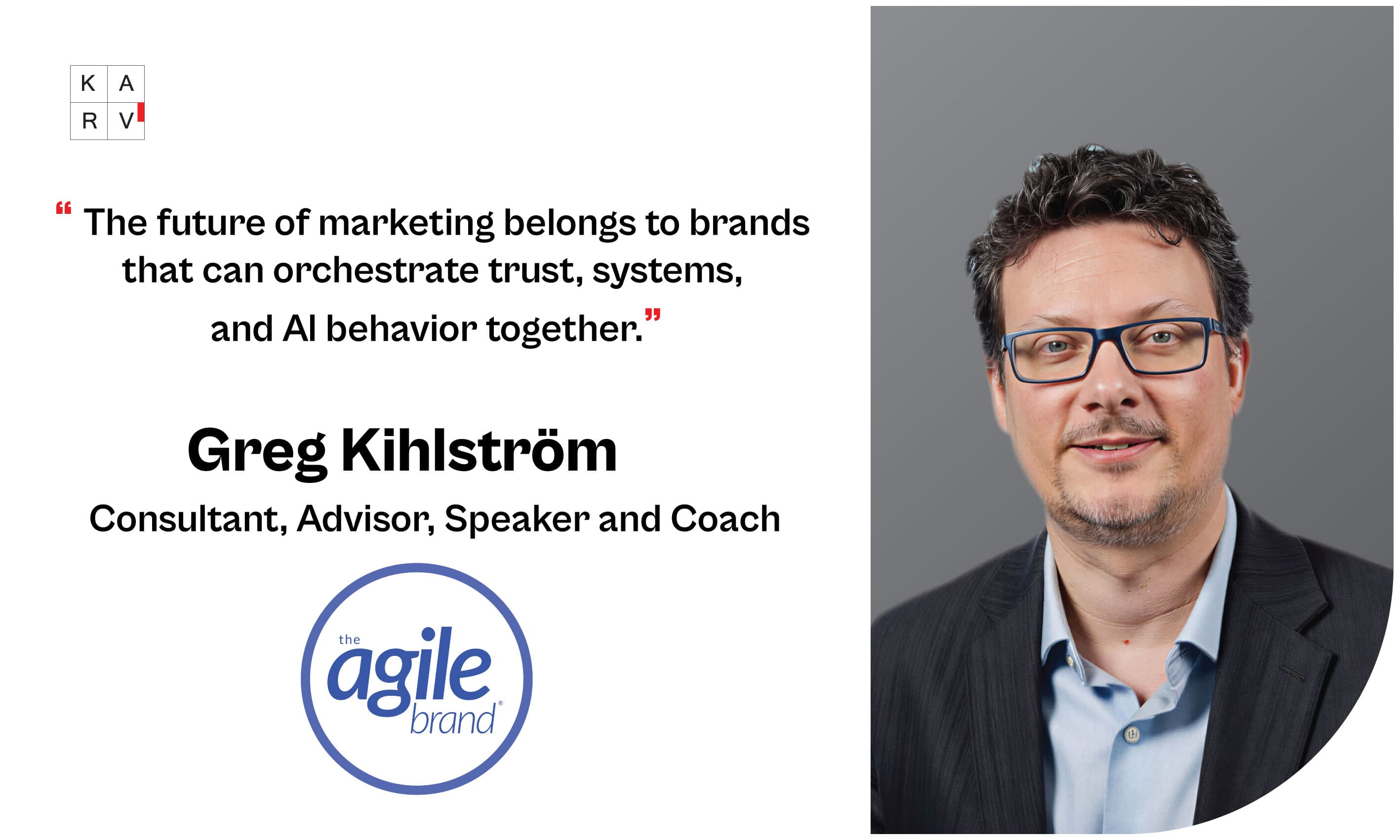
Article content
1. Mission & Market Perspective
Q: You’ve spent years advising global brands on marketing transformation, CX, and AI adoption. How has your perspective on “agility” evolved as marketing systems have become more complex and AI-driven?
A:
In my experience, Agility began as a conversation about how to write about sprint cadences and break marketing free from prescriptive, waterfall style annual planning cycles. That’s helpful, but it was also focused mostly on delivery.
Where we are today is agility as a coherence argument: How do we show up with the same level of consistency, experience, and excellence at scale when everything around us is changing? It’s no longer about speed of delivery (which most marketing teams can do faster with AI assistance)…it’s whether your People, Process, Data and Platforms underneath all of that work behave consistently when you need to scale to machine speed and let an AI system make a decision in milliseconds that a human being would use to apply judgment.
Agility now is if the enterprise can move at machine speed without contradicting itself…and that’s a much taller bar than figuring out how to run two-week sprints.
2. AI, Marketing Systems & Decision Making
Q: With AI now influencing everything from customer journeys to internal decision-making, where do you see most organizations struggling the most: data, systems, or mindset?
A:
All three, but not equally. I’ve found the order here matters a lot. Mindset is job one because far too many leaders approach AI as a productivity layer that gets bolted on top of an existing operating model instead of treating AI as the shining light that exposes everything that’s broken underneath it.
Data is the next big issue…and easily misdiagnosed as a “platform problem.” I’ve watched otherwise well-funded personalization programs fail because customer records were spread across seventeen systems and while AI didn’t cause the data problem…it absolutely amplified existing incoherence at machine speed across exponentially more customer interactions.
Systems? Those are usually the symptom, not the cause. If leaders don’t know how they want their business to behave at scale, no platform investment is going to save them.
3. The Future of Marketing Leadership
Q: You’ve worked closely with CMOs and enterprise teams across some of the world’s biggest brands. How is the role of marketing leadership changing as boundaries between brand, CX, and technology continue to blur?
A:
Chief Growth Officer. Growth CMO. Growth Marketing Lead. Whatever you call it, the role of the CMO is quietly becoming the Chief Growth Orchestrator — title change or not.
Brand, CX, Sales, and Product aren’t blending by accident. Businesses aren’t organized this way because somebody drew the org chart with fuzzy boundaries. They’re collapsing because customers don’t experience brands, they experience one company. They don’t interact with products, they consume solutions. Customers increasingly expect a singular experience…and one company to behave like one cohesive unit.
Which leaves today’s CMO in the awkward position of having to own commercial continuity across silos that have been defending their P&L territories like divas for decades. The marketers I’ll be watching closely in 2027 will be those that can orchestrate decisions, signals and AI behavior uniformly across a customer’s entire lifecycle.
4. Agile Brand Thinking in Practice
Q: Your work consistently emphasizes “The Agile Brand” as a philosophy. What does an “agile brand” actually look like in practice today, beyond just being a buzzword?
A:
Agile brand is not a brand that flips-flops to react to each new thing. An agile brand is one whose values have been encoded as operating logic, such that when systems make decisions, humans aren't second-guessing. The outcome is still unmistakably yours.
Applied, that means your pricing engine and your eligibility rules and your bot-human handoff and your exception routing all act in ways that don't betray your brand promise. Brand will continue to be about what your customers say about you, as well as what is said by employees, but it will also be what your systems do when no one is watching.
5. AI, Customer Experience & Trust
Q: As AI becomes a primary interface between brands and customers, how should companies rethink trust, personalization, and customer experience design?
A:
Trust has traditionally been earned by tone and consistency of message and while that isn’t going away, it is changing rapidly. When your brand’s interactions with customers are mediated by artificial intelligence, trust is predicated on behavioral reliability.
Does it know who the customer is? Will it apply that rule consistently next week? Does it know when to stop trying and hand off to a human?
creepy personalization isn’t a creative problem to solve. It’s a governance problem. You should be building for contextual autonomy today. Design kill switches and audit layers. Define clear human escalation thresholds.
Any AI deployment that can’t explain why it made a decision should be treated like a liability, not a competitive capability.
6. Organizational Transformation
Q: Many enterprises still struggle to move from siloed marketing operations to integrated, agile systems. What are the most common structural barriers you see, and how can leaders overcome them?
A:
We all know the structural barriers that separate P&Ls, channel-specific functions and KPIs, and competing priorities across the board can create. Capped by governance that slows things down instead of enabling better decisions and faster action.
The tougher challenge to address is what I refer to as the “inside-out trap.” This describes when enterprises keep organizing customer-facing change around their internal calendars, approval chains, and org charts before they organize it around the customer's reality.
Leaders overcome through these barriers by doing three pretty unsexy things: ensuring there's clear end-to-end ownership of customer flows, articulating decision rights clearly enough that they can survive disagreement, and managing experience debt as ruthlessly as a CFO would manage financial debt.
It's not transformation so much as sound operating model decisions and actions.
7. Content, Storytelling & Influence
Q: As someone who has authored books, hosted a top-ranked podcast, and spoken globally, how important is storytelling in shaping how leaders and brands are perceived today?
A:
Storytelling used to be how leaders earned the right to be heard — but the medium and the stakes have changed. After producing over 850 podcast episodes and several books, here's what I've learned: people are sick of weak-nerved thought leadership and have an extremely high tolerance for good-faith practitioner perspective.
The leaders who cut through the noise right now are the ones willing to talk about what didn't work, call out the trade-offs, and stop acting like they know everything.
When fluent content can be generated by AI at near-zero marginal cost, rarity is judged by your capacity for judgment, expertise, and accountability. That's the stuff machines will never be able to replicate, and it's what your audience craves.
8. Looking Ahead: AI & The Future of Work
Q: Looking ahead 2-3 years, what is the biggest shift you believe will redefine marketing, CX, and digital transformation as AI becomes embedded in every workflow?
A:
The biggest shift is that the first audience for a growing share of marketing won't be human. Consumer agents are going to evaluate, filter, and increasingly negotiate on behalf of customers before a person ever sees a polished interface as part of the B2A2C (business to agent to consumer) economy.
It’s happening already faster than most brands are operationally equipped to handle. Which changes the purpose of marketing. Persuasion is still important, but it becomes intimately linked to operations performance: If your pricing, policies, and product info aren’t legible and consistent enough for a machine to parse reliably then your brand will be rerouted around before a human ever has a chance to consider it.
The companies who will thrive over the next three years are the ones who stop treating AI like a content accelerator and start treating it like another participant in the market; albeit one that requires governance, brand-aligned behavior, and clear guidelines of where the humans take precedence.
About Greg Kihlström
Greg Kihlström is a MarTech futurist, best-selling author, speaker, and advisor who helps leaders understand where marketing technology, customer experience, and AI-mediated execution are heading next - and what their organizations need to change now to keep up. He has advised some of the world's leading brands, including Adidas, Coca-Cola, FedEx, HP, Marriott, Nationwide Insurance, Victoria's Secret, and Toyota.
A multiple-time co-founder and C-level leader with several successful exits, Greg has written more than 25 books on marketing, marketing technology, and customer experience, including titles published by De Gruyter Brill and his Agile Brand Guide® series. He hosts the award-winning The Agile Brand with Greg Kihlström® - a top 10 Apple U.S. marketing chart podcast now in its eighth year with more than 800 episodes and millions of downloads.
Greg is a member of the School of Marketing Faculty at the Association of National Advertisers (ANA), is pursuing a doctorate in Business Intelligence, and has been named #1 on Thinkers360's list of Top Global Marketing Thought Leaders. He is a contributing writer to CMSWire (a two-time contributor of the year), MarTech, and CustomerThink, and has been featured in Advertising Age, Business Insider, Financial Times, Forbes, and The Washington Post.
Learn more at gregkihlstrom.com.
About The Agile Brand
The Agile Brand is a marketing, customer experience, and AI-focused media and advisory company founded by Greg Kihlström, headquartered in Arlington, Virginia. The company produces The Agile Brand with Greg Kihlström® - a top 10 Apple U.S. marketing chart podcast in its eighth year with more than 850 episodes - and executive produces a growing network of top-ranked shows for marketing, CX, and technology leaders.
Beyond the podcast network, The Agile Brand publishes a library of books and guides on marketing technology, customer experience, and enterprise transformation, including The Agile Brand Guide® series and a portfolio of titles with De Gruyter Brill. The company also delivers advisory work, executive workshops, and training programs that help enterprises operationalize agility, coherence, and responsible AI adoption across the customer lifecycle.
Learn more at https://www.agilebrandguide.com