
Leader InterviewsAI Leadership & Strategy
AI Reputation, Narrative Control, and the Future of Brand Trust: Renee Chemel on Marketing’s Next Big Shift
Article content
1. Mission & Market Perspective
Q: As Head of Marketing at Five Blocks, how are you positioning the brand in a world where AI is reshaping how reputation is built and perceived?
A:
When I joined Five Blocks, the platform had already been built with a clear conviction: LLMs were becoming a new search channel, and reputation was going to matter there just as much as it did on Google. The company had spent years becoming the best at managing reputation in traditional search, and the leadership saw early that the same discipline would be needed for this new layer. That's what drew me to the role. This wasn't a company bolting AI onto an existing product. They had already built something purpose-built for it.
The way I'm positioning Five Blocks now is around a gap the rest of the industry isn't addressing. There's a lot of energy around GEO, Generative Engine Optimization, and I think that work is real and valuable for the demand gen side of marketing. But it doesn't cover reputation. The main metric marketers have right now is share of voice, which tells you how often you're mentioned across the LLMs. It doesn't tell you why you're being mentioned, how you're being characterized, or where the risks and opportunities are. That's the half of the picture most tools aren't built for, and that's exactly where Five Blocks lives.
2. AI Reputation Gap
Q: You’ve highlighted the “AI reputation gap.” What are the first practical steps brands should take to measure and close this gap?
A:
The first step is to stop treating share of voice as the finish line. Right now, that's the main metric marketers have for AI visibility, and it tells you how often you're mentioned across the LLMs. But it's a lot like where email marketing was with open rates. For a while, opens were the whole story. Then we realized that if your email had a call to action, what you actually cared about was whether someone clicked it. The open rate became a lot less interesting. Share of voice is in that same moment. It tells you that you were mentioned, but not how you were described, in what context, or whether that mention is helping or hurting you.
What brands should be doing is looking at how the LLMs are actually talking about them, based on the prompts their customers, clients, investors, and potential employees would be asking. And they should be doing the same for their peers and competitors. That's how you find the risks and opportunities. Not from a count of how many times you showed up, but from understanding the narrative around your brand when it does show up. You need a platform to do this well. Whether you run it yourself or bring in a team to guide the strategy depends on the organization, but the visibility into what's actually being said is the non-negotiable starting point.
3. Marketing Strategy Evolution
Q: With your experience across multiple SaaS companies, how have demand generation and brand strategy evolved over the last few years?
A:
On the demand gen side, there's still an over-reliance on volume as a measure of success. Lead counts, badge scans at events, email lists. The number feels good, but nobody is stopping to ask whether these are the right leads or what happens next. Events are a perfect example. Most companies show up, collect as many leads as they can, and hand them to sales with no structure. No advance marketing, no intentional booth strategy, no bucketing leads by where they are in the buying process. Sales picks the lowest hanging fruit and everything else just sits there. I do think AI will help here, not so much the intent signal hype, but as a brainstorming partner that pushes marketers to be more creative if they're asking the right questions.
On the brand side, I'm seeing a real shift. More companies are hiring senior brand people, and I think that has a lot to do with AI. People are going to the LLMs to ask questions about companies and their leadership, and what comes back matters. Brand isn't just a visual exercise or a tagline refresh anymore. It's how your company shows up when someone asks an AI "who is this company and should I trust them." That's a much bigger job than picking colors and writing values on a wall, and I think the market is starting to understand that.
4. Building from Scratch
Q: You’ve built marketing functions from the ground up more than once. What are the top priorities in the first 90 days?
A:
The first thing I do is listen. I talk to sales, customer support, customers, partners, and spend real time with the product. I need to understand the full ecosystem before I build anything. Then I synthesize all of that into a picture of what exists, what's missing, and what's good enough for now. The other thing I do very early is get aligned with the CEO. In my experience, expectations are often unrealistic at the start, and if you don't address that head-on, you're set up for failure. I show the synthesized audit, get sign-off on next steps, and make sure we're looking at the same picture before anything else moves forward.
After that, what you build depends entirely on what the audit and that alignment conversation revealed. There's no universal playbook. But hiring is the last step, not the first. Partly because you can't know what role you actually need until you understand what's missing. You might think you need a digital marketer when what you really need is someone focused on social media. But also because hiring is a long, involved process, and those first months are too valuable to spend in interview loops. You need that time to move the playbook forward. Get the foundation right first, then bring in the people to run it.
5. AI & Brand Narrative
Q: How should companies rethink narrative control as AI increasingly influences what customers see and trust?
A:
I think the word "control" needs to be reframed. It's really about consistency and management. Companies need to make sure their brand story is consistent across every channel and source, and that includes the sources that feed AI models. The challenge is that LLMs are pulling from everywhere, and a lot of what they find is outdated or forgotten. Old web pages that are still indexed but have the wrong information. A Wikipedia entry that hasn't been updated in years. PR coverage from a previous era of the company. If those sources are telling a different story than what's on your website today, the AI is going to reflect that inconsistency back to anyone who asks about you. The first step is monitoring what's actually out there so you can see where things don't match up.
Once you can see the gaps, the work is figuring out how to course-correct. That might mean updating forgotten pages, working with PR to refresh coverage, or partnering with a company like Five Blocks that specializes in this. But the bigger point is that when your baseline narrative is solid and consistent across all your sources, you're also building resilience. When a crisis hits, and it will, a strong foundation means it's a blip rather than a catastrophe. The companies that are most vulnerable in a crisis are the ones whose narrative was already fractured before anything went wrong.
6. Growth & Collaboration
Q: Having worked closely with product and R&D teams, especially in PLG environments, what makes marketing collaboration truly effective?
A:
In a PLG environment, marketing needs a seat in the room with product and R&D. It's not a nice-to-have. Without it, I think you're setting the product up to fail. PLG depends on people finding and adopting the product on their own, and that doesn't happen without marketing. These two functions have to go hand in hand. When marketing is in the room, things run smoother. There are fewer surprises. You talk things through together, and marketing brings a perspective that the technical side doesn't always have. Sometimes product teams are so deep in what they know that they can't see the outside view. Marketing adds that dimension.
The practical side matters just as much. When marketing understands the roadmap, we can make sure everything is ready to go when product ships. Messaging, positioning, campaigns, all of it lined up. When you're shut out of that room, you have no idea what's coming down the pike and you can't build a plan. You end up reactive instead of strategic, scrambling after a launch instead of driving it. The best collaboration I've experienced is when both sides recognize they need each other and act like it from the start, not just when something is about to go live.
7. Leadership & Scaling Teams
Q: What are the key principles you follow when building and scaling high-performing marketing teams?
A:
Building teams is the hardest and most rewarding part of what I do. My approach is to hire people who fill in my gaps. I look for people who can do what I cannot, and then I give them the space to do exactly that. I don't micromanage. I give credit generously. And I make sure the team understands the bigger picture, the north star, what management is deciding and why. When people feel like they're part of something larger than their own task list, they give 100%. They hold each other up, they work harder to create and build, and they take real ownership of growing the company.
When it comes to scaling, once you have your core team in place, they take responsibility for the next level. They become the ones who bring new people in, set the tone, and carry the culture forward. The principle stays the same at every stage: give people the chance to grow, give them real responsibility, and trust them to show you what they can do. If you hired the right person for the job, let them do the job. That's how you build a team that scales without losing what made it work in the first place.
8. Looking Ahead
Q: What is one major shift in marketing or brand reputation that leaders should prepare for over the next 2–3 years?
A:
I think we're going to see the marketing function split into two distinct sides of the house, each with its own executive seat at the table. One side will be communications, under a Chief Communications Officer or similar role, responsible for all comms, internal and external, PR, brand, and reputation. The other side will be demand and lead generation under the CMO, owning SEO, PPC, marketing automation, events, product marketing, field marketing, everything that drives pipeline. Right now a lot of companies try to put all of that under one person, and I think that's going to change.
The reason is that the stakes on the comms and reputation side have gotten too high to treat as a subset of marketing. The goals are different. The skills are different. And both need direct access to leadership to be effective. You can't have reputation and brand living two levels down from the executive team when AI models are shaping public perception of your company in real time. That's a board-level concern now, not a marketing task. I think the companies that make this structural shift early will be better positioned on both sides, because each function gets the focus and leadership it deserves.
About Five Blocks
Five Blocks transforms how organizations understand and manage their reputation across the digital landscape. Combining proprietary technology with proven strategy, the company gives communications and marketing leaders real-time intelligence into how search engines, media ecosystems, and AI platforms portray their brand, along with a clear path to shaping that story.
About Renee Chemel
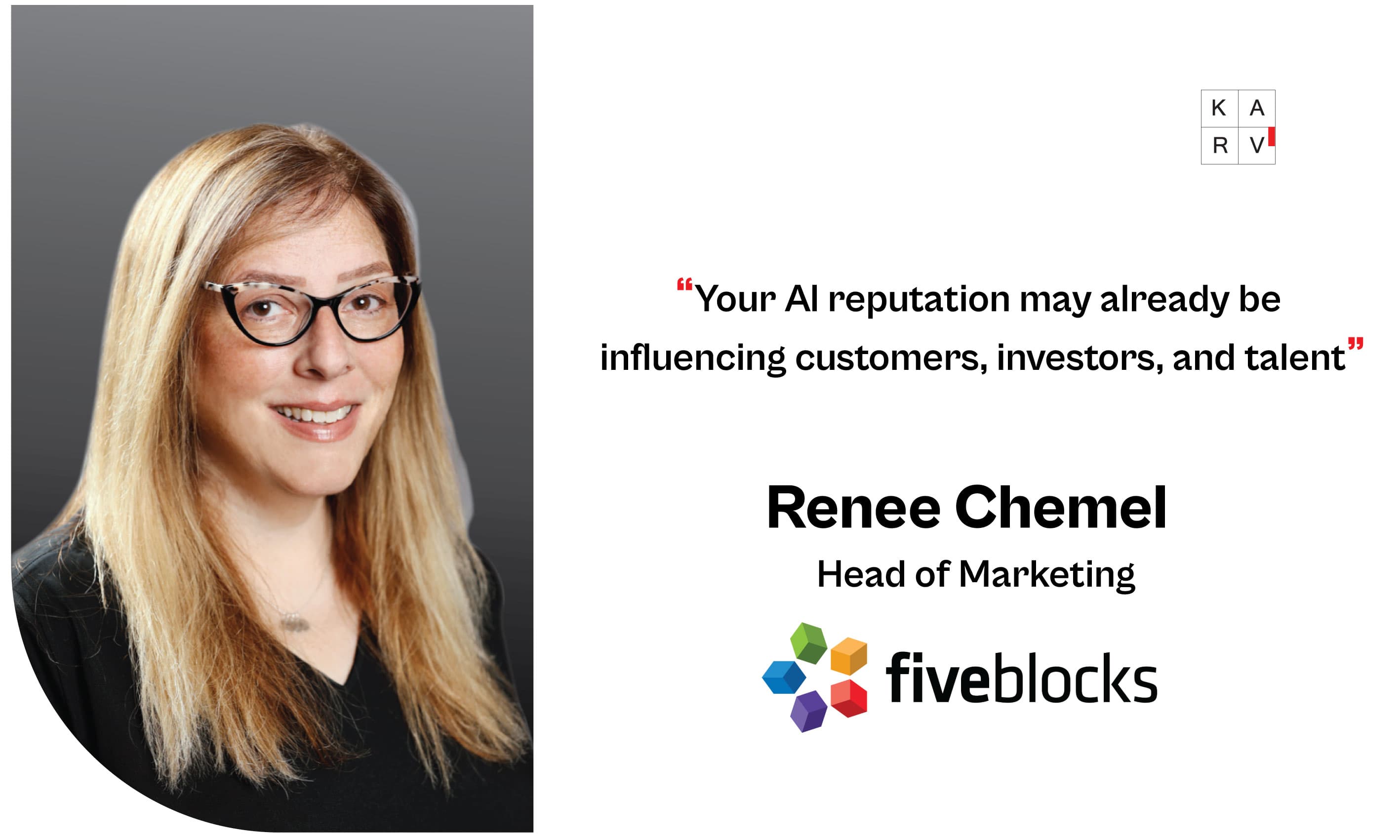
Renee Chemel is Head of Marketing at Five Blocks, where she leads marketing for one of the most respected names in digital reputation management. Her career spans marketing leadership roles at technology companies that went on to be acquired by OpenWeb and BMC.
She builds teams and processes that connect marketing directly to revenue, keeping strategy tightly tied to the KPIs that matter to the whole business, not just the marketing function. The companies she has been part of achieved successful acquisitions through strong teams, disciplined processes, and measurable business outcomes.