
Industry NewsAI Infrastructure & Compute
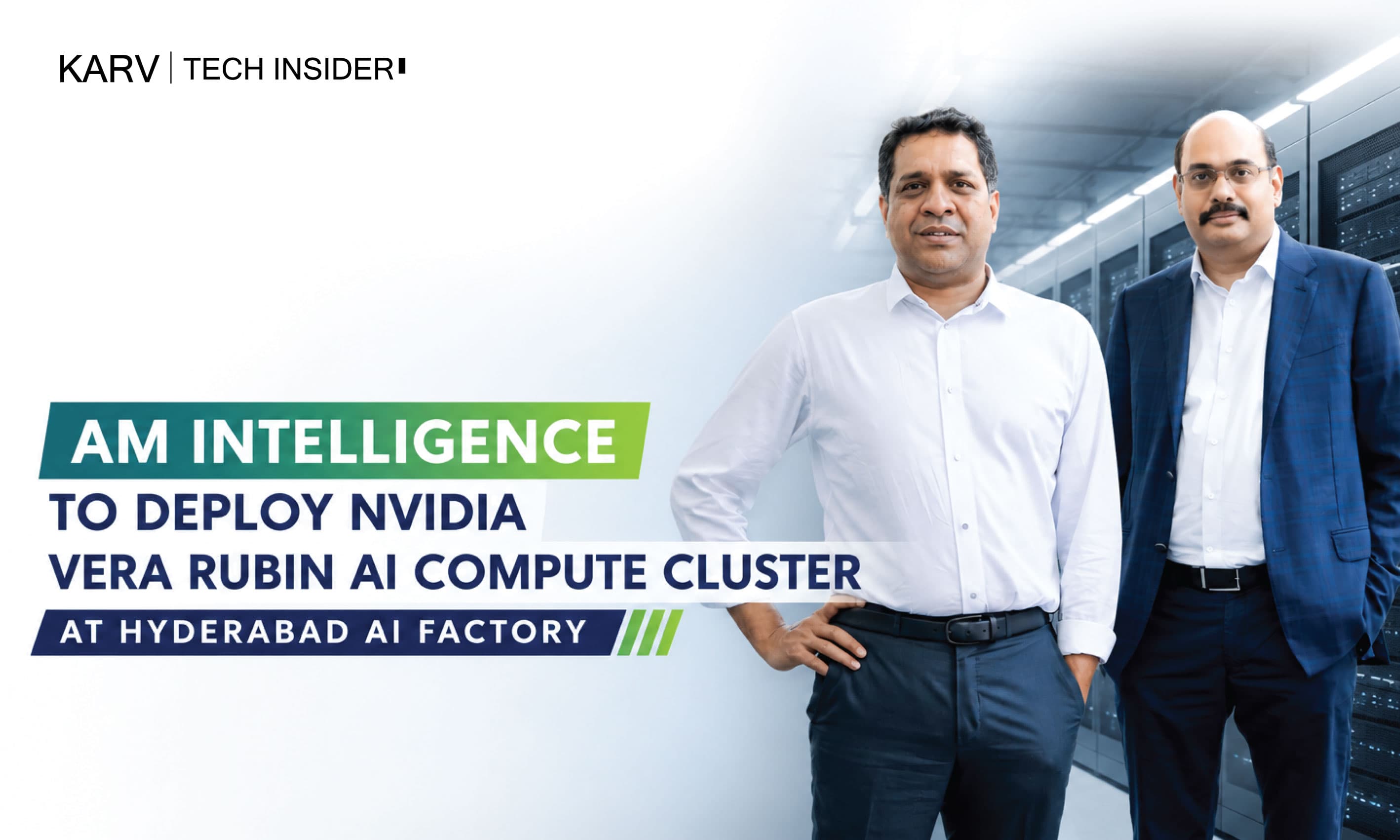
AM Intelligence to Deploy One of Asia's First NVIDIA Vera Rubin Clusters in India
Article content
AM Intelligence (AMI) has placed a firm and binding order for approximately 9,000 NVIDIA Rubin GPUs, to be deployed as Vera Rubin NVL72 rack-scale systems at its first AI Factory in Hyderabad.
The systems are scheduled for delivery in the first quarter of 2027 and will support approximately 30 MW of capacity at the Hyderabad facility. Once deployed, the cluster is expected to rank among the first frontier AI compute installations in Asia using NVIDIA's next-generation Vera Rubin architecture.
The announcement represents the first major step in AMI's plan to build large-scale AI compute infrastructure, with the company targeting 1 GW of Compute-as-a-Service capacity across India, the United States, Finland and Malaysia.
Hyderabad at the Center of AMI's AI Compute Strategy
The Hyderabad AI Factory will serve as the first tranche of AMI's planned compute infrastructure. The company intends to bring an initial 200 MW of capacity to market in the near term, involving more than $8 billion in planned capital expenditure.
AMI is also developing a broader portfolio of powered AI data centres, with a stated target of 5 GW across India, the United States and Europe.
The strategy is built around integrating energy infrastructure with high-density computing capacity, allowing AMI to offer AI compute services to hyperscalers, AI labs, enterprises, sovereign AI initiatives and AI-native companies.
Building for Frontier AI Workloads
The Hyderabad facility is being designed to support some of the most computationally intensive AI workloads, including trillion-parameter models and next-generation agentic AI applications.
AMI plans to combine NVIDIA's Vera Rubin architecture with RDMA over Converged Ethernet (RoCE) networking and advanced storage infrastructure to enable high-throughput movement of data between computing and storage systems.
The company expects the Hyderabad AI Factory to deliver approximately 450 exaFLOPS of NVFP4 inference compute, creating a substantial platform for running advanced AI models at scale.
NVIDIA Vera Rubin Architecture
The deployment will use NVIDIA Vera Rubin NVL72 rack-scale systems, incorporating technologies designed to improve the economics and performance of AI inference.
Among the architecture's features is NVFP4, a low-precision computing format designed to improve efficiency for AI workloads, alongside next-generation HBM4 memory.
According to AMI, the architecture is designed to reduce AI inference token-serving costs by up to 10 times compared with the preceding NVIDIA Grace Blackwell generation.
For AI infrastructure providers, improvements in inference economics are increasingly important as demand shifts from simply training increasingly large models toward operating them continuously at scale.
From Energy Infrastructure to AI Compute
AMI's AI strategy builds on the broader energy infrastructure platform developed by the promoters of Greenko.
The company describes its approach as moving from "electron-to-token" economics, using its experience in energy infrastructure to support the power-intensive computing requirements of modern AI.
This model connects energy generation and storage with data-centre infrastructure, AI hardware and computing services.
The approach is designed to address one of the central challenges facing the AI industry: providing sufficient power and compute capacity to support rapidly growing AI workloads while keeping infrastructure economics viable.
A Larger Global Compute Ambition
The Hyderabad deployment is part of a much larger infrastructure roadmap.
AMI says it is developing 5 GW of powered AI data centres across India, the United States and Europe, while targeting 1 GW of Compute-as-a-Service capacity globally.
The company expects the initial 200 MW of Compute-as-a-Service capacity to come online in the near term.
Its planned facilities are being designed around high-density AI computing and liquid cooling, enabling them to manage the power and heat requirements of advanced AI accelerators while providing flexibility to accommodate successive generations of AI silicon.
Leadership Perspective
Anil Chalamalasetty, Chairman of AM Intelligence, described the deployment as the next stage in the company's evolution from energy infrastructure toward AI compute.
He said the company sees an opportunity to convert its experience in power infrastructure into frontier AI computing capacity at scale, with the NVIDIA Vera Rubin deployment in India forming an important part of that strategy.
Supporting India's AI Infrastructure
AMI's planned infrastructure also has implications for India's growing AI ecosystem.
The company intends to make its compute infrastructure available to hyperscalers, neo-cloud providers, frontier AI labs, sovereign AI initiatives, AI-native companies and local developer communities.
By combining large-scale compute with access to next-generation GPU infrastructure, AMI aims to widen access to high-performance AI computing for both domestic and global workloads.
Looking Ahead
The Hyderabad AI Factory marks the first major deployment in AMI's broader AI infrastructure strategy.
With a 9,000-GPU NVIDIA Rubin order, plans for 200 MW of near-term Compute-as-a-Service capacity and a longer-term 1 GW global target, AMI is positioning itself around the infrastructure layer required to support the next phase of AI adoption.
As AI models become larger and inference workloads increasingly move into production, access to power-efficient, high-density compute will become an increasingly important part of the AI economy.
About AM Intelligence
AM Intelligence (AMI) is an AI infrastructure company promoted by the founders of Greenko. The company is developing a full-stack AI infrastructure ecosystem spanning energy, data-centre infrastructure, hardware and customized AI models.
AMI is developing 5 GW of powered AI data centres and 1 GW of Compute-as-a-Service capacity across India, the United States and Europe. Its broader infrastructure activities also include renewable energy, energy storage and low-carbon molecule platforms.
Source & Credits
AM Intelligence