
Expert ArticlesAI Business & Ecosystem
The AI Race Is Accelerating. But Are We Forgetting What We Are Trying to Save?
Article content
An uncomfortable conversation about artificial intelligence, human livelihoods, freshwater, and the future we are building for our children.
Every company wants to win the AI race.
Every founder wants to announce a breakthrough. Every technology giant wants to demonstrate how its latest model can do more, faster, and at a lower cost. Investors are chasing the next big opportunity, businesses are racing to automate, and AI has become one of the most powerful narratives shaping our future.
I understand the excitement. I understand the opportunity. I understand why companies want to innovate, grow, remain competitive, and build technologies that once seemed impossible.
But lately, I have been thinking about a question that seems to be missing from much of this conversation.
In our rush to make artificial intelligence more powerful, are we forgetting the very people and the planet this technology is supposed to serve?
We celebrate how many tasks a machine can perform, how many hours it can save, how many employees a company can replace, and how much money it can add to the bottom line. But how often do we stop to ask what this progress means for the people on the other side of the equation?
When Does Innovation Stop Serving Humanity?
Let me be clear. I am not against AI. Quite the opposite.
There are places where AI can and should make a meaningful difference. When human lives are at risk, when workers perform hazardous tasks, when medical professionals need assistance identifying potential health risks, or when emergency teams need faster information, automation can be transformative.
These are meaningful applications of technology. They solve real problems.
But what happens when the objective shifts from solving a genuine human problem to replacing people simply because a machine makes the spreadsheet look better?
What happens when the biggest measure of success becomes how many jobs a company can eliminate rather than how many lives it can improve?
We need to distinguish between using AI to make people more capable and using AI to make people economically disposable.
“Efficiency is a business advantage. Human dignity should never become its collateral damage.”
If One Tool Can Do the Work of a Hundred People, What Happens to Those Hundred People?
Across industries, businesses are exploring AI systems that can perform tasks previously handled by entire teams. In some cases, this creates extraordinary opportunities to improve productivity. In others, it raises serious questions about employment, career development, and the distribution of economic gains.
I understand that businesses must remain competitive. I understand that payroll is a cost, investors expect returns, and organizations cannot ignore technological change.
But there is a difference between improving how work gets done and treating the people who built a business as expenses waiting to be removed.
Imagine a company that once employed a hundred people to manage its operations. It introduces AI, increases output, reduces costs, and retains only a fraction of its original workforce. The company might report a remarkable efficiency gain. Its margins may improve. Its investors may celebrate.
But what happens to the people who are no longer required? What happens to the professional who spent a decade building expertise, the young graduate entering an industry where traditional entry-level tasks are disappearing, or the family whose financial security depended on a job that has now been automated?
And if every company follows the same logic, who will have the purchasing power to sustain the very markets these businesses depend on?
This is not an argument against automation. It is an argument for thinking beyond the immediate financial return.
If AI creates extraordinary productivity gains, we should also be asking how those gains can translate into better wages, new opportunities, shorter working hours, retraining, and broader economic participation.
The future of work should not be a competition to determine how many human beings we can remove from the equation. It should be an opportunity to reconsider what meaningful work can look like when machines take over more of the burden.
The Freshwater Question We Cannot Afford to Ignore
AI does not exist in an abstract digital universe. It runs on physical infrastructure: data centres, servers, chips, cooling systems, electricity grids, and networks.
That infrastructure requires resources.
Depending on the facility's design, cooling technology, location, and energy supply, data centres can consume substantial amounts of electricity and, in some cases, significant quantities of water. The wider impact also includes the resources required to manufacture hardware and build infrastructure.
As demand for AI computing grows, these environmental costs deserve the same seriousness as the commercial opportunities.
Freshwater is particularly important because it is not an unlimited resource that we can casually replace when demand exceeds supply. Communities in many parts of the world already face water stress. Agriculture, households, ecosystems, and industry compete for resources that are essential to life.
Against this backdrop, we must ask difficult questions. Are new data centres being built in locations where water resources are already under pressure? Are local communities being adequately consulted? Are companies transparent about their water consumption? Are they investing in efficient cooling, responsible water management, and cleaner energy?
Not every data centre has the same environmental footprint, and not every AI application carries the same cost. That is precisely why transparency and location-specific assessment matter.
We cannot treat environmental responsibility as an afterthought once the infrastructure is already operational.
“When a child is thirsty, what matters more: the valuation of the company that built the AI system or the availability of safe drinking water?”
The answer should be obvious.
Money can fund solutions. Technology can help manage resources. AI can even support water conservation, infrastructure monitoring, and early detection of leaks. But money itself cannot replace the water our bodies need to survive.
If our pursuit of technological advancement compromises the natural systems that sustain human life, we need to question our definition of advancement.
Who Benefits, and Who Bears the Cost?
There is another dimension to this conversation: inequality.
AI has the potential to concentrate enormous economic power in the hands of organizations that control the computing infrastructure, proprietary data, models, distribution channels, and capital required to compete.
At the same time, smaller businesses, workers, and communities may bear some of the disruption without receiving a proportionate share of the benefits.
This is not an inevitable outcome of AI. It is a question of how the technology is owned, governed, deployed, and made accessible. But we should not ignore the risk.
Developing economies may see opportunities in investment, employment, digital capabilities, and economic growth from the global expansion of AI infrastructure. Those opportunities are real and should not be dismissed.
However, if a region supplies land, electricity, water, and infrastructure primarily to support computing demand elsewhere, it is reasonable to ask what the local population receives in return.
Are there lasting jobs and skills? Is local infrastructure improving? Are communities benefiting from the investment? Are environmental costs being managed responsibly? Is the economic value being shared fairly?
These are not anti-AI questions. They are questions about responsible development.
The issue is not where a data centre is built. It is whether the people and places affected by that decision are treated as stakeholders rather than merely as inputs into someone else's business model.
“A technological breakthrough should not be considered a complete success if its profits are private but its consequences are pushed onto everyone else.”
We Are Not Running Out of Reasons to Innovate. We Are Running Out of Excuses to Ignore Consequences.
Perhaps the most troubling part of the AI race is not the technology itself, but the speed at which we are normalizing decisions without fully examining their long-term implications.
We have become accustomed to hearing about larger models, faster systems, autonomous agents, fewer manual processes, and increasingly ambitious automation targets. Yet the questions that deserve equal attention are often less glamorous.
What happens to the entry-level jobs through which people gain experience? How do we help workers transition when their skills are no longer in demand? How do we prevent the benefits of AI from becoming concentrated among a small number of powerful organizations? How do we ensure that AI infrastructure does not place avoidable pressure on essential resources?
And how do we protect privacy, accountability, and human judgment when more decisions are delegated to machines?
These questions deserve boardroom discussions, investor scrutiny, public policy attention, and honest conversations among technology leaders.
Innovation without responsibility is not a sustainable strategy. And speed without direction is not necessarily progress.
What If We Built AI Around Human Progress Instead of Replacement?
Imagine a different approach.
Imagine companies using AI to help employees become more productive while investing in the skills they will need tomorrow. Imagine businesses sharing some of their productivity gains with the people who helped create them.
Imagine AI infrastructure being planned around responsible water use, cleaner energy, transparent environmental reporting, and the needs of local communities.
Imagine technology companies competing not only on model performance but also on how effectively their products improve education, healthcare, accessibility, public services, and environmental sustainability.
Imagine a world in which AI helps a small business compete with a large corporation, gives a student access to personalized learning, helps a doctor make a better-informed decision, or enables a scientist to accelerate research into a critical problem.
These are not merely idealistic possibilities. They are legitimate directions for investment, innovation, and policy.
We do not have to choose between technological advancement and human well-being. But we do have to choose to make human well-being part of the objective.
Businesses can still be profitable. Founders can still build extraordinary companies. Investors can still generate returns. AI can still transform entire industries.
The question is whether we can pursue those outcomes while preserving the conditions that make prosperity meaningful in the first place.
Think About the Generation That Comes After Us
This is where the conversation becomes personal for me.
When I think about the future, I do not think only about the next funding round, the next product launch, the next billion-dollar valuation, or the next technological breakthrough.
I think about the world our children will inherit.
Will they have access to meaningful opportunities? Will they have the skills and confidence to build careers? Will the communities they live in have reliable access to clean water? Will the natural environment be healthy enough to sustain future generations?
Will they look back at this period and see a generation that used technology wisely to improve human life, or one that became so consumed by the race to build more powerful machines that it neglected the very foundations of civilization?
We cannot predict every consequence of AI. We should not pretend that every job can be preserved or every environmental challenge can be solved through good intentions.
But uncertainty should make us more thoughtful, not less responsible.
We have an obligation to consider the consequences of our choices, especially when those choices affect people who have little control over them.
And that obligation extends beyond religion, caste, nationality, race, gender, or orientation. Clean water, human dignity, opportunity, and a livable planet are not privileges that should depend on who you are or where you were born.
They are fundamental human concerns.
Before We Celebrate the Next AI Breakthrough, Let Us Ask Better Questions
I want to see AI advance. I want to see businesses innovate. I want to see technology solve problems that humanity has struggled with for generations.
But I do not want us to confuse the ability to do something with the wisdom of doing it.
Not every task needs to be automated simply because it can be. Not every job reduction should be celebrated as a breakthrough. Not every AI investment deserves praise without scrutiny of its wider consequences.
And not every company needs to win the AI race at the expense of asking where the finish line is taking us.
Perhaps the most important measure of AI progress will not be how intelligent our machines become, but how wisely we choose to use them.
So, to founders, CEOs, investors, technology leaders, and everyone shaping this future, I have a request.
Before celebrating how much work your next AI tool can replace, consider how many lives it can improve.
Before announcing another data centre, consider the resources it will consume and the community that will live alongside it.
Before celebrating another round of cost reductions, consider what happens to the people whose livelihoods are affected.
Before chasing the next valuation, ask whether the value being created is reaching the people who need it most.
And before calling every new capability progress, ask whether it brings us closer to the kind of world we actually want to live in.
Because one day, when the headlines fade and the valuations change, our children will not judge this generation solely by how advanced its technology became.
They will live with the consequences of what we chose to prioritize.
“We are not here merely to build a smarter world. We are here to build a better one.”
Let AI serve humanity. Let innovation protect our future. Let business success coexist with human dignity and environmental responsibility.
And let us never become so fascinated by the intelligence of our machines that we forget the value of human life.
The race for AI is real. But the future of humanity is not a race we can afford to lose.
A Question Worth Discussing
Where should we draw the line between using AI to advance humanity and using humanity merely to advance AI?
I would genuinely like to hear the perspectives of founders, business leaders, AI researchers, and professionals navigating this transformation.
About KARV | Tech Insider
KARV | Tech Insider is a digital-first B2B technology publication covering enterprise technology, artificial intelligence, marketing, leadership and innovation. It brings perspectives from business and technology leaders to a global audience, exploring the ideas and developments shaping the future of business.
About Rahul Bhosale
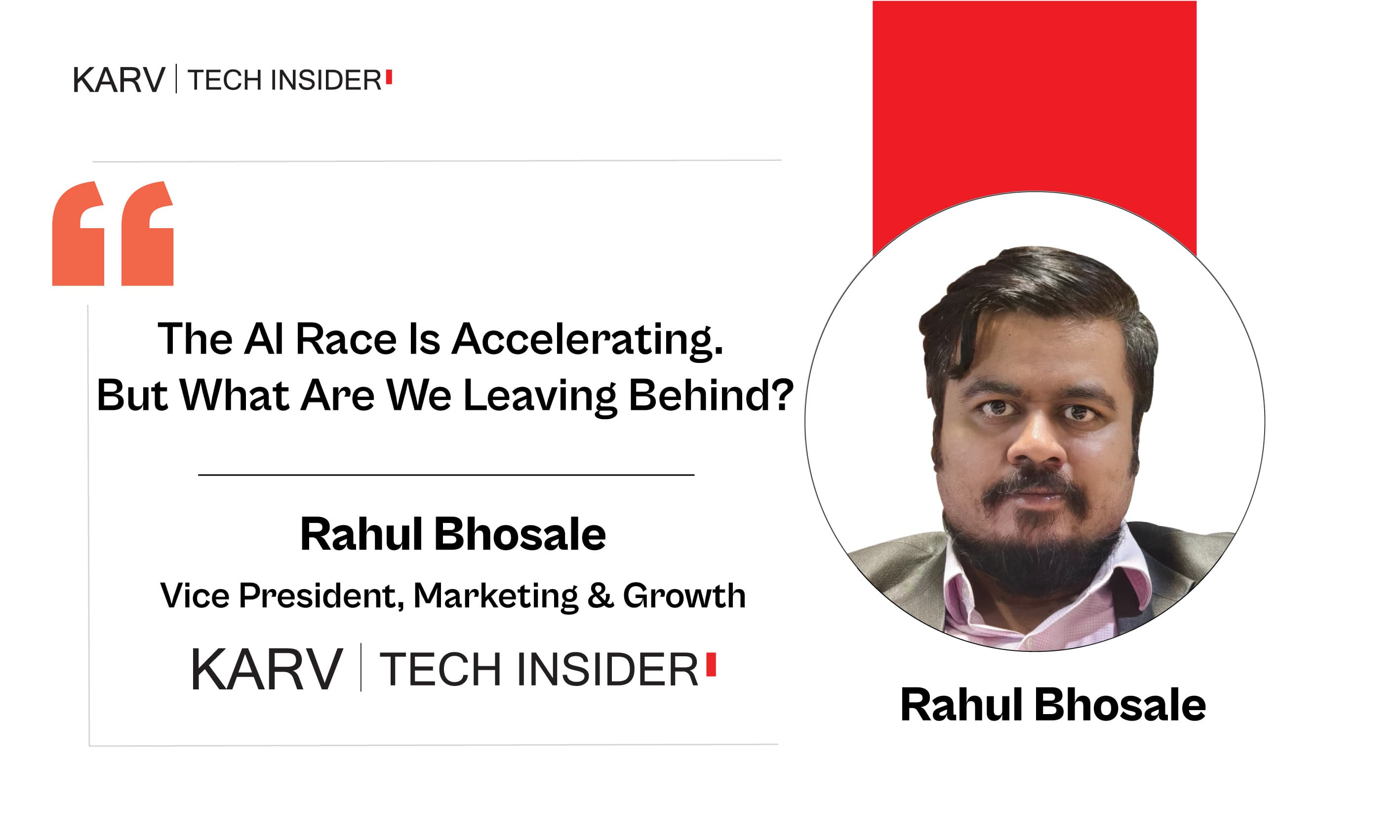
Rahul Bhosale is Vice President, Marketing & Growth at KARV Tech Insider, where he works across marketing, growth strategy and the development of a technology media platform focused on leadership, innovation and the future of business.
Source & Credits
This article was written by Rahul Bhosale, Vice President, Marketing & Growth at KARV Tech Insider, and is published on KARV Tech Insider with author permission.