
CXO MovesAI Leadership & Strategy
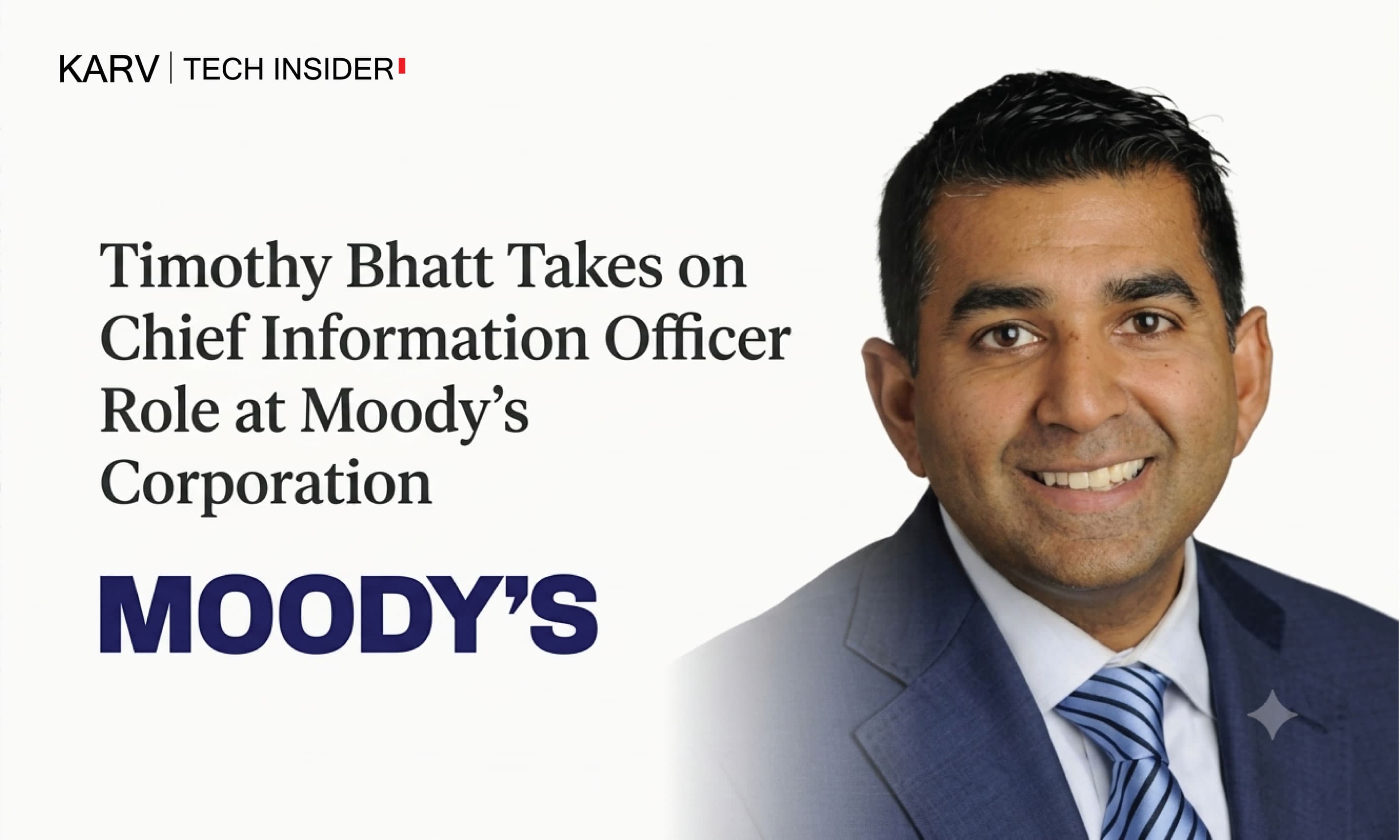
Timothy Bhatt Takes on Chief Information Officer Role at Moody’s Corporation
Article content
Timothy Bhatt Takes on Enterprise Technology Leadership as Moody’s Advances Its AI Strategy
The growing role of artificial intelligence in financial services is changing how organisations manage information, assess risk and make decisions. For companies whose businesses depend on trusted data, analytical expertise and secure technology infrastructure, the challenge is no longer simply adopting AI tools. It is redesigning how work gets done while maintaining the reliability, governance and security that customers expect.
Against this backdrop, Moody’s Corporation has appointed Timothy Bhatt as its Chief Information Officer (CIO), creating a new enterprise leadership role that brings technology strategy, AI enablement and information security under his remit. Effective December 7, 2026, Timothy will join the company's Executive Leadership Team while continuing as Chief Technology Officer (CTO) of Moody’s Ratings, a position he has held since 2018.
The appointment extends Timothy's technology leadership beyond the Ratings business to the broader Moody’s organisation. His responsibilities will include enterprise technology strategy, AI deployment, information security, technology services and operations, and cybersecurity.
The move reflects a wider shift in enterprise technology leadership. As organisations move AI from experimentation into operational use, technology executives are increasingly expected to connect infrastructure modernisation, business transformation, data governance and security. At Moody’s, Timothy's expanded role places him at the centre of that effort.
From Modernising Moody’s Ratings to Leading Enterprise Technology
Timothy's appointment builds on his work modernising the technology foundation of Moody’s Ratings. Since becoming CTO in 2018, he has led significant changes across its technology infrastructure and applications, moving the business towards a common cloud-based, AI-enabled platform designed to support workflows across the organisation.
His remit at Moody’s Ratings has covered technology infrastructure, application development, data management, digital product management and IT risk. The modernisation effort has helped establish a more scalable and secure technology environment, while creating a foundation for the integration of AI into business processes.
For a ratings business operating in complex global financial markets, technology infrastructure is closely connected to the delivery of analytical products and services. Reliable systems, accessible data and secure applications support the work of analysts and the delivery of insights to customers.
Moody’s leadership has highlighted Timothy's contribution to this transformation, alongside his experience in AI deployment and cybersecurity. As he takes on the CIO position, the company will look to extend that platform-oriented approach across its wider operations.
The dual appointment also creates continuity between the technology strategy of Moody’s Ratings and the enterprise-wide transformation agenda. Timothy will retain responsibility for the Ratings technology organisation while taking on a broader mandate across the corporation.
Making AI Part of Everyday Enterprise Work
A defining element of Timothy's new role will be helping Moody’s move AI agents beyond pilot programmes and into everyday business operations.
The company's stated ambition is to bring together human expertise, trusted data and AI agents to rethink enterprise workflows. This points to a shift from deploying AI as a standalone productivity tool towards integrating it into the processes through which employees access information, complete tasks and make decisions.
For Moody’s, the opportunity is particularly relevant because its business is built around data, risk analysis, financial intelligence and decision support. AI-enabled workflows could help employees navigate complex information more efficiently and improve how knowledge and capabilities are applied across the organisation.
However, the transition also introduces questions around data quality, access controls, model reliability, accountability and security. In financial services, the value of AI depends not only on its ability to accelerate processes but also on whether its outputs can be trusted and used responsibly.
Timothy's enterprise responsibilities bring these priorities together. His experience in technology modernisation and information security will be relevant as Moody’s works to scale AI adoption while maintaining the resilience and operational discipline required across its business.
The focus on AI agents also signals a broader ambition: redesigning workflows around the combined capabilities of people, data and intelligent systems rather than simply adding new tools to existing processes.
A Career Across Technology, Cybersecurity and Financial Services
Timothy brings nearly three decades of technology leadership experience in financial services. Before joining Moody’s, he spent nearly a decade at Ally Financial, where he served as Chief Technology Officer, following earlier roles as Chief Information Security Officer and Chief Enterprise Architect.
These positions gave him experience across several interconnected areas of enterprise technology, from architecture and infrastructure to cybersecurity and technology leadership. His background in information security is particularly relevant to his expanded responsibilities at Moody’s, where enterprise AI adoption will need to progress alongside the protection of sensitive information and critical systems.
Earlier in his career, Timothy held technology leadership roles at Bank of America and JPMorgan Chase. His experience across major financial institutions has provided exposure to the scale, complexity and security requirements associated with technology operations in highly regulated financial environments.
His academic background includes a bachelor's degree in computer engineering from Lehigh University and a master's degree in software engineering from Pennsylvania State University's Great Valley Graduate Center.
The combination of technical education, financial services experience and leadership across technology and security functions gives Timothy a broad foundation for the newly created enterprise CIO position.
Why the CIO Role Is Becoming Central to Moody’s Transformation
Moody’s operates in a business environment where technology is integral to the delivery of its products and services. Its work spans credit ratings, research, data, analytics and risk intelligence, serving customers who rely on informed perspectives across interconnected global markets.
The company has also been positioning its data, insights and technology capabilities as a connected proposition for customers navigating increasingly complex risks. In this environment, enterprise technology is not simply an internal support function. It is a strategic capability that influences product development, operating efficiency, information security and the customer experience.
Timothy's appointment reflects the importance Moody’s places on coordinating these priorities at the enterprise level. The creation of a dedicated CIO role, with a place on the Executive Leadership Team, establishes a broader leadership mandate for technology strategy and AI enablement.
His responsibilities across technology services, operations and cybersecurity also bring operational resilience into the centre of the transformation agenda. As AI becomes more embedded in business processes, the systems supporting it must be secure, scalable and dependable.
The challenge will be to accelerate innovation without compromising the trust and discipline expected of a global financial intelligence company.
Building the Next Phase of Moody’s Technology Strategy
In his message following the appointment, Timothy expressed enthusiasm about working more closely with colleagues across technology, cybersecurity, operations and AI enablement. He also acknowledged the work already underway and the opportunity to bring AI into more aspects of everyday operations.
His expanded role brings together two connected priorities: continuing the modernisation of technology at Moody’s Ratings and extending enterprise-wide transformation across Moody’s Corporation.
As AI agents become more capable and organisations reconsider how work is structured, technology leadership will increasingly involve more than managing infrastructure. It will require aligning people, data, systems and security around new operating models.
For Moody’s, Timothy's appointment signals a more integrated approach to that challenge. His experience modernising the Ratings technology platform, combined with his background in financial services cybersecurity and enterprise architecture, provides a foundation for the company's next phase of technology transformation.
The focus now will be on turning AI ambition into practical enterprise adoption while ensuring that trusted data, secure systems and human expertise remain central to how Moody’s operates.
About Moody`s Corporation
Moody’s Corporation is a global provider of data, insights and technology that helps organisations understand interconnected risks and identify opportunities. Through its businesses, including Moody’s Ratings and Moody’s Analytics, the company provides credit ratings, research, data, analytical tools and risk intelligence to customers across global markets. Moody’s employs approximately 16,000 people across more than 40 countries.
Source: Moody’s Corporation official LinkedIn announcement